ENG 5530: Language Writing and Beyond
Wayne State University, Fall 2025

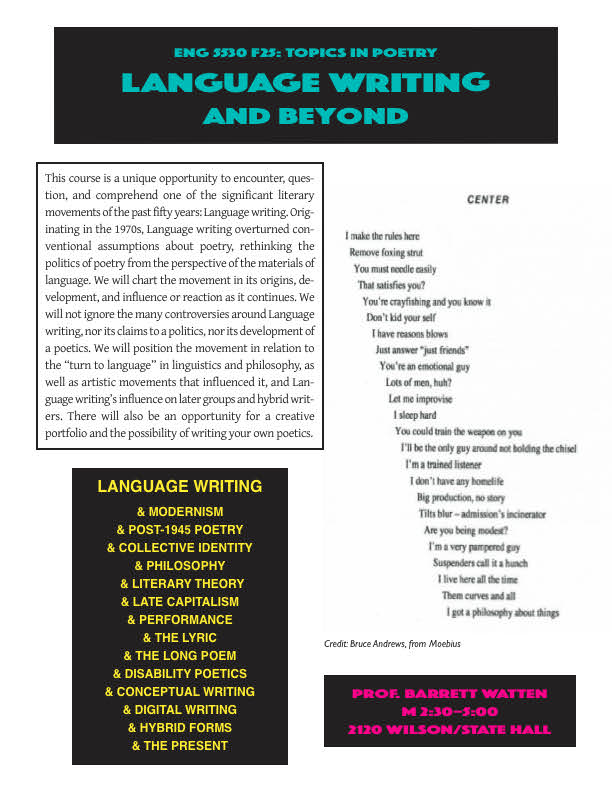
Breaking with custom, I am uploading the syllabus (minus boilerplate and policy) for my “Topics in Poetry” this fall. The reasons are several. Since coming to Wayne State, unlike other major hires of Language writers in the early 90s, I was brought in to teach literature and cultural studies, with my poetry and poetics career a plus but not well understood. Over twenty-five and more years, I crafted a pedagogy designed to bring literature and cultural studies together, and the dissertations I advised reflect that synthesis—while there are several that address modernist and later poetries at a high level of discussion. However, I have never taught a course devoted to my work or literary movement in poetry and poetics per se, and now is the time—again for more than one reason. One, I want this poetry, history, and theory to be as pedagogically known and significant as any other “approach,” at any level of instruction from GenEd (to students in other fields) through the Major and the graduate program—my teaching at three levels as has usually been the case. Then, it is time for an overview of Language writing that takes into account not only its emergence but the controversies and reception issues it produced, followed by its academic reception and gradual departure from the academy, and finally with the evidence of the strong new work that has appeared, from every major figure, since the Millennium. Lyn Hejinian’s death in 2024 is also a turning point: while her work was always written prospectively and toward its continuing, we may now compare her lifelong project—Beginnings, Middles, and Ends at once—to other authors who may be read in that way: Stein, Zukofsky, Riding, Creeley, Hughes, Baraka and so on. Retrospection is one aspect of that reading, but also a careful attention to the values of time, memory, historicity and everyday life in her project. Given many aspects of her uniqueness, constructing comparative frameworks must now also be undertaken across the board: with the original figures, the controversial history, the emergence of new schools and writers where there is variously a connection to an overarching focus on Language as site of meaning making.
Herewith the provisional syllabus, as always a working document that may be cut back or amended as the course unfolds, with many authors and issues overly condensed or regrettably left out. Sixteen sessions, or eighteen, would do more justice, but fourteen 2½-hour classes is what we are given. So forth: … More