Entries tagged with Language writing

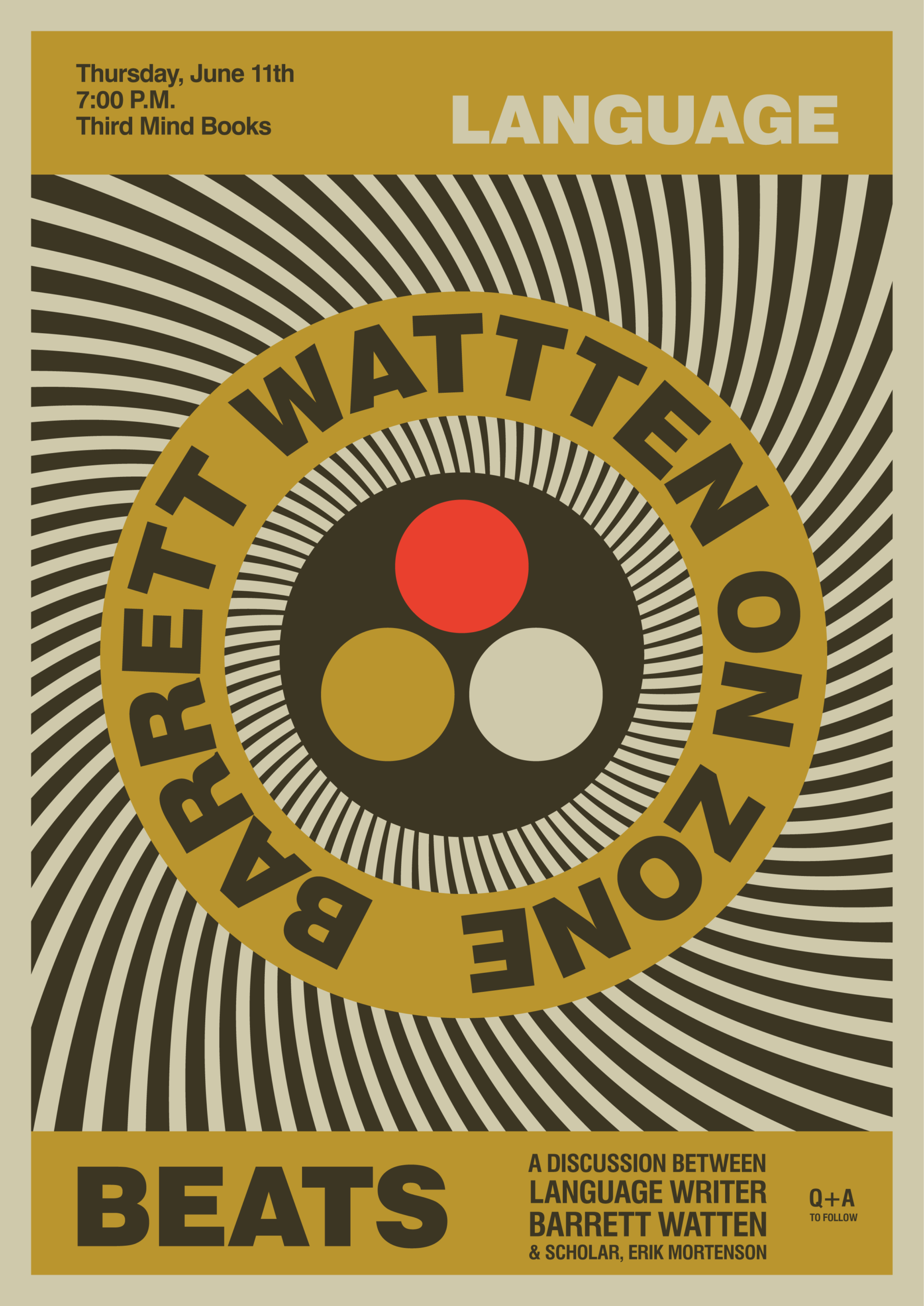
Entry 74: Language/Beats

Language/Beats
Book event & discussion

Barrett Watten: Zone:
correlations (Chax Press)
Erik Mortenson: Allen Ginsberg
in Context (Cambridge UP)

Third Mind Books
118 E. Washington, Ann Arbor
June 11, 2026, 7:00 P.M.

On this day, Erik Mortenson and I took the stage to present and reflect on recent work, literary history, and our work together, which stretches back two decades since Erik was my first Ph.D. advisee at Wayne State University. His project was exemplary, on its own merits and in terms of what I wanted to direct: a comprehensive, revisionist, culturally reflexive account of the Beat movement. What resulted was his first book, Capturing the Beat Moment: Cultural Politics and the Poetics of the PresentI cannot stop recommending this book: it is “cultural poetics” as it should be: a synthesis of historical and contextual readings, revisionist expansion of the canon, and focused attention to form and media—with strong readings of key figures in a larger field of authors, history, genre, and meaning. Not only should his work be better known; it should be taught and emulated. And there is strong evidence that the range of poetics it takes part in continues, not least with Erik’s current edited volume, Allen Ginsberg in Context. It was the occasion of his publication and my own Zone that brought us to this “moment” of continuation. … More

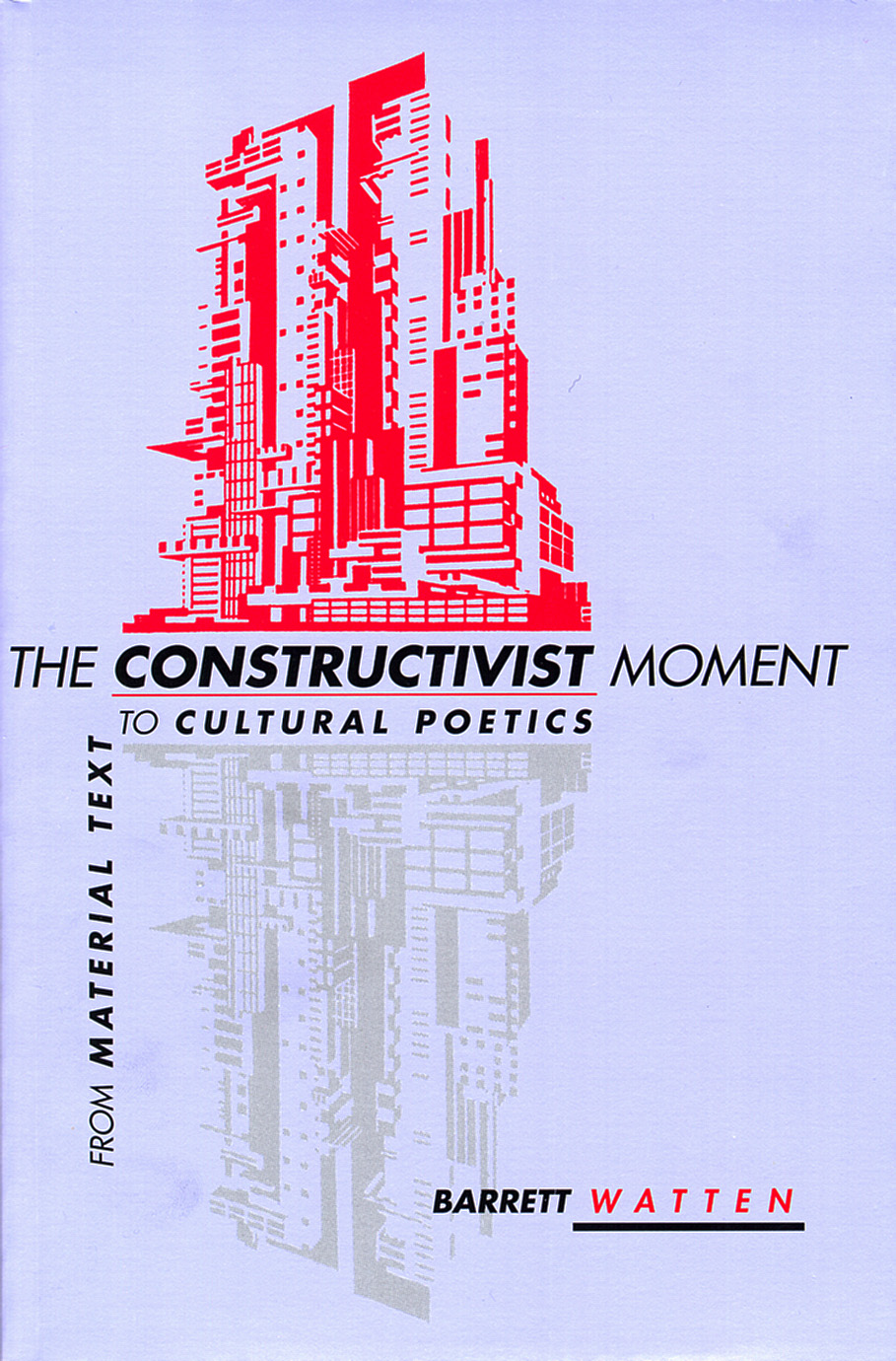
A recent post by Vladimir Feshchenko, Russian linguist and scholar of language-centered writing, raised a question of the historical reception of Language writing—as a history of its own making. Language writing’s historicism is in this sense double—not only a question of its publications, influences, reception, contexts, but the way its formal and theoretical or explorations lead to the future unfolding of new meanings. One thus can trace the historical (real-time) reception of Language writing in relation to these aspects of its “constructivist” poetics, in the sense I develop in The Constructivist Moment. That was 2003, “midway through Language writing’s journey,” and the results keep coming in. They continue in a line that extends to Lyn Hejinian’s later theory of allegory, in Allegorical Moments (2023), pluralizing “moments” in dialogue with that “moment.” … More

Entry 69: Language Notes III

ENG 5530, “Language Writing and Beyond,” has now passed the halfway mark. Organizing the vast amount of material is one thing, but the challenge of teaching Language writing at this historical date—50 years after the first emergent activity—involves rethinking its (non)narrative, its “author function”, its categories, its forms, its values, its politics, what is revealed and concealed, and what comes next. To summarize this pedagogical work of framing, I devised a midterm exam that students understood was, to begin with, an assemblage of the work done so far. Here I want to make this intellectual labor, in the context of an advanced upper division “Topics” course at Wayne State University, available to the field. I believe strongly a revision is necessary and in the works, and that the “usual” account has long since outlived its opening rationale for our work of literary production and reception, and that much needs to be recovered. What emerges, decisively, is that Language writing was in no sense a “period style,” a combine of, say, open form plus material textuality after the New Americans or collage-driven abstraction as a “turn to language” with the New York School—or really, any of a dozen major influences, from modernism and Conceptual Art and to the politics and artist spaces of the 70s. … More

Entry 68: Language Notes II

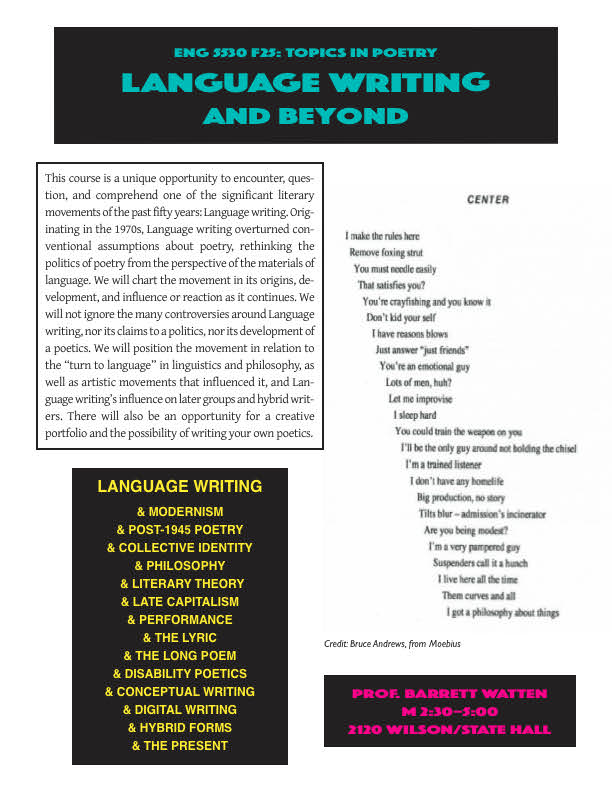
ENG 5530: Language Writing and Beyond
Wayne State University, Fall 2025

Breaking with custom, I am uploading the syllabus (minus boilerplate and policy) for my “Topics in Poetry” this fall. The reasons are several. Since coming to Wayne State, unlike other major hires of Language writers in the early 90s, I was brought in to teach literature and cultural studies, with my poetry and poetics career a plus but not well understood. Over twenty-five and more years, I crafted a pedagogy designed to bring literature and cultural studies together, and the dissertations I advised reflect that synthesis—while there are several that address modernist and later poetries at a high level of discussion. However, I have never taught a course devoted to my work or literary movement in poetry and poetics per se, and now is the time—again for more than one reason. One, I want this poetry, history, and theory to be as pedagogically known and significant as any other “approach,” at any level of instruction from GenEd (to students in other fields) through the Major and the graduate program—my teaching at three levels as has usually been the case. Then, it is time for an overview of Language writing that takes into account not only its emergence but the controversies and reception issues it produced, followed by its academic reception and gradual departure from the academy, and finally with the evidence of the strong new work that has appeared, from every major figure, since the Millennium. Lyn Hejinian’s death in 2024 is also a turning point: while her work was always written prospectively and toward its continuing, we may now compare her lifelong project—Beginnings, Middles, and Ends at once—to other authors who may be read in that way: Stein, Zukofsky, Riding, Creeley, Hughes, Baraka and so on. Retrospection is one aspect of that reading, but also a careful attention to the values of time, memory, historicity and everyday life in her project. Given many aspects of her uniqueness, constructing comparative frameworks must now also be undertaken across the board: with the original figures, the controversial history, the emergence of new schools and writers where there is variously a connection to an overarching focus on Language as site of meaning making.

Herewith the provisional syllabus, as always a working document that may be cut back or amended as the course unfolds, with many authors and issues overly condensed or regrettably left out. Sixteen sessions, or eighteen, would do more justice, but fourteen 2½-hour classes is what we are given. So forth: … More

Entry 67: Language Notes

This fall, I continue an adventure of some 50 years with the literary movement with which I am associated, Language writing, once so-called and now so inscribed. ENG 5530 is a dedicated “Topics in Poetry” course, addressing students at all levels at Wayne State University. For some, this will be a first encounter with poetry; others are already writing in ways identified by their teachers as “aha! Language writing!”; and others are taking a literature or creative writing elective with, hopefully, open minds and interest. I want to approach the topic with new eyes and ears, and thus have not given much thought as the opening of school approaches to how, precisely, I will proceed. In moving forward, I will be retrospectively assembling a curriculum but not in any linear fashion—that end has already taken place. How then to redefine, redeploy, rethink Language writing while constructing the course of study that opens new issues and opportunities?

My first thought was to provide a useful historical background, summarizing the “tale of the tribe” without dwelling on it. One divergence from the canonical narrative already appears—as Language writing gathered momentum and a degree of institutional recognition, there was a kind of mimicry of the Pound tradition and its “tale of the tribe,” a concept that is in need of historical and cultural correction. “Tribe” is not an auspicious term, for example, and the fact that there might be one “tale” that would hold it together even less so. The Orono conferences, importantly, were the site for a shift from the Pound model to an increasing pluralism, that over the decades (30s, 50s, 60s, 40s, and 70s) had increasingly to do with departing from a single narrative. Still, some kind of historical or periodizing ground is needed.

The best source I know for that was a series of online essays by Eleana Kim, written in 1994 and published on Gary Sullivan’s web site Readme, which is no longer online. Nada Gordon, however, has archived the series on the Wayback machine and I was able to download and pdf the series, with the addition of the bibliography from Nada directly. I have assumed that Kim is the same person as the UC Irvine Professor of Anthropology (here), but that needs to be confirmed. If so, she likely wrote the history as a graduate student, as she began publishing in Korean Studies about 2000. I suspect there is a connection, however, as the account of Language writing has a political awareness, sense of inclusion and exclusion, and critical astuteness about dominant narratives that could well connect to a cultural anthropologist. When that is determined I will repost, but this stands for one of the questions that now could be asked as the course unfolds: Why did Eleana Kim write on Language writing, and what does she think now? How did this very well written, politically savvy narrative become forgotten and erased, and why?

Eleana Kim, “Language Poetry: Dissident Practices
and the Makings of a Movement”

Note to the archived publication: “This essay was written in 1994 and, with the exception of minor editing for clarity, has not been rewritten. It does not, in other words, take into account material published in the years since.”

Part 1: “What is Language Poetry?” here

Part 2: “Tradition and Communal Praxis” here

Part 3: “San Francisco, circa 1975” here

Part 4: “Theory, What Theory?” here

Part 5: “Rumor in the House of Fame” here

Part 6: “The New Americans vs. the Treed Americans” here

Part 7: “Inclusions” here

Part 8: Bibliography here

Bear in mind that this was written in 1994; thus the bibliography is out of date. It would be important, first, to establish a 90s bibliography, but even more to track the works that have appeared since the millennium. That body of work could lead to an entirely different narrative. As well, the emergence of two immediate offshoots of Language writing, Flarf and conceptual writing; the influence of Language writing on poets of color; its relation to New Narrative, hybrid writing, disability aesthetics, digital writing and AI—all would need to be taken into account, which is precisely what I plan to do over the next fourteen weeks. Stay tuned for more posts as decisions get made on what to read and feedback happens on how that reading takes shape.

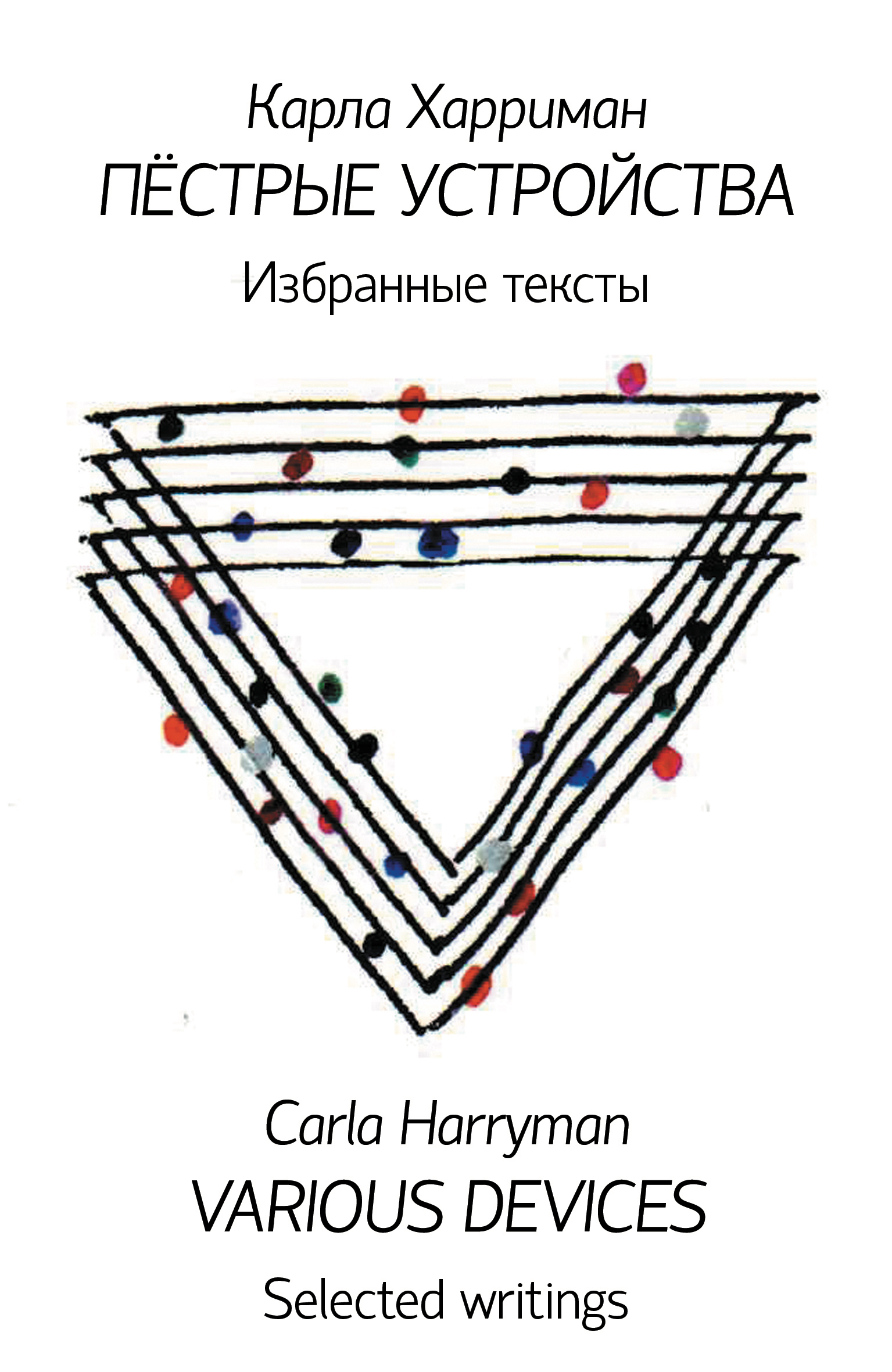
Document 106: Various Devices!

FOR IMMEDIATE RELEASE! 

VARIOUS DEVICES:
SELECTED WRITINGS

BY CARLA HARRYMAN

MOSCOW: POLYPHEM, 2024

[for Russian text, click here]

Polyphem, an independent press in Moscow, announces publication of a comprehensive, bilingual edition of the writings of Carla Harryman.

The works, chosen by editor Vladimir Feshchenko, represent the full range of her pioneering genre-disrupting, performative texts—from Percentage (1979) and Under the Bridge (1980) to Cloud Cantata (2020) and Scales for the Living (2023).

Also featured are the complete scripts of her germinal works for San Francisco Poets Theater: “Third Man” (1978); “There Is Nothing Better Than a Theory” (1984); and “Memory Play” (1994).

Excerpts from her dystopian novel Gardener of Stars (2001) and the ludic hybrid text Baby (2005) are included, along with selections from her erotic picaresque, co-authored with Lyn Hejinian, The Wide Road (2011).  … More

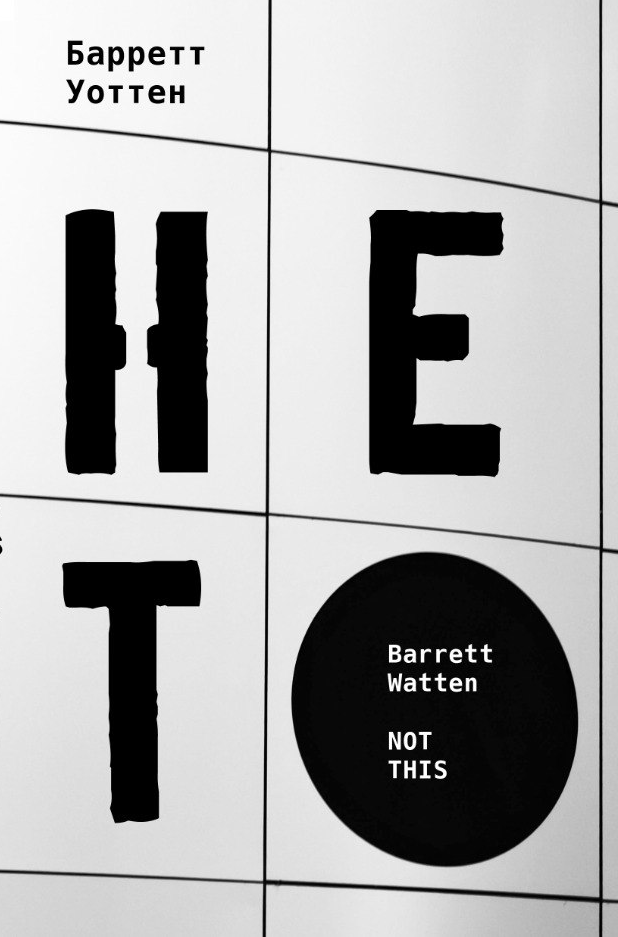
Document 105: Not This!

FOR IMMEDIATE RELEASE! 

NOT THIS: SELECTED WRITINGS
BY BARRETT WATTEN

MOSCOW: POLYPHEM, 2024

[for Russian text, click here]

Polyphem, an independent press in Moscow, has announced publication of a comprehensive, bilingual edition of the writings of Barrett Watten.

The works, chosen by editor Vladimir Feshchenko, extend from his first collection (Opera—Works, 1975) to the unpublished “Notzeit,” written during COVID (2020).

The selection represents the author’s “turn to language” in the 1970s, his development of hybrid genres and longer forms, and his critique of distorted social communication. … More

Remarks on Jameson and Narrative

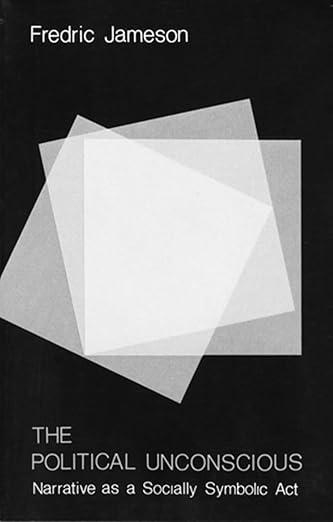
Under any house is a basement of psychological dimensions, a surplus affective space. And as I read The Political Unconscious into the night, a sump pump in the basement would go on and off, shunting gallons of water out of its perpetual flood. An editor asked me for a theory of such drainage in the form of a critical review, which I refused as not entirely serious. —”Foxes,” Bad History, 60

The year is 1981. Carla Harryman and I are living in a working-class bungalow on Hampshire Street in San Francisco’s Mission District, competing with raccoon families and occasional gunshots to establish a relationship in an indeterminate time. Ronald Reagan has been elected, while the alternative arts are forging ahead on multiple agendas. Poets Theater is in full swing, with a character called “Jameson” in Kit Robinson’s play, as I discussed previously. Jameson has entered the Language and New Narrative debates and given his talk at 80 Langton Street, siding with Narrative while symptomatizing Language, but also has now published The Political Unconscious, a watershed work that would have long-term impact on questions of narrative and form. Jameson’s “questions of interpretation,” bringing together form and history, would anchor a more expansive, contextual methodology not confined to surface language—bypassing precisely the critique of Language’s dissociation of sensibility in the postmodern. The “turn to history” via poetic form begins right here. … More

Entry 61: History Is What Hurts

Remarks on Jameson and Language

The media, for once, are getting it right: with the announcement of Fredric Jameson’s passing on September 22, one often sees a likeable photo of an engaged, outer-directed, smiling and welcoming, if prodigious and awe-inspiring scholar and critic in early or late days of his notable life and career. There is something of the Peaceable Kingdom in the intellectual devotion and worldly accomplishments evoked: “For Fredric Jameson, Marxist Criticism Was a Labor of Love,” per The New York Times. While Critical Theory, in both nature and practice, accentuates the negative, Late Jameson presents a beneficent gaze that is rarely encountered—especially with Marxists. The Grand Narrative of Progress Toward a Better Life seems activated by his very presence, a moment of positivity restored at the moment of loss. … More

Scaffolding Repetition: Gertrude Stein,
Language Writing, Electronic Dance Music
(online here)
eLyra 22, special issue on “Poetics and Politics
of Repetition,” ed. Bruno Ministro, 25 December 2023
(online here)

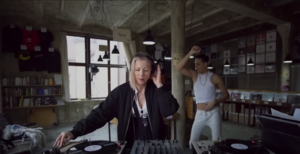
Abstract: This essay takes up the critique of repetition in Gertrude Stein, her claim to have written a “continuous present” that “begins again and again” and “includes everything” versus her later qualification that repetition is always shifting in terms of “insistence” and “emphasis”. Even so, Stein focuses on the unfolding of the verbal material primarily in a linear fashion, though resonances and overtones abound. In Electronic Dance Music, from Detroit to Berlin techno, one finds more vertical layerings and “scaffolding”—a term taken from Soviet psychologist Lev Vygotsky—as a way of building up sonic elements in pleasurable and meaning-bearing ways. Using these two contrasting models of repetition, I read three language-centered poets—Ron Silliman, Leslie Scalapino, and Marjorie Welish—in terms of their complex forms of temporality in poetic form, seen in terms of Stein’s often repeated framework of “beginnings, middles, and ends”. I conclude with a discussion of ”vital movement” in the electronic dance music of Berlin DJ Ellen Allien.

Keywords: Modernism, avant-garde, repetition, language writing, poetry, electronic music, American, Berlin

… More