Entries tagged with Beats

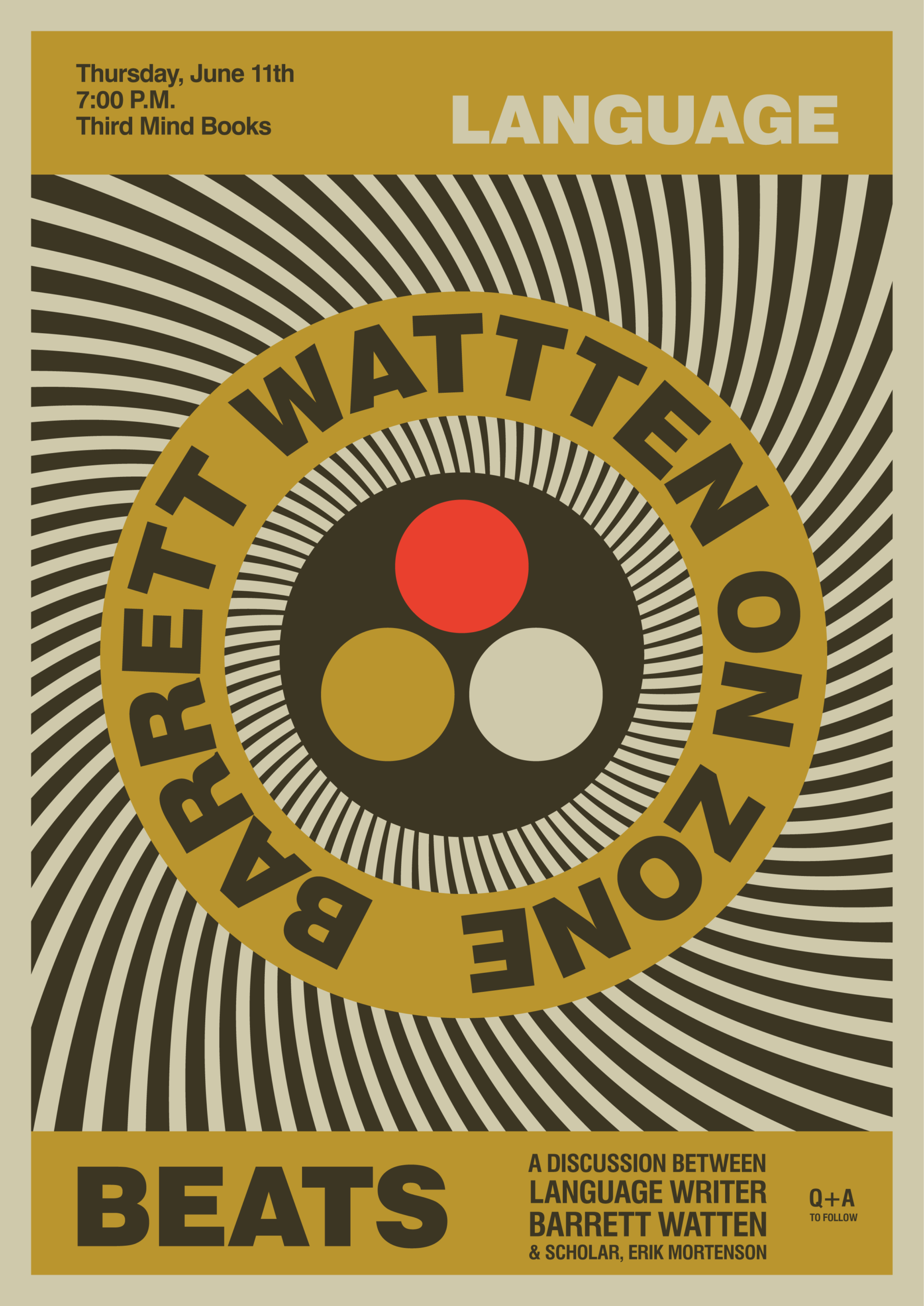
Entry 74: Language/Beats

Language/Beats
Book event & discussion

Barrett Watten: Zone:
correlations (Chax Press)
Erik Mortenson: Allen Ginsberg
in Context (Cambridge UP)

Third Mind Books
118 E. Washington, Ann Arbor
June 11, 2026, 7:00 P.M.

On this day, Erik Mortenson and I took the stage to present and reflect on recent work, literary history, and our work together, which stretches back two decades since Erik was my first Ph.D. advisee at Wayne State University. His project was exemplary, on its own merits and in terms of what I wanted to direct: a comprehensive, revisionist, culturally reflexive account of the Beat movement. What resulted was his first book, Capturing the Beat Moment: Cultural Politics and the Poetics of the PresentI cannot stop recommending this book: it is “cultural poetics” as it should be: a synthesis of historical and contextual readings, revisionist expansion of the canon, and focused attention to form and media—with strong readings of key figures in a larger field of authors, history, genre, and meaning. Not only should his work be better known; it should be taught and emulated. And there is strong evidence that the range of poetics it takes part in continues, not least with Erik’s current edited volume, Allen Ginsberg in Context. It was the occasion of his publication and my own Zone that brought us to this “moment” of continuation. … More

A Poetics of Encounter:
Dialectic of Outside with the Beats

Read at “Can We Teach the Beat Generation?”
Discussion organized by Erik Mortenson and Tony Triglio
Session 228, 5 January 2024, 10:15–11:30 AM, Loews 3rd Fl.
Modern Language Association, Philadelphia 

“The transmission of poetry is a passion unlike any other.”
“I too have started a riot in the academy.”

In this note, I want to call up certain moments of encounter that were, as with the visual image of a “diamond thunderbolt” or dorje, immediate, double-faced, and bivalent: outward in the transmission of poetry, from the Beats or New Americans and others; and inward, toward self-formation and a long process of professionalizing within the Academy. In charting such a poetics of encounter, I draw from my presentations at the “decades” poetry conferences at University of Maine, Orono, in the 90s and 00s that I, in the company of a shifting assemblage of poet/critics, took part in. I connect these moments to Steven Belletto’s genealogy of three early moments of encounter between Beats and the Academy: Jack Kerouac’s intervention at a symposium sponsored by Brandeis University in New York, 1958; Diana Trill­ing’s reaction to Allen Ginsberg’s being given an “unofficial” reading at Columbia, that same year; and Gregory Corso’s rebuttal to a symposium on the Beats in Wagner Literary Review, 1959. These are part of series of breakthrough moments: the Gallery 6 reading, San Francisco, 1955; Ginsberg’s appearance in Time magazine, 1959; the Vancouver Poetry Conference, 1963; the Berkeley Poetry Conference, 1965. What makes the first three definitively “Beat” aligns with two concepts from my essay on Michael McClure: antagonism and holism. In challenging the Academy’s scholastic pedagogy—I often thought of the English Department in the 60s or 70s as a kind of monastery, corridors filled with the brethren nodding to each other under hooded robes—the Beats took a position Outside that was, at the same time, subject to everything—“Is there a world?,” Kerouac asked; “Man does not exist,” opined Corso. The nature of this encounter between an unregulated Outside and a self-regulating Inside points to a dialectic of the Academy whose stakes are not only literary, pointing toward our volume’s significance not only for Literary but University Studies. … More