>> Documents <<

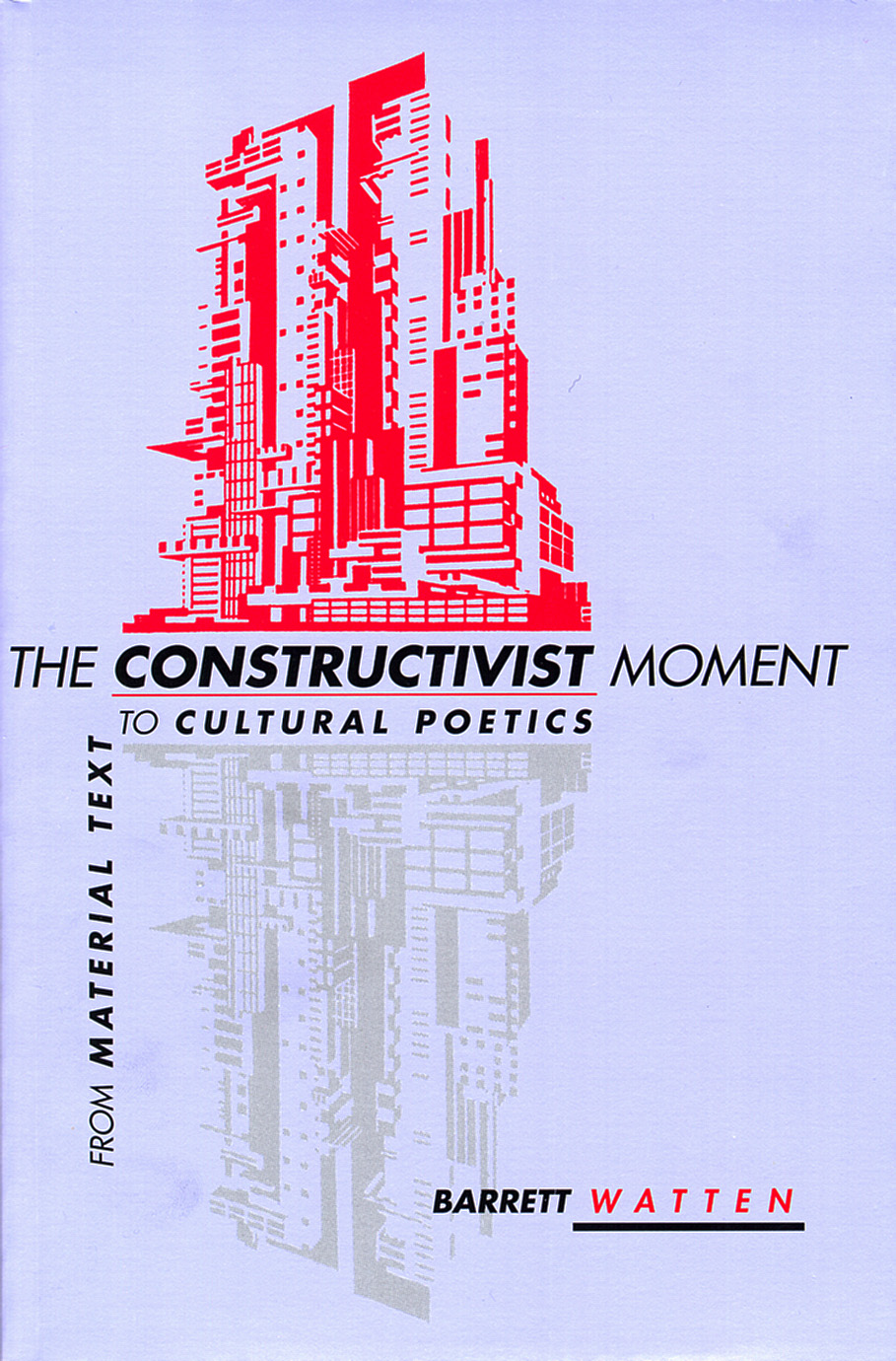
A recent post by Vladimir Feshchenko, Russian linguist and scholar of language-centered writing, raised a question of the historical reception of Language writing—as a history of its own making. Language writing’s historicism is in this sense double—not only a question of its publications, influences, reception, contexts, but the way its formal and theoretical or explorations lead to the future unfolding of new meanings. One thus can trace the historical (real-time) reception of Language writing in relation to these aspects of its “constructivist” poetics, in the sense I develop in The Constructivist Moment. That was 2003, “midway through Language writing’s journey,” and the results keep coming in. They continue in a line that extends to Lyn Hejinian’s later theory of allegory, in Allegorical Moments (2023), pluralizing “moments” in dialogue with that “moment.” … More

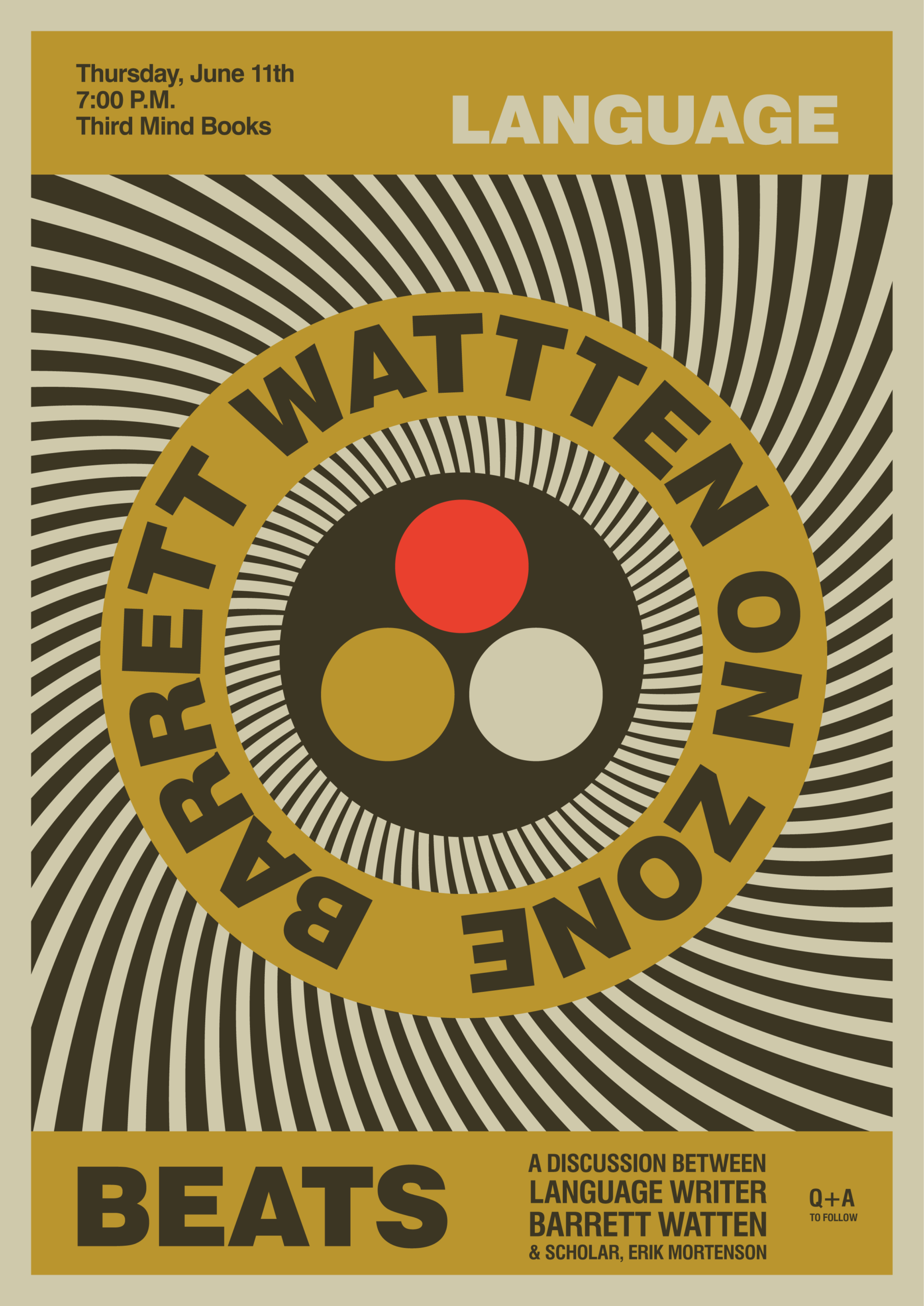
Zone (Paris)
@ Double Change / L’Atelier Michael Woolworth
2 rue de la Roquette, 11e
May 4, 2026

with Suzanne Doppelt, Cole
Swenson, and
Carla Harryman
Abigail Lang: translation

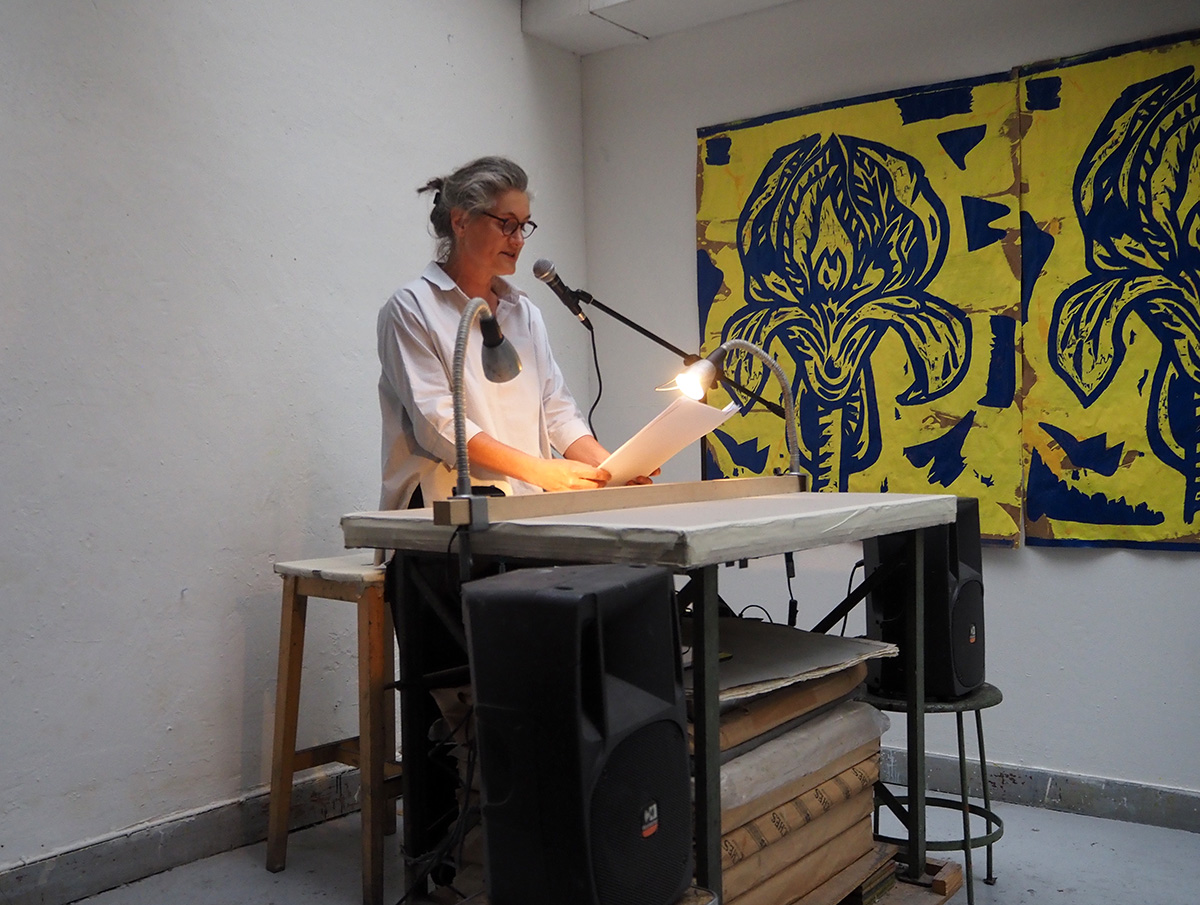
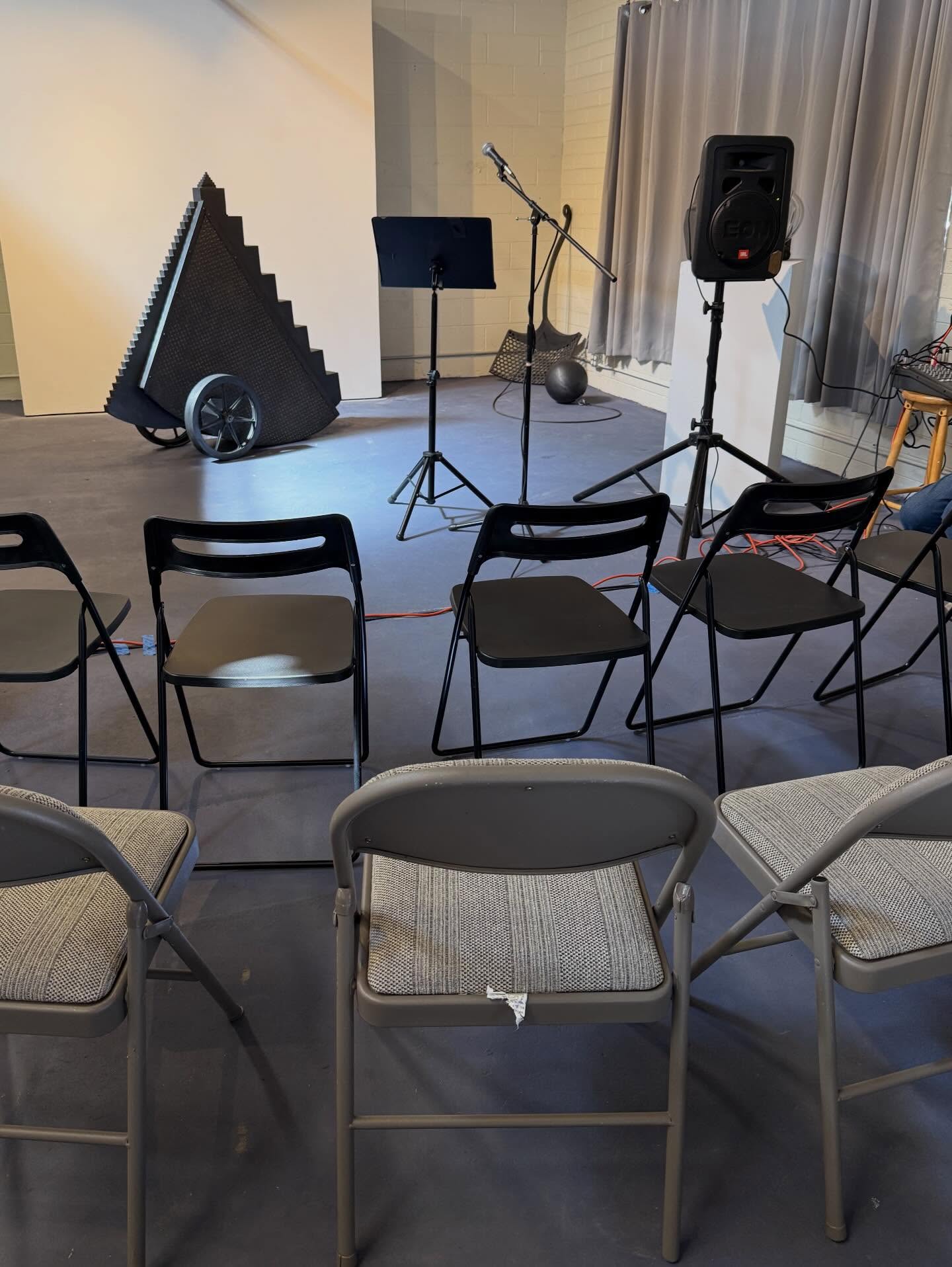
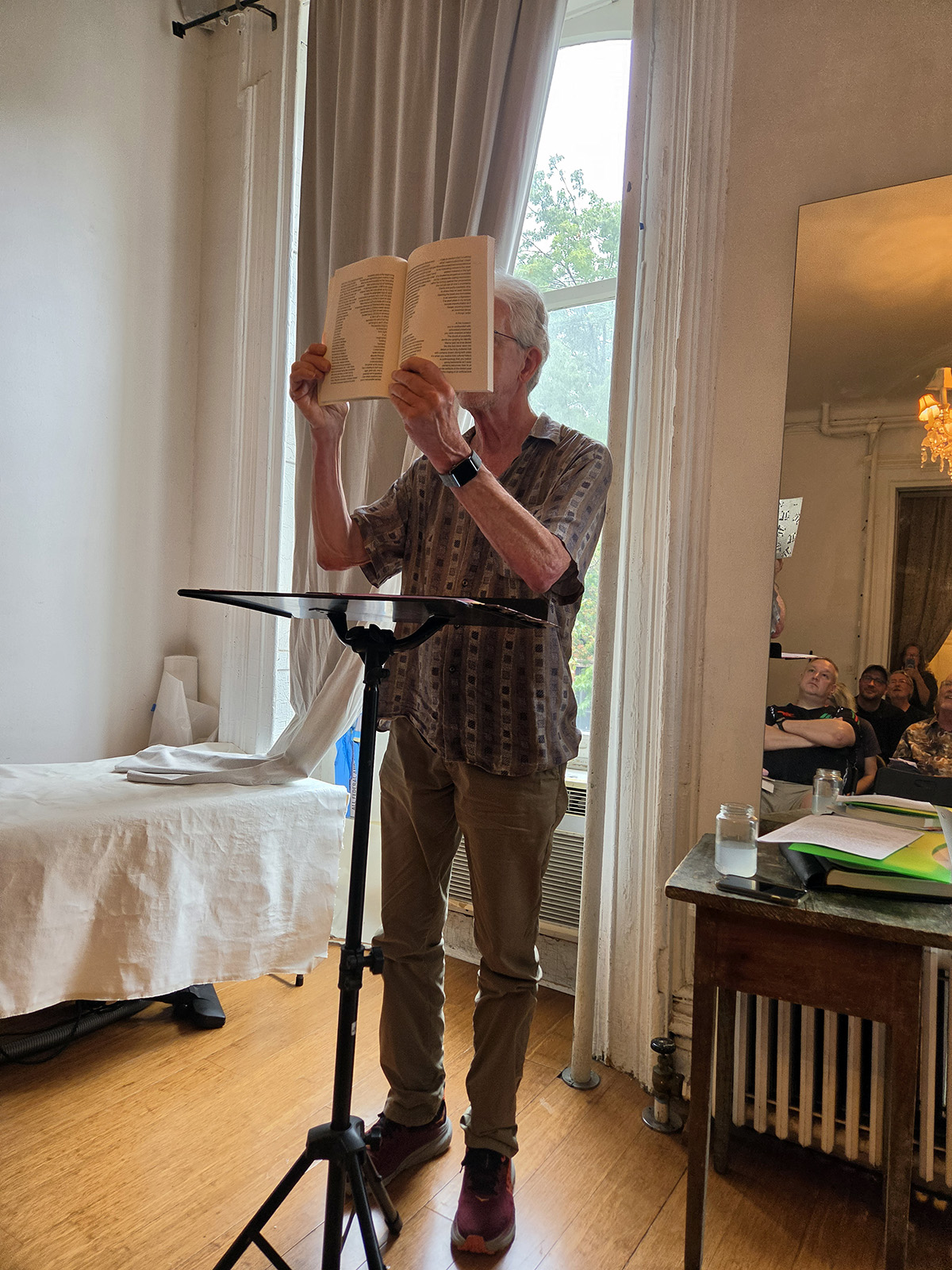
For Double Change, I followed the procedure from my previous reading in Oakland, while limiting the sequence to thirteen sections for reasons of economy. I thus sampled once from each of the twelve works in Zone plus one selected as “clinamen” or swerve to end the piece. A previous post (“Performing the Zone,” here) summarizes the method, but as before the “aleatorical indeterminate” of the randomly generated numbers for text and passage (beginning, middle, end) could not have been improved by human means.

Below, I note pagination and the beginning and ending of the thirteen samples. In addition, Abigail Lang read French translations after sections 3, 6, and 9—in the section derived from Williams’s Paterson alternating French and English with every stanza. I read the French lines from “Orphée in Translation,” after abandoning the idea of having Abigail pronounce them properly. This was the right choice: my attempting French as “other” is a mirror reinforced imagistically throughout the poem (cf. “a man cut in half by a window,” a key moment in surrealism). … More

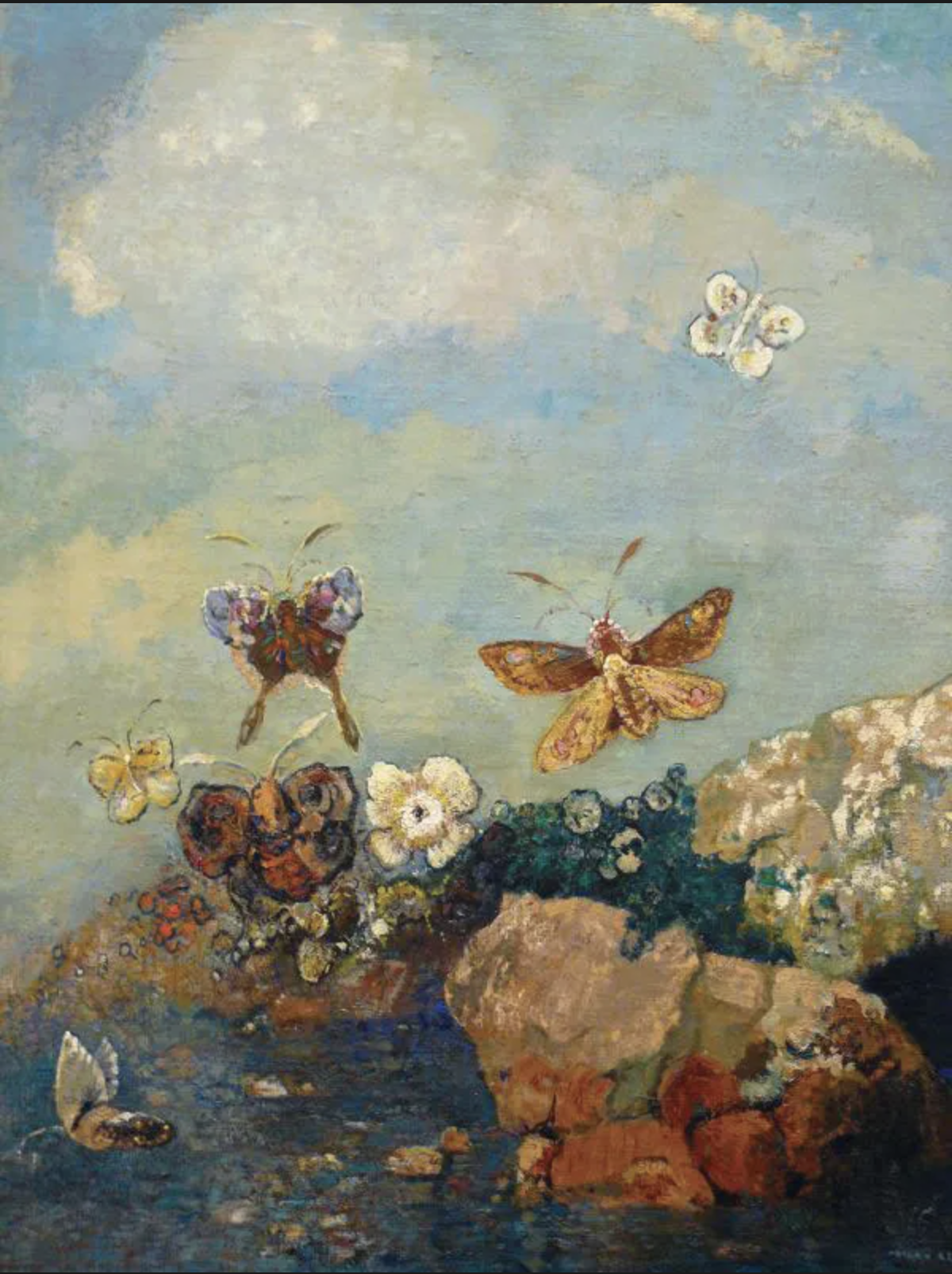
On this day in history, I am informed, Odilon Redon was born in Bordeaux, France. There is otherwise a remarkable series of destructive events, according to Encyclopedia Brittanica, none of them related to each other except for the date of April 19. I’m not going to list them, but their constellation is affected by the memory of my mother, Jeanne Alderton Watten, who was born precisely one hundred years ago on this date in 1926. I must remember not to let the occasion pass. I will further inscribe it in memory by typing out and re-presenting the work I wrote that brought those dates together in Bad History. Such were the deaths the date is associated with. Of course, nothing is ever lost, nor can it be—to quote Emerson. It is just such transcendence the date offers 100 years hence. Also in 1926 was a positive conjunction of births—the poets Allen Ginsberg, Robert Creeley, and Larry Eigner all were born that year. I once relayed that fact to Creeley, and he gave me one of those big sloppy kisses of his later days. Remind me, now that I have come to his age, not to do that to anyone (in any case we are not allowed). Odilon Redon seems just the right touch to remember my mother, who had the instincts of an artist and generously enacted them. But now I see Redon was born the next day, not the day horrible things happened. Thus erased, we move ahead. The image on the right, randomly accessed on the wrong date, thus confirms me in my mission. … More

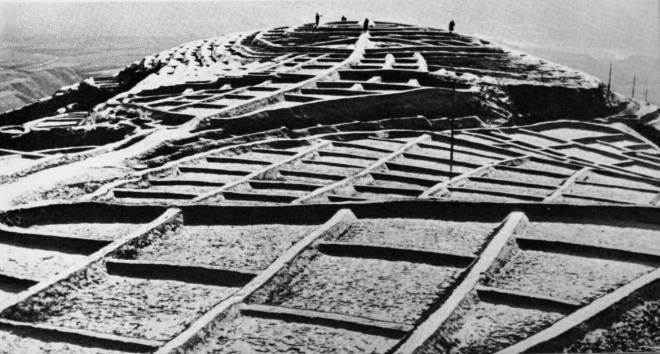
In the Zone, there is no beginning, middle, or end—they have been erased. But there is a before, during, and after—they are activated. Zone is the space between text and world that productively activates them.
—Introduction to reading from Zone: correlations (1973 2021), 15 March 2026

For my reading from Zone, I prepared a score made by randomly sampling and sequencing selections from across its twelve separate works, a continuous presentation without individual titles and with little or no comment, with the exception of an occasional nod to an audience member (George Lakoff, Brian Ang) mentioned or inferred in the text, and on one occasion to interact with loud street music coming from outside the gallery space. This is a strategy I have deployed on a number of occasions, and it suggests or “rhymes” with the modular construction of most if not all the works in Zone, each built up by differing versions of sampling and sequencing. Brian Ang noticed this strategy in a reading I gave at Kelly Writers House in 1999 (here). In dialogue with Ang’s account, I documented two readings from 2013, in Nuremberg and Amsterdam, for their sampling and sequencing strategies (Nuremberg here; Amsterdam here). … More

“Avant-Garde Poetics of the Zone:
Interchange, Transposition, Translation”

CALL FOR PAPERS/MULTI-SESSION PROPOSAL
SUBMIT BY JANUARY 30 (CONFERENCE DEADLINE FEBRUARY 1)

European Network for Avant-Garde
and Modernism Studies (EAM)
10th Annual Conference, Stockholm, Sweden
2–4 September 2026 /flyer here
… More

“Particularity, Nonnarrative, and Global Poetics:
Critical Regions of Cultural Transmission”

CALL FOR PAPERS/MULTI-SESSION PROPOSAL
SUBMIT BY OCTOBER 2, 12:00 P.M. PST

American Comparative Literature Association
Palais des congrès de Montréal
February 26–March 1, 2026 /submit proposal here
… More

In 2013, I took the stage at a session of the Modern Language Association in Boston, on a panel hosted by the Marxist scholar Jason Baskin on “Marxism and Modernist Studies.” My hope was to extend an argument I raised about Language writing and neoliberalism at the 2008 Orono Conference to an account of modernist poetics—expatriate poet Eugene Jolas’s editing of transition magazine in the 20s and 30s. But I also wanted to start a dialogue, even a polemic, with the new school of Marxist poet-critics I had encountered there: Joshua Clover, Christopher Nealon, and Ruth Jennison. With Clover’s recent, untimely death, various tributes and memories have circulated, for example this Orono photo by Patrick Pritchett. I had some memories of Clover too, some of them benign and some less so, which when I mentioned them led to a considerable reaction and disclosure of an antagonistic post mentioning me, linked here. The link to Clover’s writing online led to the “blog” published in 2019 (see here for full discussion). It turns out Clover had published an anonymous hit piece on the “blog,” which up until then I could not place or interpret. The scene he describes, it turns out, was the session at MLA Boston in 2013. The main argument of my paper has since been published (see here), but without the opening polemic with Clover, Nealon, and Jennison. To understand, and refute, Clover’s anonymous “blog” post as participating in the larger group take-down of my work and person, it is necessary to return to the traumatic scene itself, which Clover describes in these terms: … More

For its pedagogical interest, I want to document the 23 seminars and 1 proto-seminar that I taught at Wayne State University since 1995. The seminars build on a series of dialectical faultlines, from the first offerings on the avant-garde and social modernity; literary subjectivity and language; cultural studies and poetics; social form and literary agency; to the crisis of modernity and the subject. The arrival of the New Modernist Studies offered a disciplinary framework for this sequence, followed by twin historical critiques of the avant-garde and postmodernism. As the series developed, I tried to construct spaces that would unite critical thinking and poetry. The series provisionally concluded in 2018 after three seminars that pushed toward new approaches at a moment of increasing crisis in the university: “The Poetics of Value”; “After the End of History”; and “Questions of Unreason.” While it was not a foregone conclusion that this level of ambition could not continue, it is now now time to look back and imagine what the prospects of this pedagogical endeavor may have been, what they were as they unfolded, and what they still might be.

1. ENG 7004 / Fall 2018 / Theoretical Issues in Cultural Studies: “Questions of Unreason in Modern Cultures” (https://bit.ly/2vgHFYL)

This seminar will bring together several interrelated areas of inquiry: 1) critical and psychoanalytic theories that address the genesis and form of “unreason” in modern culture and public art, including Critical Theory after Dialectic of Enlightenment and The Authoritarian Personality and psychoanalytic theory from Freud to Žižek; 2) theories of language and the public sphere from Habermas to ideology criticism; 3) theories of populism, racism, xenophobia, fascism, and gender and class antagonism; 4) popular movements that are relevant to these theoretical approaches, from hyper-nationalism to fascism, populism, and authoritarianism; and 5) works of modernism and the avant-garde that reflect on, diagnose, or exemplify questions of public unreason, from surrealism to the present. [See https://bit.ly/2vgHFYL]

2. ENG 8004 / Winter 2018 / Seminar in Literature and Culture after 1870: “2049: Historicizing the Present After the End of History”

The release of Blade Runner 2049 offers a chilling register of the global present and its dark futurity. This seminar will take the questions explored by the film, in relation to its postmodern progenitor Blade Runner (1982/1992), and explore the historical present through a series of dystopian registers. These will include global capitalism, democracy, and authoritarianism; climate change and ecocide in the anthropocene; the man/machine interface in ever advancing forms of digital technology; new class formations and urbanization; gender, sexuality, and the decline of patriarchy; war and the fragmented body; and new forms literary and artistic representation and response, both mimetic and antimimetic.

3. ENG 7033 / Winter 2017 / Postmodernism and Postmodernity: “The Poetics of Value: Modernity, Crisis, and the Work of Art”

We are constantly reminded in public discourse that our “values” have deteriorated and that we are living in a state of “valuelessness” that requires drastic measures. This seminar will take up the relation of values as represented in works of art to underlying forms of value and valuation they depend on—from aesthetic to moral to political to economic. Putting the question of value to works of art and cultural production, we will read a wide range of genres and text—literary, visual, and cinematic—with major theorists of value from Kant to contemporary Marxism. The seminar will begin with questions of aesthetic and moral values and valuation but will look forward to the turn to political economy and critique of modernity that emerged after the financial crisis of 2008, broadening it to include the “making” of value in an economic sense as a question of poetics and the valuation of the work of art.

… More

Launch of  Barrett Watten,
Not This: Selected Writings

Voznesensky Center, Moscow
46 Bolshaya Ordynka Street
January 24, 2025

The meeting focuses on how American literature experienced a “turn to language” in the 1970s, what the hybrid genres of contemporary poetry are, and the challenges faced by translators working with the “language trend” in literature. (Voznesensky Center announcement)

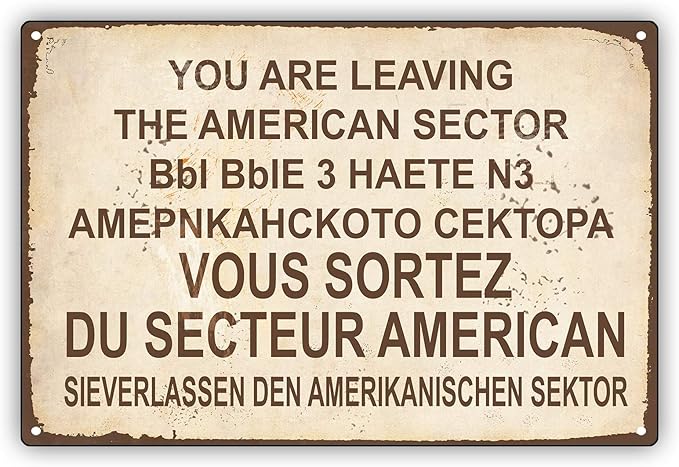
On the given date, at about 11:30 A.M. from a Detroit suburb, I was transported behind the lines of antagonistic states for a literary evening that, I hoped, would have long-term cultural and political meaning. It was not the first time had I stepped over this line, as I did for our “Summer School” in then-Leningrad, 1989, about which much has been written (including the multi-authored text published in 1991; here). Twenty-seven years later, with Carla Harryman, I traveled to now-St. Petersburg to participate in the Dragomoshchenko Prize awards in 2016. The consequences of these transpositions, as they may be called, between literary and cultural/political realities, continue to expand and be productive as sites of meaning. The turn to language turns out to be more than one thought. … More

“Dispersed Poetics: Signifying Non-Solutions
in Time of War”

Ekaterina Derisheva, University of Pennsylvania
Barrett Watten, Wayne State University
Jamie Olson, St. Martin’s University

The Louisville Conference on Literature and Culture
University of Louisville, February 22, 2025

“Dispersed Poetics: Signifying Non-Solutions in Time of War” introduces the work of experimental poets writing in Russian and Ukrainian, from positions of opposition, emigration, and displacement, from the late Soviet period to the present conditions of war and exile. The notion that “the non-solution must signify” is a formulation by critic Terry Eagleton that seems apt to the present moment, where poetry can best address a situation of profound indeterminacy.

… More