 Zone (Paris)
@ Double Change / L’Atelier Michael Woolworth
2 rue de la Roquette, 11e
May 4, 2026
with Suzanne Doppelt, Cole
Swenson, and Carla Harryman
Abigail Lang: translation
For Double Change, I followed the procedure from my previous reading in Oakland, while limiting the sequence to thirteen sections for reasons of economy. I thus sampled once from each of the twelve works in Zone plus one selected as “clinamen” or swerve to end the piece. A previous post (“Performing the Zone,” here) summarizes the method, but as before the “aleatorical indeterminate” of the randomly generated numbers for text and passage (beginning, middle, end) could not have been improved by human means.
Below, I note pagination and the beginning and ending of the thirteen samples. In addition, Abigail Lang read French translations after sections 3, 6, and 9—in the section derived from Williams’s Paterson alternating French and English with every stanza. I read the French lines from “Orphée in Translation,” after abandoning the idea of having Abigail pronounce them properly. This was the right choice: my attempting French as “other” is a mirror reinforced imagistically throughout the poem (cf. “a man cut in half by a window,” a key moment in surrealism).
[1: 193–95] “Orphée in Translation,” sections XLII—L, from “L’oiseau chante avec son doigt” to “Character is destiny!”
[2: 74–75] “Blue States (After Fearing),” from “The number 43 is up” to “All necessary products have been supplied . . .” [without samples from Fearing].
[3: 141–42] “Notzeit (After Hannah Höch),” section XI, from “Civilization has gone beyond discontent” to “an underlying logic that is discontinuous from one to the next.”Abigail Lang reads French translation from “Notzeit”
[4: 238–40] “Some / Ruins,” twelve two-word poems beginning with “ADORNO / Lacan” and ending “LIKE / Language.”
[5: 129–30] “Media Literacy,” section I, stanzas 3–8, from “Desire confronts a tyrant” to “A foreign register of darkness / is put down, never to admit” [without lines from the original poem, “Radio,” which in turn sample Tristan Tzara.]
[6: 89–91] “Zone (Correlation),” sections XXXI–XXVIII, from “Words attach to a palpable blankness” to “He is immersed in the plenitude surrounding him . . .” [without samples from Paterson, book 1].French translations alternating with English original
[7: 59–60] “War of Position,” two sections, paragraphs from Tolstoy’s War and Peace: from “Und die ganze Welt hoch!” to “Only the dead-looking evergreen firs . . .” [without my prompts].
[8: 165–66] “The Meridian as Archive,” section II, from “If all lyric poetry is a dated event . . .” to “as pure product of a text that survives and the missing parts that exceed it.”
[9: 178] “Unthought,” section VI, from “As in a dream. An empty grey arena . . .” to “A new discovery can but follow . . . .”French translation of English original
[10: 62] “Question of Interpretation,” stanzas V–VIII, from “See, they return . . .” to “Loaded with cargo for El Dorado.”
[11: 108–12] “The Annotated ‘Plan B,'” lines 31–45, from “In the reception room . . .” to “A gutted document / Of burned parchment” [without annotations].
[12: 24–25] “Period Style,” two boxed sections, from “‘The gradual wearing down of words or sounds . . .” to “he couldn’t resolve anything.”[13: 204–6] “Orphée in Translation,” sections LXXXVI–XCV, from “Orphée, there is no person” to “It is the mirror of culpability.”
Orphée has the last word as clinamen or swerve, the random number generator’s homage to the French tradition. The confirmation among the other works read that evening (concept lyrics by Cole Swenson, sonically dense hybrid writing by Suzanne Doppelt, boundary-surpassing dialogues by Carla Harryman, translated by Abigail Lang) contributed to a sensus communis among the atelier audience.
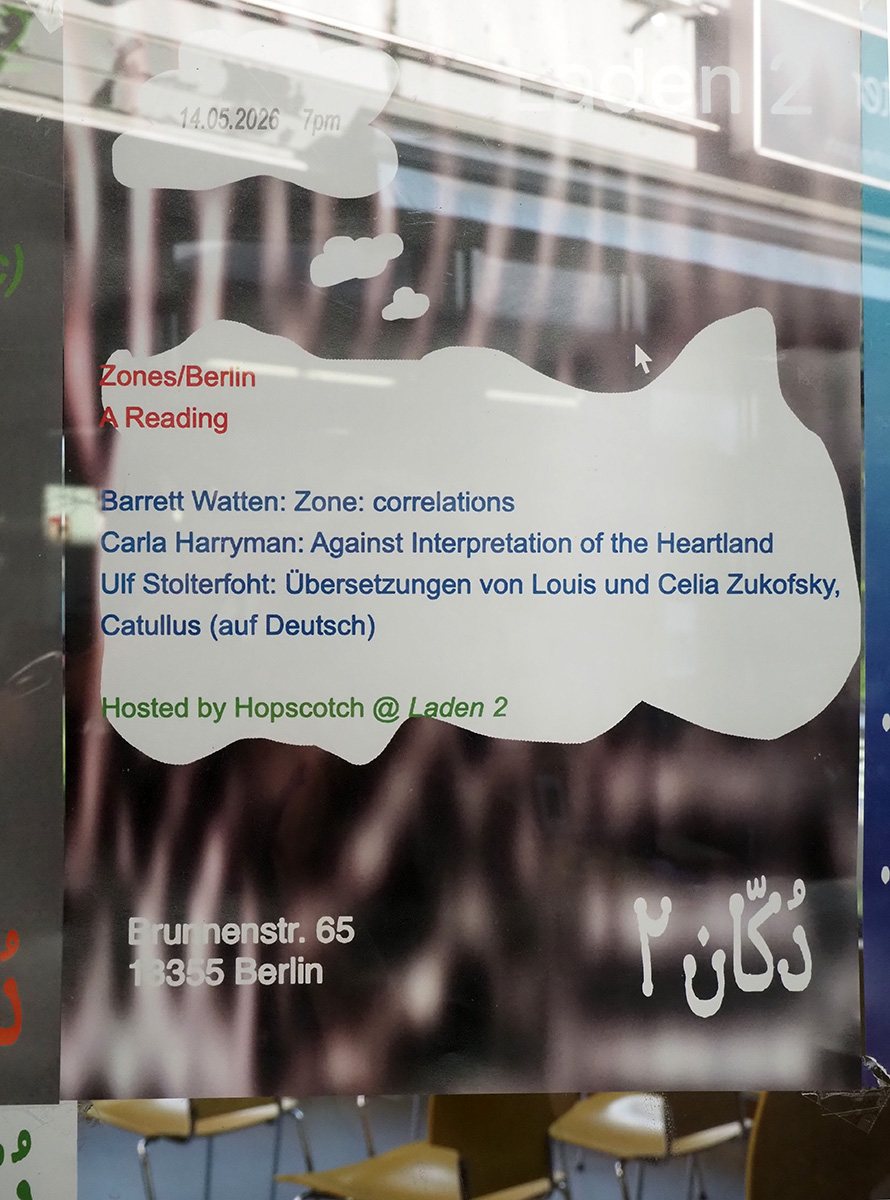
Zone (Berlin)
Hopscotch Reading Room @ Laden2
Brunnenstraße 65, Wedding
May 14, 2026
with Ulf Stolterfoht, Übersetzungen
von Louis & Celia Zukofsky, Catullus
and Carla Harryman, Against
Interpretation of the Heartland
This much anticipated event, the terminus ad quem of our two-week tour, took place in Hopscotch Reading Room’s displaced venue (while a move to new bookstore is negotiated) at Laden2, a glass-enclosed space in a down-at-heels 70s commercial development in Wedding now refunctioned for cultural events. A Laden in this case would be a separate commercial space, say for a small grocery or dry goods store, separated from the larger commercial spaces by a pedestrian sidewalk. Emptied of its utility and converted to countercultural use, the space hosts readings, talks, music on an ad hoc basis. Here everyday life, social space, the avant-garde, and the Left unevenly combine. Due to a minor publicity glitch, some audience members might not arrive for the 7 P.M. start on the flyer, as I wrote on a Facebook post:
For tactical reasons—there was a misprint in the online program, and the audience was still showing up—host Siddhartha Lokanandi gave an improvised lecture on the concept of Staatsräson and its current uses to control and/or deny cultural initiatives in Germany. What followed was an improvised discussion of our transatlantic “distressed present” in which Carla and I took part, framing the reading. Magister-poet Ulf Stolterfoht then read from his German translation of the Zukofskys’ Catullus, a palimpsestic text demanding precise attention. I presented a Zone reading of 15 sections distributed over the entire volume, after which Carla read from Against Interpretation of the Heartland, her social space-shifting work in progress.
For my Berlin Zone (or tone row), I prepared fifteen samples over the range of the twelve works, adding a second sample from three. These latter reinforced key thematic throughlines (rather than being a destabilizing addition to break the even distribution). The numbers found their way to a core reading that, in hindsight, was overwhelmingly bleak (a word that has been in use among poets at least since the Creeley Era to describe the hopelessness of the world situation). In addition, I was fighting off a travel-related respiratory issue, so that as I launched into the text my voice began to crack and fragment, an effect akin to Lotte Lenya on a scratched recording from the 50s—both dire and resolute.
[1: 149–50] “Notzeit (After Hannah Höch),” section XVII, from “Who gets to achieve social distance?” to “It would be marvelous to think so.”
[2: 174] “Unthought,” section VI, from “Terrifying thoughts. Each more terrifying than the next . . .” to “Forms of life that insufficiently address their illusion of being there . . . .”
[3: 72–73] “Blue States (After Fearing),” from “The condition of evaporating as a narrative progress” to “The public fact had disappeared” [without samples from Kenneth Fearing].[4: 63] “Question of Interpretation,” stanzas IX–XIII, from “What is belief?” to “It is not I.”
[5: 15–16] “Period Style,” two boxed sections, from “Even at the moment of impact . . .” to “Who has the voice to record it.”
[6: 170] “The Meridian as Archive,” section VIII, from “Now we are working in isolation . . .” to “it is an immobile language-block, facing us as silent catastrophe.”[7: 101–4] “The Annotated ‘Plan B,'” lines 1–15, from “Damn the consequences!” to “To Plan B as next segment / Of the narrative” [without annotations].
[8: 196–98] “Orphée in Translation,” sections LIII—LXIV, from “There is something shady / and second hand” to “I must / Now seem very stupid to you.”
[9: 87–89] “Zone (Correlation),” sections XXVI–XXXII, from “Here is that discontinuity of image with language” to “Solidarity in unlikeness forever . . .” [without samples from Paterson, book 1].[10: 131–32] “Media Literacy,” section III, from “The stench is extensive” to “Overwriting wastes of shame” [without lines from the original poem, “Radio,” sampling Tzara.]
[11: 209–212] “Some / Ruins,” twelve two-word poems beginning with “GROUND / Abyss” and ending “CONFERENCE / Badge.”
[12: 60] “War of Position,” two last sections, paragraphs from Tolstoy’s War and Peace: from “But on the Eighth of August . . .” to “something the living did not and could not understand . . .” [without my prompts].[13: 13–14] “Period Style,” two boxed sections, from “Flesh rots off the bone, now standing revealed” to “changes into its opposite.”
[14: 158–60] “Notzeit (After Hannah Höch),” section XXII, from “Imagine I am consulting the present” to “They are shouting down dark alleys of the sequestered city . . . .”
[15: 94–96]: “Zone (Correlation),” sections XLV–L, from “As the high-value information of nature falls” to “The people are saturated with the discourse of their multiplicity . . .” [without samples from Paterson, book 1.]
Those who wish to reenact the sequence can do so, by reading from Zone in the sequence(s) of inclusive page cites/passage above. The cyclical or feedback nature of the text starts to come forward as new combinations elicit productivité from its mode of production.
Notes and links
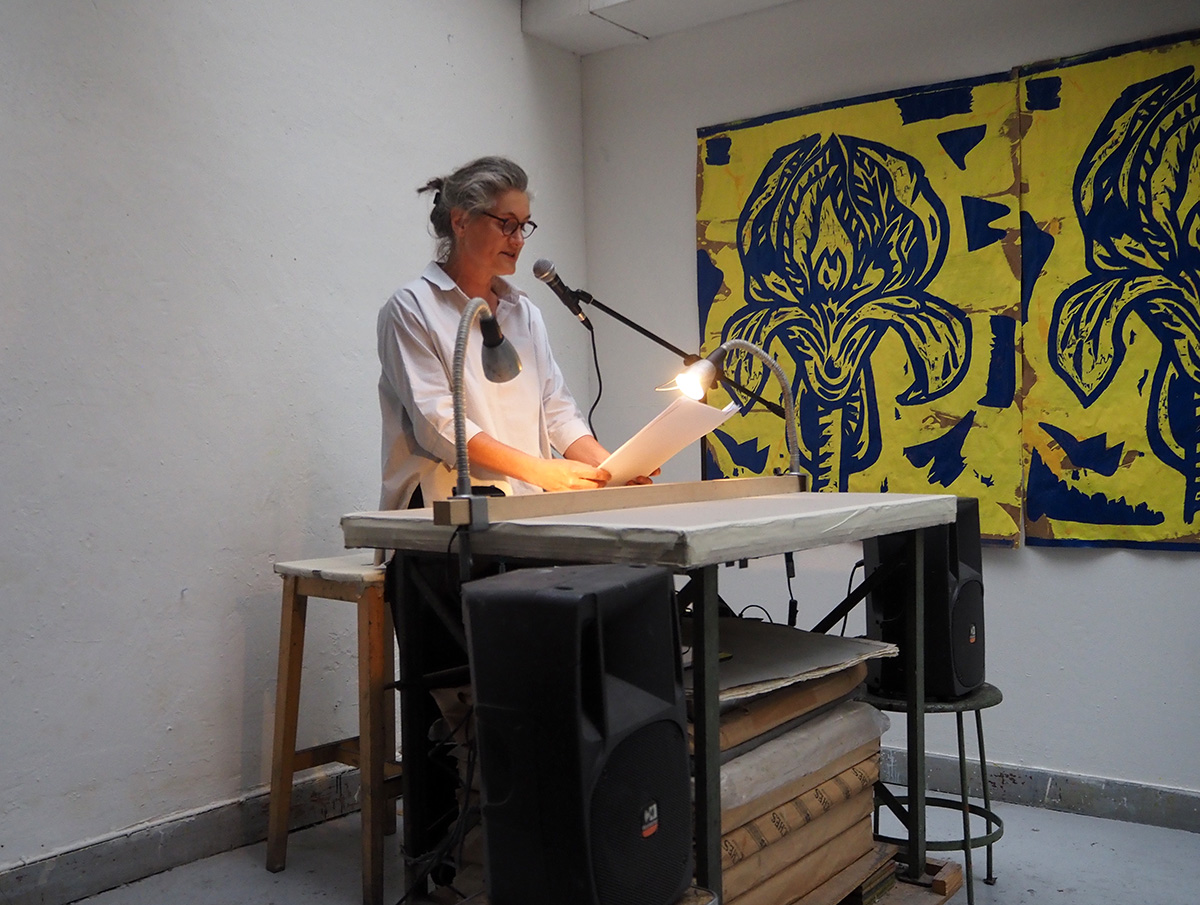
Images: Abigail Lang, introducing BW. Photo: Carla Harryman
Poster for event at Laden2. Photo: BWDouble Change website: here
Publicity for Hopscotch/Laden2 event: hereOn Zone and earlier sampled performances:
Brian Ang, “Barrett Watten, 1999”: here
Entry 17: Reading @ Nuremberg: here
Entry 18: Reading @ Amsterdam: here
Entry 70, Performing the Zone: here