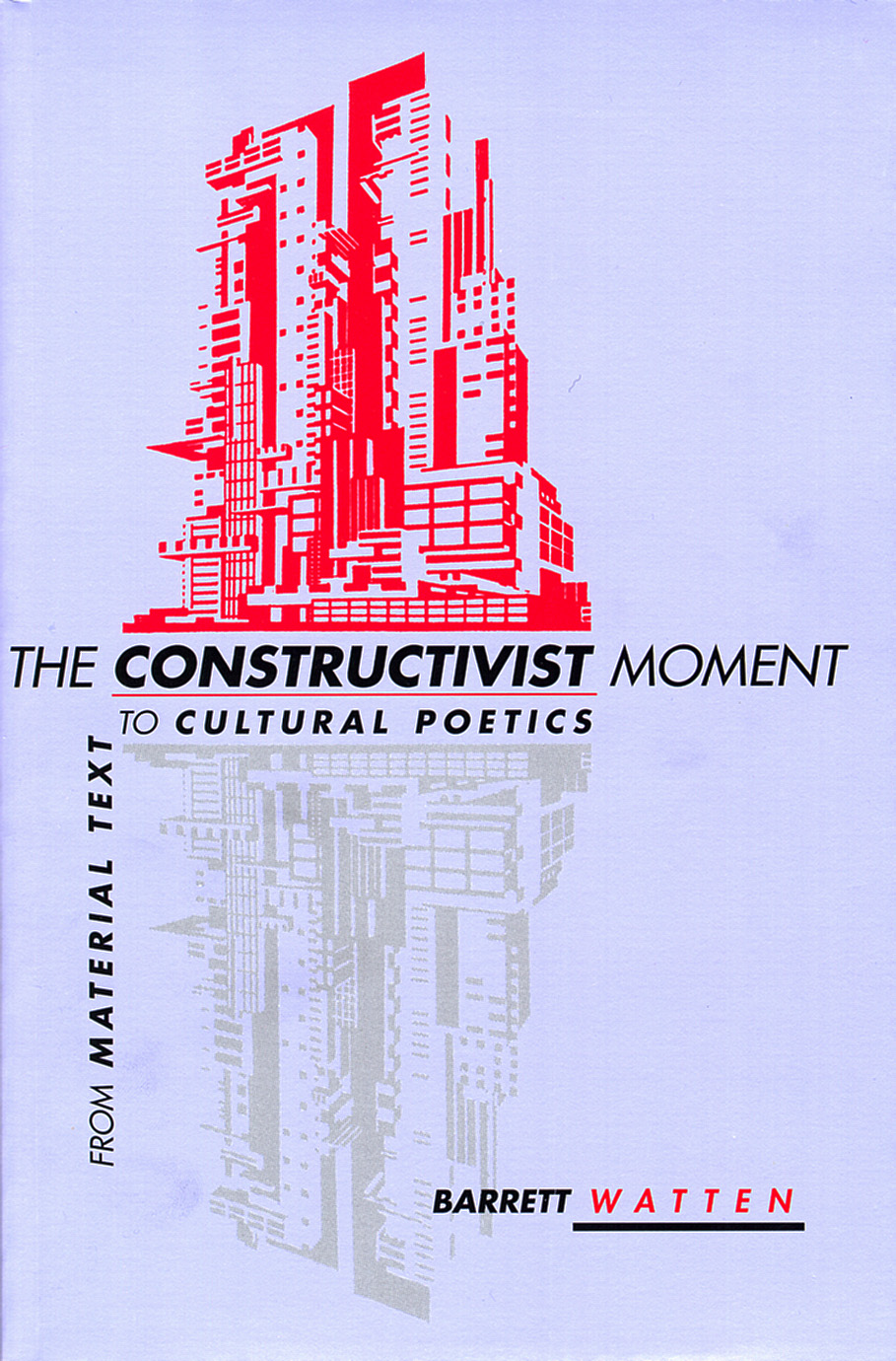
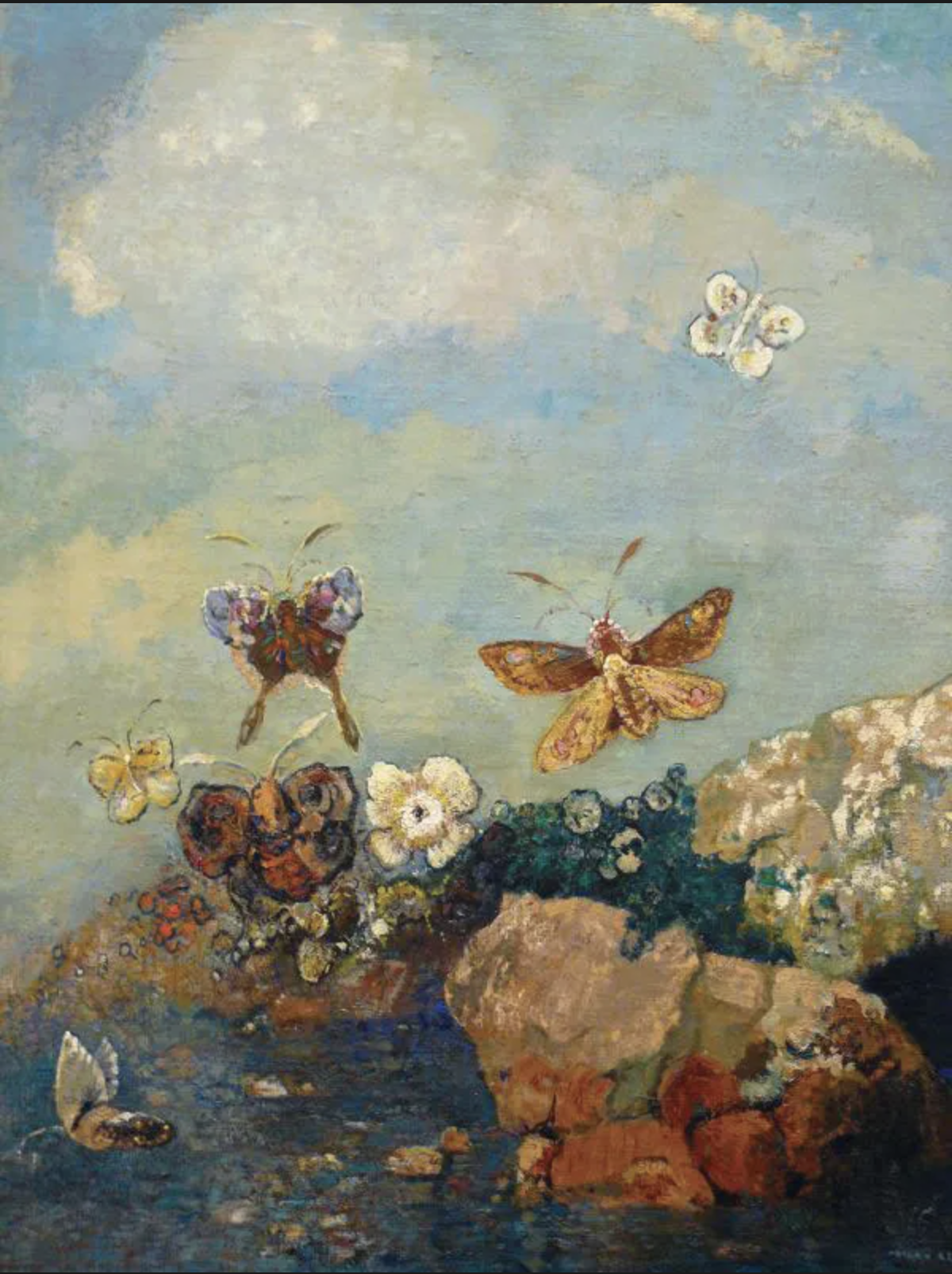
 On this day in history, I am informed, Odilon Redon was born in Bordeaux, France. There is otherwise a remarkable series of destructive events, according to Encyclopedia Brittanica, none of them related to each other except for the date of April 19. I’m not going to list them, but their constellation is affected by the memory of my mother, Jeanne Alderton Watten, who was born precisely one hundred years ago on this date in 1926. I must remember not to let the occasion pass. I will further inscribe it in memory by typing out and re-presenting the work I wrote that brought those dates together in Bad History. Such were the deaths the date is associated with. Of course, nothing is ever lost, nor can it be—to quote Emerson. It is just such transcendence the date offers 100 years hence. Also in 1926 was a positive conjunction of births—the poets Allen Ginsberg, Robert Creeley, and Larry Eigner all were born that year. I once relayed that fact to Creeley, and he gave me one of those big sloppy kisses of his later days. Remind me, now that I have come to his age, not to do that to anyone (in any case we are not allowed). Odilon Redon seems just the right touch to remember my mother, who had the instincts of an artist and generously enacted them. But now I see Redon was born the next day, not the day horrible things happened. Thus erased, we move ahead. The image on the right, randomly accessed on the wrong date, thus confirms me in my mission.
April 19
Blank walls sealed with writing tape. This eidetic line presents itself to you with an absence guaranteed by means of a value-added transmission device automatically indexing the cost of its signification. The house formerly left open was sealed in such a way that only light would enter it. Is it a coincidence that at 10:00 A.M., the morning of 19 April 1993, an empty house in an Oakland residential neighborhood was reproduced universally as our collective demise, burning on TV? The prospect shown prospective buyers was a sequence of small hills succeeding each other into moderate but unthinkable distance. On a flat plain, a column of smoke rose into the thin air of unforgiving skies. Bad history—simply the labor preparatory to writing good poetry. A tangled mass of overgrown branches and trunks blocked out all light from dark recesses where animals had hidden torn-up plastic Wonder Bread wrappers for years. The properly constituted authorities to whom I ought to have submitted earlier admitted to their mistakes, only later. Again it was my assignment to tear down the gothic impediments to all we had ever known and loved. Unwilling to tear down the walls, agents poked holes in their sides with projecting machines to spray tear gas within. The sequence of angles, corners, and plans that comprised the former family home played light and shadow on a faultless day. Some of the most persistent and compelling aspects of his work are traces of subjectivity, violently erased. The excitement of white styrofoam packing of consumer electronics products just opened must be experienced yet again. The view out the picture window is to a southern exposure from which light bears down in all its immensity. Our day is tarnished by a series of bad acts performed in it. You have to trust your impulse to render things inevitably in some kind of deformation. Looking south, a moment of coincident occurred when the body was released, floating away in a time of pure dancing. Using multiple slide images and text, I made sentences that constantly changed focus of the audience’s thought. Architecture yields a concrete foundation once an edifice has burned to the ground. God sees the form of a sculpture in air; man can only break down the walls of its axonometrics. Whose examination was a design problem in three dimensions? They wanted to place mirrors in waste lands near the ruins of ancient civilizations, reflecting back the nothing of clouds and sky at a particular time, the mid 1970s. Outline of body composed of smoking ashes dug into the shallow pit of an open grave. There must be a way to write total syntax. We know who we are only at the beginning of our negotiations with the blank page; the world is always a ghostly after-image of that displacement. Arriving in a new world, they began to buy up available real estate and wildly propagate their kind. Errors result. What kind of language do we need to get rid of our faults? If I have something to say, will it be said after my time is up? Blank walls sealed with habits, wallboards wedded with mud and tape. A whirling cloud of combustion products remained after their millennial designs had been reduced to a moment on TV. Materializations that could hurt us were polished brass knobs as we grasped handles and entered at will. I invite all play of light until nothing but the view out the window (oak trees, brown hills) frames us. An agent had walked through the empty house taking pictures of white walls and track lighting to reproduced in a brochure. I reject that media information. The remodeled kitchen invites immediate use.
Notes
Jeanne Alderton Watten, 19 April 1926–20 January 1990.
Text: “April 19,” in Bad History (Berkeley: Atelos Press, 1998), 80–83. Copyright (c) Barrett Watten.