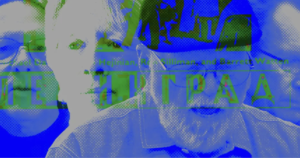
For the forthcoming publication of a newly translated Russian version of Leningrad: American Writers in the Soviet Union (here), I was asked to write an introduction, reflecting on the occasion, the time in between, and the present global situation. The original work comprised four sections of four entries each by the four authors, depicted above: Watten, Hejinian, Silliman, and Davidson. The project itself, based on a 1989 conference of avant-garde Russian and American poets (and others) as an event, has to a degree passed into lore—or better, was a self-conscious exploration of making lore, joining with a project of the ages where poetry (a poem, a body of work, a specific poet, a movement) creates a parallel text that circulates, perhaps anonymously and unwritten, to define the interpretive space (or “zone” in my sense) in which it may be situated and understood. I need only mention the Beat poets (especially the trinity Kerouac, Ginsberg, and Burroughs) to find an example of poetry creating its own lore along with its works (see my entry on “Language/Beats,” here). A new translation might take up this lore and possibly change it; with Leningrad, it seeks a new occasion, at the present moment of total disruption utterly unlike its initial time stamp.
I titled my introduction “This Time We Are Not,” and will provide the English original once its Russian equivalent is in print. Mimicking the numbers of authors (four) times the numbers of sections (four), the introduction was written in sixteen precisely measured paragraphs, each framed by a keyword in Russian, that attempted a summary rethinking of both work and event. Printing a copy for my archive, I opened my text file in Acrobat. There I noticed, above the text, a banner asking if I would like to “save time with a document summary using AI assistant,” with a button on the right to “view summary.” I thought, why not—let’s see what AI can do with this highly condensed, nearly elliptical summary of my nonnarrative text. I pushed it, and received after a short interval of machinic processing a summary of the gist of my introduction to Leningrad for Russian translation, which I copy here exactly as it was produced, a teaser to unlock the full powers of AI:
This document explores the relationship between poetry, history, and political context through reflections on the Soviet and post-Soviet experience, emphasizing how poetic forms respond to and record historical events.
Historical and Cultural Context
• The four poets’ nonnarrative poem “Leningrad” documents an event of writing, reflecting on the quiet White Nights before the fall of the Soviet Union.
• Encounters with crowds and perceptions during travel highlight the collective identity and political tensions.
• Language is viewed as a harmonic complex, reflecting global aspirations and ideological interpretations.Poetry and Ideology
• Poetry serves as a mediator between systems, destabilizing memory and ideology through textual embodiment.
• The absence of commodity forms and money in the poets’ work signifies a focus on lived experience and critical theory.
• Poets grapple with constructing subjectivity within opposing political systems, seeking understanding and connection.Collectivity and Loss
• Collective memory is tied to historical loss, exemplified by monuments and spaces representing war and destruction.
• Poets’ work embodies a poetics of loss, serving as an index of historical trauma and resilience.Cross-Cultural Encounters and Future
• Contacts with Western artists and poets expanded understanding but faced limitations post-1991, amid political upheaval.
• The future of poetry involves global distribution, emphasizing language politics and utopian hope amid contradictions.Temporal and Spatial Dimensions
• Fate is likened to a blind camel, emphasizing violence and fragmentation in history.
• Poetry offers a predictive, spatially aware tool to chart future developments and bridge divides.
• Efforts to overcome Cold War divisions through translation and networks sustain hope and dialogue.Contemporary Changes and Reflection
• The 2016 Dragomoshchenko Prize debate exemplifies evolving poetic directions and ideological diversity.
• The work of poets like Dragomoshchenko and others faces mortality, yet their influence persists.
• The form “Leningrad” demonstrates how form connects to historical writing, offering a model for ongoing reflection.Overall
• The text underscores poetry’s role in understanding history, politics, and identity, emphasizing its utopian and predictive potential.
What historical experiences shaped the poetics of loss?
How is the concept of loss represented in the poem’s imagery?
Generate a summary of the four-fold epic poem Leningrad
The challenges here are many. First, there is an uncanny degree of accuracy in many of the paraphrases, to the extent that one might question what the work of an experimental, nonnarrative text would be except to mask an underlying coherence. A second doubt then arises, with such a summary: Why would anyone want to read the work itself (which is what heading seems to imply: TL:DR). On the other hand, if the summary is correct, which it is in many moments, here is an amazing work that advertises the necessity of poetry, and experiment, in creating conditions for comprehension and understanding—locating both the meaning and value of our conference in 1989. It all boils down to this, the AI summary is saying, and you can now go forward with a summary in place of the original: they are the same thing. AI predicts a future, then, in which poetry, dialectic, misunderstanding and comprehension, unreason and ambition are melted down to the base metal of paraphrase, and this is the gold. Where André Breton would say, “I seek the gold of time,” AI answers: your gold is my paraphrase. Meaning has no further means of production that the machinic analysis and recomposition of linguistic elements, which is precisely what the poets, though they did not know it, were doing.
But what is even more remarkable is the ability of AI to supply interpretants that are absent from the source text but only perhaps implied by it. Even more to the point, withheld from it: one of the sentences I thought I heard in the original event, in a lecture in Russian being translated by a bilingual comrade sitting next to me, was “Fate is like a blind camel, breaking down the man.” I recorded this as an instance of mishearing that led to some kind of wild envisionment of what “fate” could mean to a Soviet poet, and why the trope of a “blind camel” was being used to illustrate it. One possible scenario uniting both might be the “fate” of Soviet republics like Uzbekistan or Turkmenistan in the break-up of the Soviet Union, and thus of Soviet man, assuming there are camels in either republic. Why the camel is blind could lead to further speculation: because the forces of history are material and unconscious, let’s say, no one can foresee their outcome. AI cut through all that with “Fate is likened to a blind camel, emphasizing violence and fragmentation in history.” It makes no judgment on the application of the trope; it merely records that it was said. Thus the event passes into the lore of paraphrase, much like the “Brat Guts” moment in Language writing, “the pump don’t work ’cause the vandals took the handles,” from Bob Dylan’s lore of Woodstock, or any other example of an arbitrary particular that carries universal necessity and depth.
The question is AI’s “second-order interpretation” of the work that was accomplished in Leningrad and both imitated and condensed in my introduction. Does my interpretation become an another event when the work is retranslated back (from the bilingual event) into Russian, at this precise moment of political disruption between communities of avant-garde poets during time of war? Does AI know about or comprehend that context? Arguably not; it can only work with the text at hand. Then how can it understand, through paraphrase, the historical or cultural work the text is doing? On what does it base its second-order interpretation, and whether it is adequate or not? Going farther, is this the origin of lore—those embedded assumptions we have routinized until they become mere (dead) metaphors of convention? The work above poses these questions.
Notes and links
Image: graphic from Russian website anticipating publication of Leningrad, with an interview by Vladimir Koshelev with Vladimir Feshchenko, here.