Entries tagged with poetry

Zone (Paris)
@ Double Change / L’Atelier Michael Woolworth
2 rue de la Roquette, 11e
May 4, 2026

with Suzanne Doppelt, Cole
Swenson, and
Carla Harryman
Abigail Lang: translation

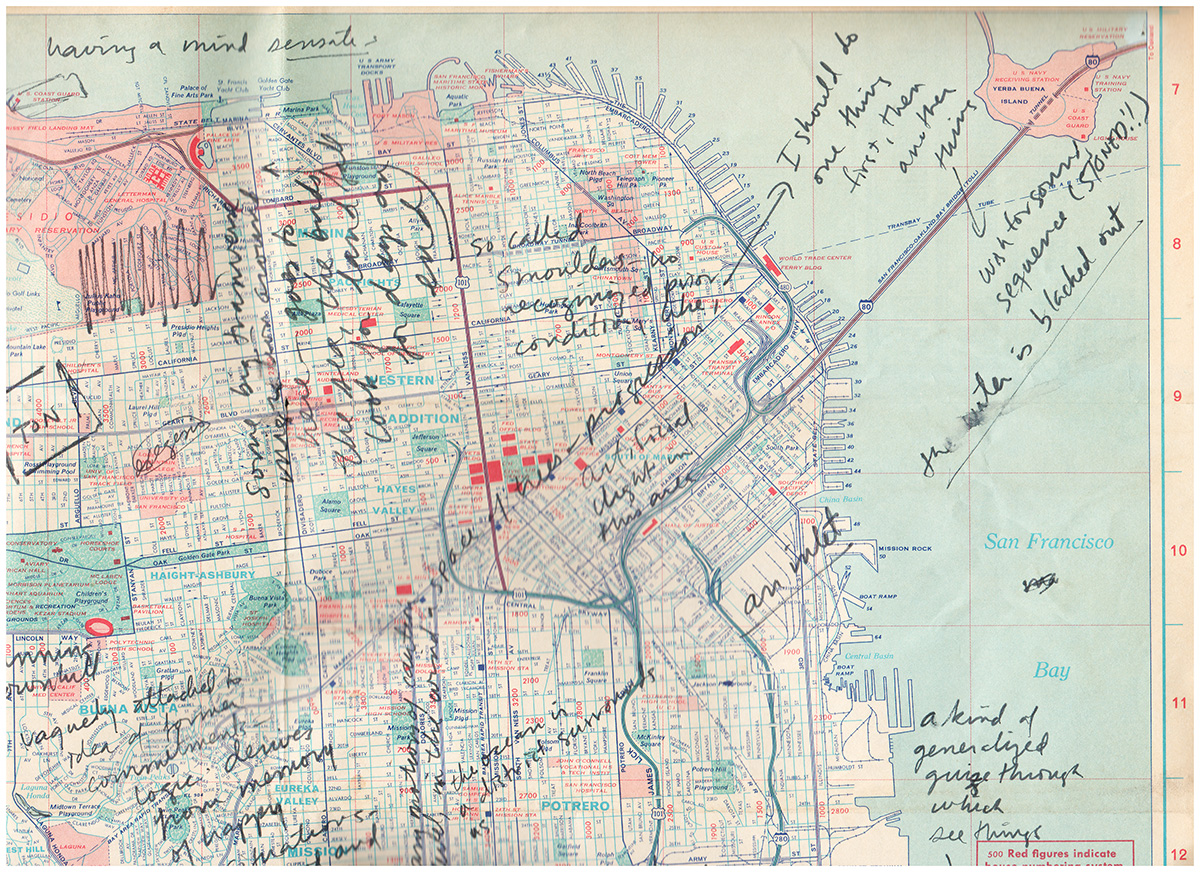
For Double Change, I followed the procedure from my previous reading in Oakland, while limiting the sequence to thirteen sections for reasons of economy. I thus sampled once from each of the twelve works in Zone plus one selected as “clinamen” or swerve to end the piece. A previous post (“Performing the Zone,” here) summarizes the method, but as before the “aleatorical indeterminate” of the randomly generated numbers for text and passage (beginning, middle, end) could not have been improved by human means.

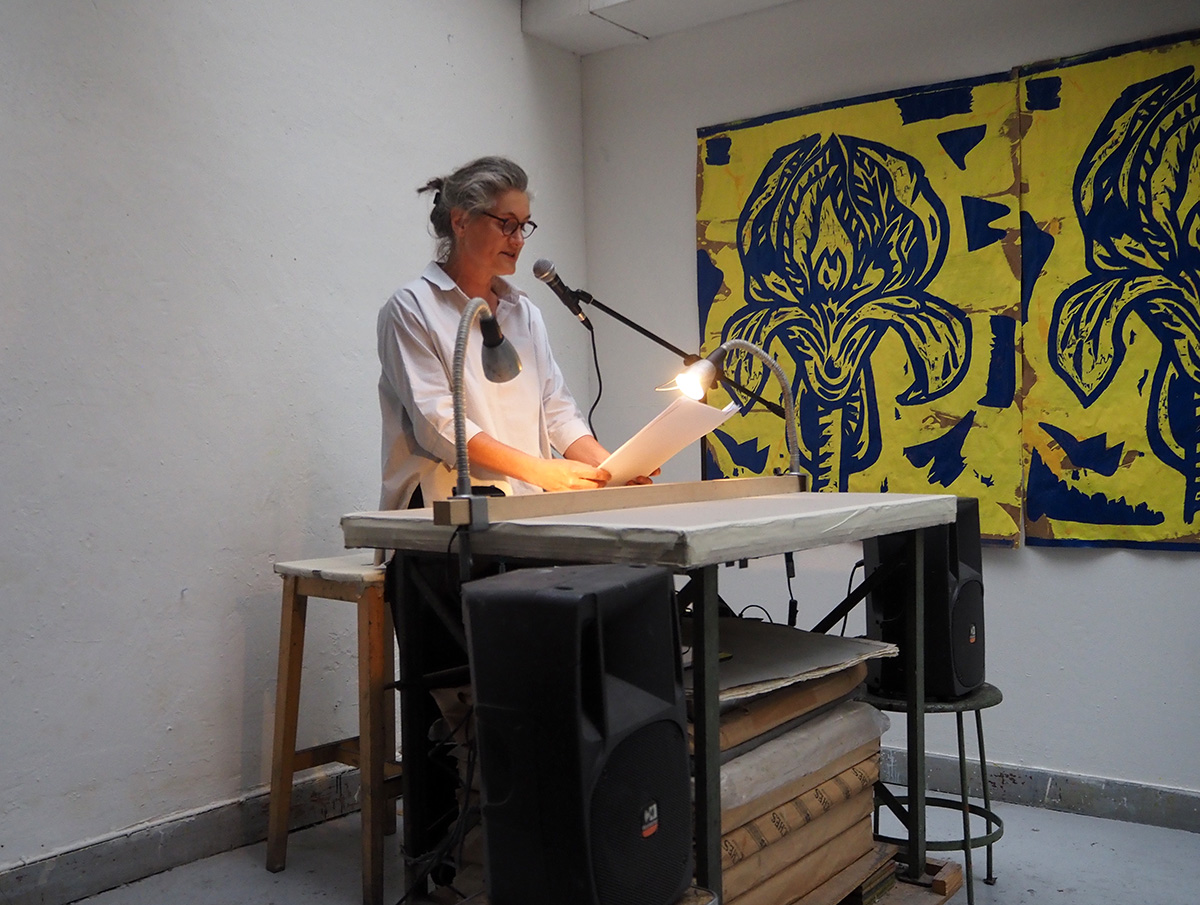
Below, I note pagination and the beginning and ending of the thirteen samples. In addition, Abigail Lang read French translations after sections 3, 6, and 9—in the section derived from Williams’s Paterson alternating French and English with every stanza. I read the French lines from “Orphée in Translation,” after abandoning the idea of having Abigail pronounce them properly. This was the right choice: my attempting French as “other” is a mirror reinforced imagistically throughout the poem (cf. “a man cut in half by a window,” a key moment in surrealism). … More
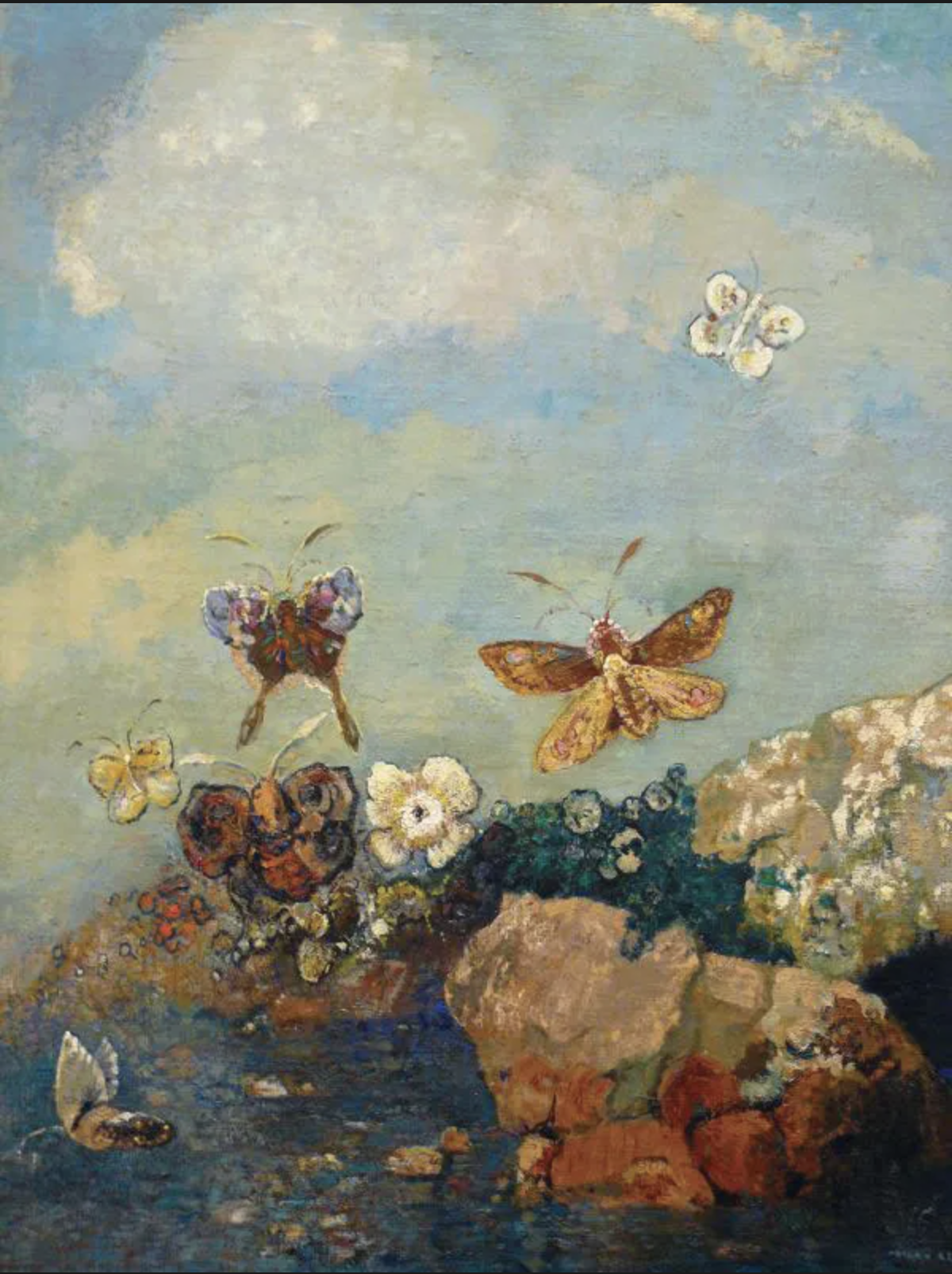
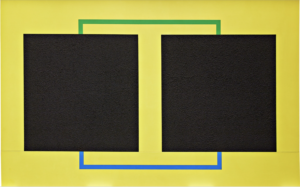
On this day in history, I am informed, Odilon Redon was born in Bordeaux, France. There is otherwise a remarkable series of destructive events, according to Encyclopedia Brittanica, none of them related to each other except for the date of April 19. I’m not going to list them, but their constellation is affected by the memory of my mother, Jeanne Alderton Watten, who was born precisely one hundred years ago on this date in 1926. I must remember not to let the occasion pass. I will further inscribe it in memory by typing out and re-presenting the work I wrote that brought those dates together in Bad History. Such were the deaths the date is associated with. Of course, nothing is ever lost, nor can it be—to quote Emerson. It is just such transcendence the date offers 100 years hence. Also in 1926 was a positive conjunction of births—the poets Allen Ginsberg, Robert Creeley, and Larry Eigner all were born that year. I once relayed that fact to Creeley, and he gave me one of those big sloppy kisses of his later days. Remind me, now that I have come to his age, not to do that to anyone (in any case we are not allowed). Odilon Redon seems just the right touch to remember my mother, who had the instincts of an artist and generously enacted them. But now I see Redon was born the next day, not the day horrible things happened. Thus erased, we move ahead. The image on the right, randomly accessed on the wrong date, thus confirms me in my mission. … More

For the thousand manifestations that dotted the American landscape yesterday, I want to post this broadside poem by Robert Creeley. It has always seemed a kind lurching effusion of a politics, a consequence of the state of mind he wrote it in without doubt. Creeley was often convulsive, and that is to the point of his aesthetic, even concerning details. But here the subject of his “attack” in William Carlos Williams’s sense is broad, vast, gestural, involuntary. It is worth remembering that much poetry that followed shelters in the shadow of that attack. Thus it bears some comment at a later moment, as late as the one we are in, where the poem resonates anew. … More

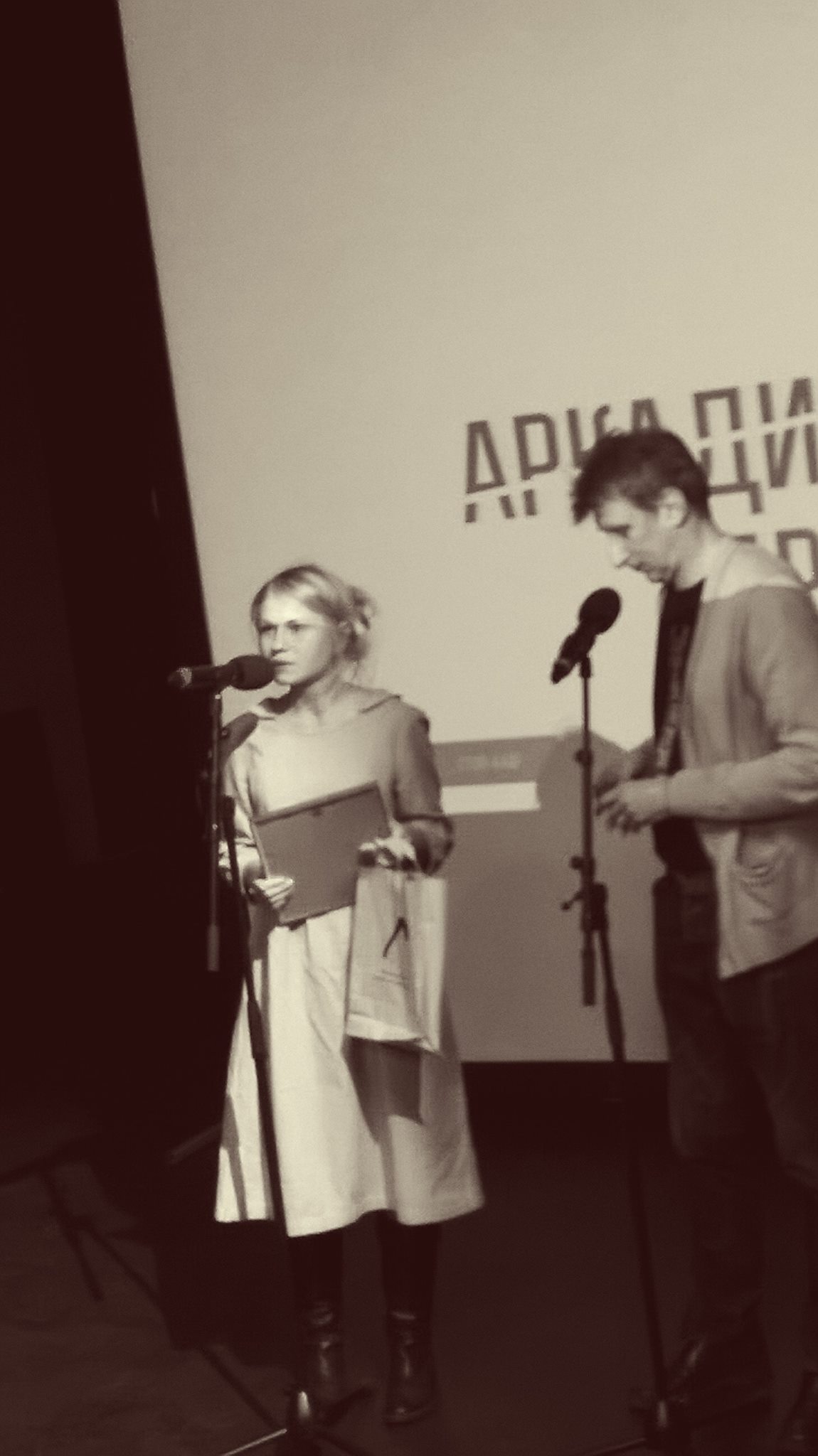
Launch of  Barrett Watten,
Not This: Selected Writings

Voznesensky Center, Moscow
46 Bolshaya Ordynka Street
January 24, 2025

The meeting focuses on how American literature experienced a “turn to language” in the 1970s, what the hybrid genres of contemporary poetry are, and the challenges faced by translators working with the “language trend” in literature. (Voznesensky Center announcement)

On the given date, at about 11:30 A.M. from a Detroit suburb, I was transported behind the lines of antagonistic states for a literary evening that, I hoped, would have long-term cultural and political meaning. It was not the first time had I stepped over this line, as I did for our “Summer School” in then-Leningrad, 1989, about which much has been written (including the multi-authored text published in 1991; here). Twenty-seven years later, with Carla Harryman, I traveled to now-St. Petersburg to participate in the Dragomoshchenko Prize awards in 2016. The consequences of these transpositions, as they may be called, between literary and cultural/political realities, continue to expand and be productive as sites of meaning. The turn to language turns out to be more than one thought. … More

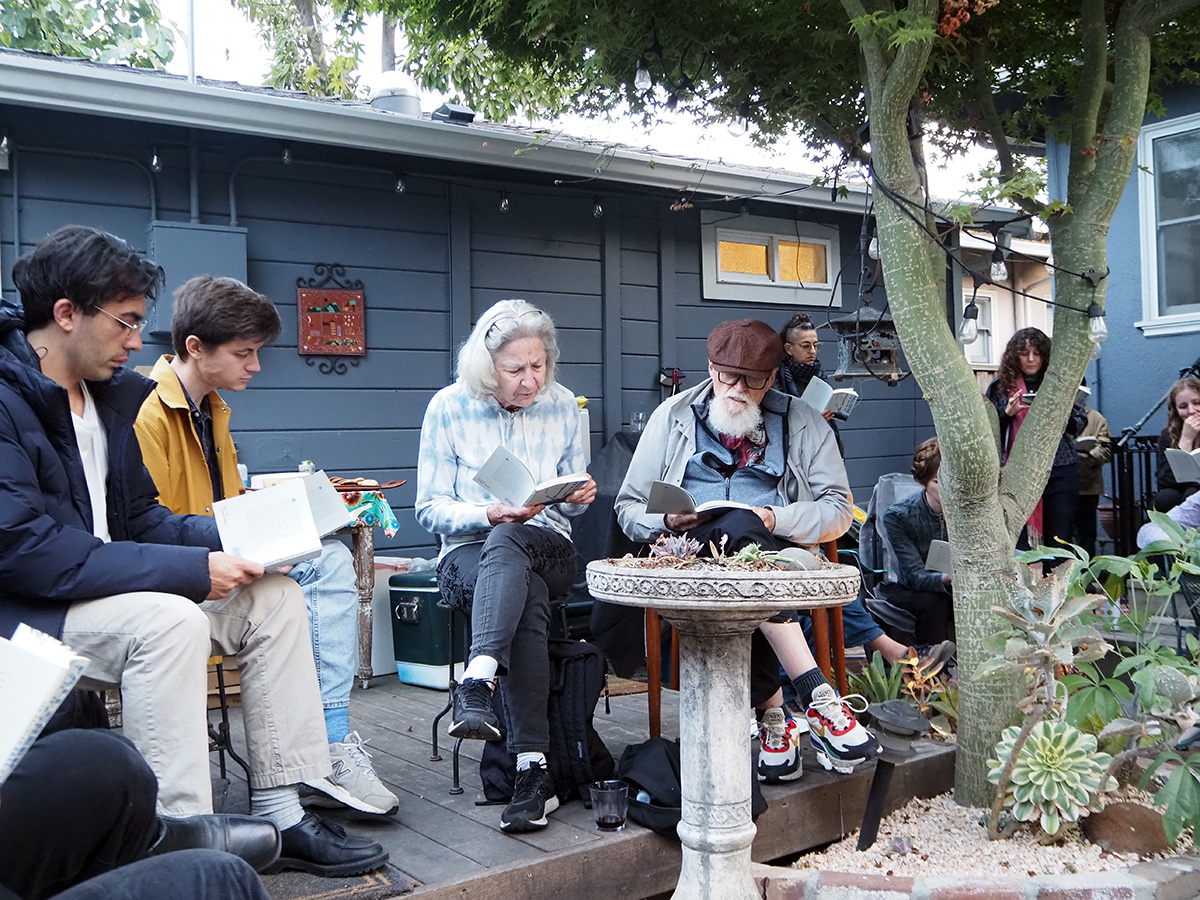
The photo registers the scene: it is Ron Silliman reading, Krishna Evans following the text. Or perhaps Krishna is reading and Ron is following the text, as will be the case in a minute or two, as soon as Ron finishes his passage. The vantage point is from where I am sitting, having read my part some time ago and now listening as it continues. To the side are  Eliot D’Silva next to Ivan Sokolov; then to the right are Jen Hofer, leaning against the garage; Claire Marie Stancek is just behind the forked trunk of a tree; Jennifer Scappettone between the branches of the tree, and Jane Gregory, the host of the event, is to the far right. Continuing out of the picture one would encounter Lytle Shaw, whose elbow is just visible, and then next Syd Staiti on the stairs. Everyone is not especially solemn but bent to the task, reading Lyn Hejinian’s just published Fall Creek (Litmus Press), copies and xeroxes of which are out on the table. All of them have taken their turn. There are thirty-three sections, with Ron and Krishna reading the next-to-final two, before the group takes up the last section in unison. This was my proposal to the group at the break, recalling the pleasure of cacophony in our Grand Piano reading of “A”–24, whose plurivocality Lyn internalized and, some decades later, realized in one of her last works.  … More

Document 102: Note on Conduit

“Conduit” (“Kanal svyazi”)
trans. Arkadii Dragomoshchenko and Vladimir Feshchenko
Vsealizm (Moscow), 11 February 2024

From Moscow, for the second week in a row, comes a new translation of my work into Russian—here, “Conduit” into “Kanal svyazi”—in preparation for a bilingual edition to appear, one hopes, later this year. This work, brought forward over decades and across continents, truly stands as a conduit in the distressed conditions of communication, between the “territories of the East” and the rest of the world assuredly, but more generally as “what we live.” As I wrote on receiving word of this wonder:

There was a line from a Poets Theater play, Third Man by Carla Harryman, early 80s, spoken by Eileen Corder: “Go ahead, Moscow—I’m listening!” That was transgressive in the Reagan Era; in the current moment, one listens carefully to say the least. And now this translation of my poem “Conduit” has appeared—it is all about receiving messages, and not letting them stand as commonplaces or placeholders but as samples of “systematic distortion.” It’s about the “systematic distortion” of communication as communication itself, which we experience every day.

… More

MATERIAL TRANSMISSIONS:
DEMOTIC SURREALISM/HIERATIC LANGUAGE,
SAN FRANCISCO, 1975–1980

Plunged each day into the fog of received ideas, man is led to conceive
of all things and to conceive of himself through a dizzy series of quickly
hidden stumblings, of false steps rectified as best as possible.

—André Breton, “The Automatic Message” (1933)

… More

Entry 51: Magnetic North (IV)

Friday, June 16
DB ICE 1040 Bergen auf Rügen > Berlin Hbf

54 Ebertystraße, Friedrichshain, Berlin

Carla Harryman
Ragna Berg
Florian Werner

Ellen Allien
Hamburger Bahnhof

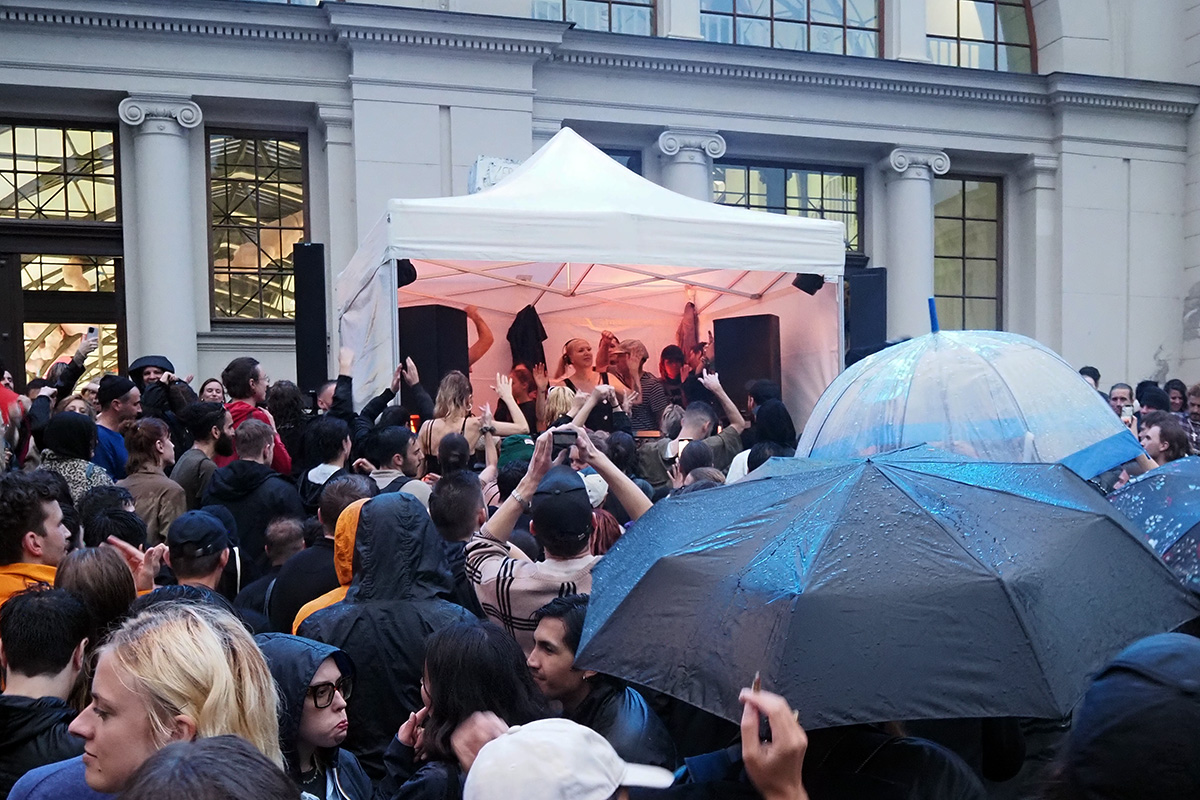
Just about to get there; we have been away. Time crosses space, beginning in Rügen Island and ending in Berlin. Then we were advised to come and we would arrive. The party crowd is aware of its having a location in time and space, had been there for awhile—before we came. The party crowd at the Hamburger Bahnhof, celebrating the new director, a new orientation for art. As we come from a distance, the music invites us in, not yet there. On arrival it is there, an insistent pulse, meditative, cruising on horizontal, an endless plane of immanence, synced in time. He is coming soon, wrote Wittgenstein; he will be coming, he will have come. That must be the new director. Then he will have arrived. Gertrude Stein repeated the phrase, only with modulation. Ellen Allien is the legitimate appointee of the new director, hired to entertain and inspire the crowd, to be a work of art in herself. The party crowd is a work of art in itself, an instance of Gertrude Stein advancing in time. As the director himself had written, “The limits of my language mean the limits of my world“—that is the principle of new art at the Hamburger Bahnhof. It is raining, the crowd is moving slightly then more openly, Ellen Allien gestures to the sky, arms raised, rain is coming down. A steady pulse of the language of limits becomes an episode in time and space. We are not afraid of speaking.

A man coming.
Yes there is a great deal of use in a man coming but will he come at all if he does come will he come here.
How to you like it if he comes and look like that. Not at all later. Well anyway he does come and if he likes it he will come again.
Later when another man comes
He does not come.
Girls coming. There is no use in girls coming.
Well anyway he does come and if he likes it he will coming gain.

Ellen Allien is the legitimate heir of Gertrude Stein. Nonsense, she pushes a button and there is a new orientation to the beat. Nonsense. Pulse, difference. Slight movements under an umbrella, the umbrellas are folded. We learn the new meaning to experience time and space, under the auspices of the new director, as an example of the new art. The art is coming all over with newness, like Gertrude Stein coming to Radcliffe, GIs arriving in the Bavarian Alps. The movement begins with a slight dancing, becomes more pronounced, is shared by many in the crowd. Finding a position in the middle, unable to really get a look at Ellen Allien, stepping back, her arms are raised with the beat. And a gigantic pause makes ensuing pulse more danceable, this is the basic grammar of techno. Nonsense. Now take a position a bit farther back, focus and click. On the pause that makes the pulse happen. Let us say what Ellen Allien teaches: electronic dance music teaches. She is the instructor of the moment, hired by the director, as an example of the new art. Her whole life is oriented toward this moment of instruction, in the form of a work of art, a way of being historical. This is the mandate of the Nationalgalerie der Gegenwart: to preserve the present as ethical obligation in the form of Ellen Allien and the crowd, moving under rain, skies now clearing, continuing as may be, a work of art.

… More

xxx
by Ekaterina Zakharkiv

(trans. Joseph Simas)

fucking sky: because it is open, it is occupied, recognized as an extremist organization, acting as a foreign agent, banned across the territory of the russian federation.

discrediting actions
with the help of words. how do you act on the sky with words?

don’t look up, don’t cross its borders, don’t read paul celan under its vaulted blanket.
the sky before dawn is buzzing, collapsing without warning.

it’s no longer a metaphor, no longer a generalization of conflict.
blinded, we roll into the sleepy suburbs and strike. we harm the defenseless.
we lose our sense of smell and fail to notice the stench of black smoke.
we get caught off guard in the mix.

now is not the time for quotations. all the marks have been forged into antitank hedgehogs. nevertheless

days go by, and we lay never-roses at the foot of myth. what have we seen with our own eyes? transmissions, streamed from a billion bloodlines. childhood dreams burgeoning into political imagination in airports and hotel rooms. craters blown into our former tongue suck up shards of grass, hallways blasted in. language is tongue-tied. it leaves neither trace of name nor address. in its vacant alleyways the hissing utterances of an orange serpent. no one’s, again … More

From Scales (11)
by Carla Harryman

to Russian/Ukrainian Poets

—checking email every five minutes for an answer. I got it I got the answer and it didn’t make me look so good.

Pounding on your own goodness sounds a bit tarnishing.

Say stinging.

Have a latke.

The smell of onion in the vapor of potato reminds me of the Russian poets in our kitchen drinking vodka at a somewhat earlier hour than this.

They did not sleep.

They do not sleep much now either.

Up all night in your fantasy. Some of them dead.

No not in mine. In mine they sleep willowy sorts of idealisms smothering vast plains sequestered in small farms and mushroom gathering.

They are almost all gone now, but there are more.

Some. Alexei. Others too are lauded on the lips of the still living.

Alexei turned vitriol blue.

Hmmm . . . I thought it was a reference to hydrated copper.

Ukrainian rubble recalls each dead poet in Russia as Ukrainian.

They have to be careful now. That rubble disseminates in the elements spreading across the globe.

As ever but more so.

Tabling the turn and turning.

So. Let them leave as they did.

They leave again and again.

So and so is arriving.

A ways off.

They are arriving.

We break hearts with them when they arrive with stoic pretense.

And then we get out the vodka.

They have not yet slept.

We keep the vodka in the freezer in case someone is looking for it.

I confess I didn’t understand entirely, these males. But Alexei—

Now understanding, forget.

—I was a poet in the company of Alexei.

The point is disbursed in rubble—

Yes forget understanding.

—and never made again in the same way.

That’s right. It’s missing varnish.

—March 20, 2022 … More