Entries tagged with poetry

Writing in the Event:
“The Beirut/Hell Remix
(After Etel Adnan)”

Last October I had the good fortune to preview Etel Adnan: Light’s New Measurethe Guggenheim Museum’s career retrospective of Adnan’s visual art, which makes significant reference to her writing. The cross-genre and multi-languaged aspects of her work could not be missed, an opening beyond the usual categories that art history and museum curating maintain. The museum was also making a political point in showing Adnan’s work along with a deep selection of the abstract painting of Vasily Kandinsky. The move from landscape to abstraction unites the two, but the differing contexts for abstraction are equally the point. Eurocentric modernism is in transition, refunctioned as a global cosmopolitanism, which arrives with the breakthrough moment of Adnan’s painting at dOCUMENTA 13 (2012) at what I have described as a “global archive.”

The occasion itself was compelling and bittersweet. Etel herself could not attend the opening but was represented by her partner, Simone Fattal—whose solo show at the Whitechapel Gallery in London was also on the global agenda. With Carla Harryman, we made plans to meet in Paris in November; we would have a French Thanksgiving, the day after the American one. Etel Adnan died on November 14, a Saturday. The news came through friends the next day. From all corners and all kinds of people the reaction was profound: the passing of a figure who had touched many, over many decades. We would still be coming to Paris as travel was arranged and plans had been made; the Omicron curtain had not yet come down. Everything was up in the air, suspended. Simone texted after we arrived; will you still be coming to dinner? Meetings with a remarkable woman on the rue Madame. We discussed everything and nothing as friends came and went. One resonant detail concerned Etel’s daily attention to events in Beirut, from economic collapse to the 2020 explosion. Not coincidentally, the Institut du Monde Arabe was exhibiting visual art referencing Beirut before and after the explosion under the title “Lumières du Liban,” in which Etel and Simone were both strongly present. We told Simone we would attend, and reported back after we did.

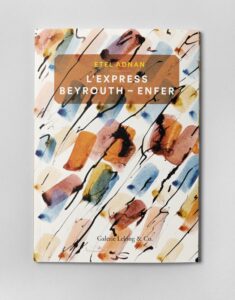
The museum bookstore stocks an impressive array of titles by Adnan, in many languages. I was immediately taken by Galerie Lelong’s 2021 publication of L’Express Beirut–Enfer, which brought together three texts, the first originally written in French and then later published in her English version. Meanwhile, plans that had been under way at the Guggenheim Museum were also up in the air, with the news of Etel’s passing, the onset of the Omicron surge, and the Guggenheim’s new partnership with the Academy of American Poets. In the end, I would agree to provide a written work, on commission, for the tribute to Etel, to be published online in conjunction with a virtual reading by poets who could perform in New York. Both events took place: the reading, while impeded by some gapping due to bandwidth issues, features an epochal performance by Anne Waldman along with tributes by Ammiel Alcalay, Omar Berrada, Stephen Motika, and Asiya Wadud, made available on Vimeo. And my text, “The Beirut–Hell Remix (After Etel Adnan),” along with an explanatory note that appears at the end of the poem, is published at the link below. One can only hope that, in future days, the many facets of this event for Etel Adnan will be seen together.

“The Beirut–Hell Remix (After Etel Adnan)” [link]
Original by Etel Adnan composed 1970; first published 1971
Adaptation/translation by Barrett Watten; completed January 2022
Online publication by The Guggenheim Museum, January 2022

Notes and links

[t/k]
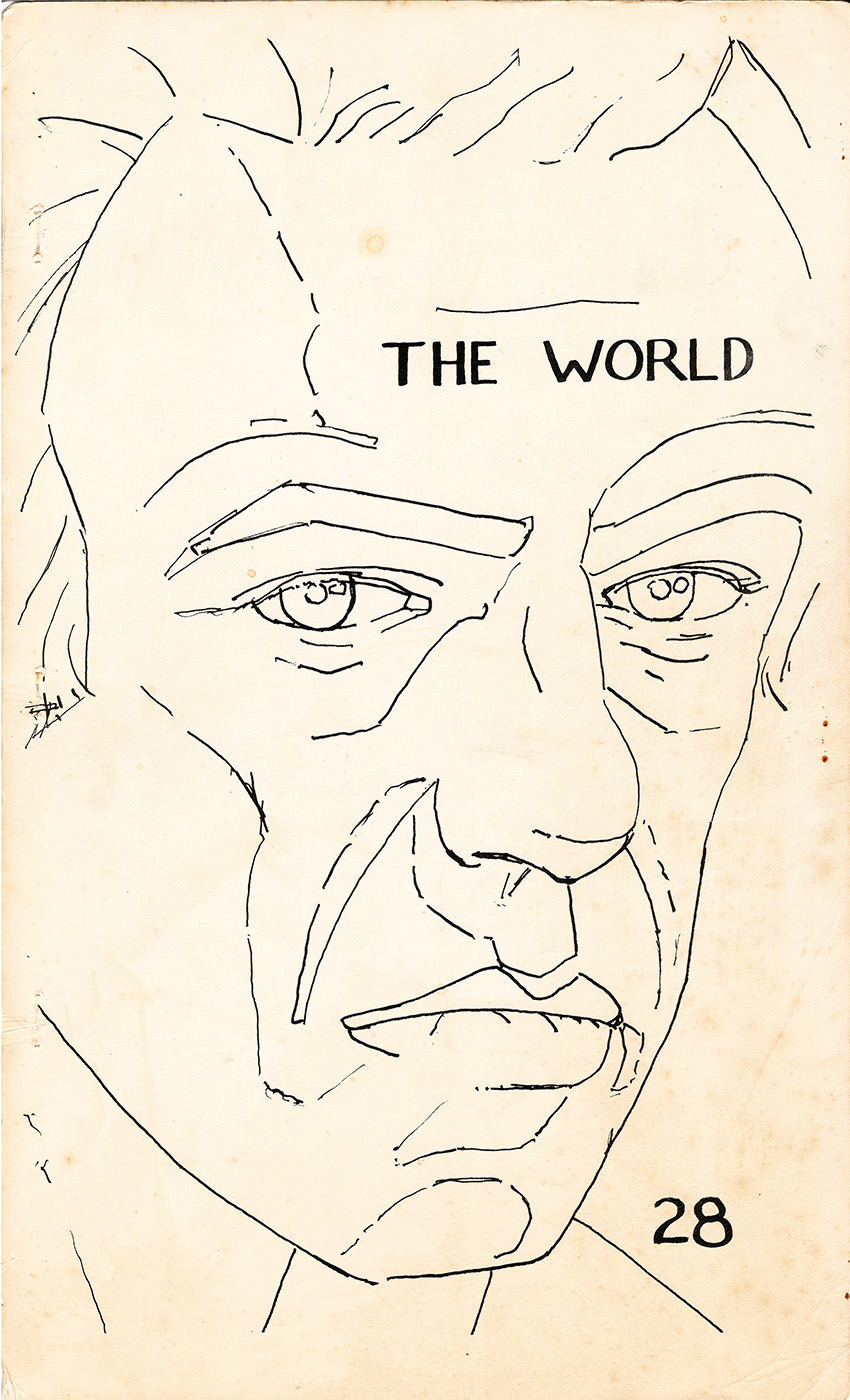
I return to the vexed question of autobiography, which in earlier times I believed one should “start writing” only when all other options—of world transformation, for instance—had failed. The two key terms are brought together in the 1973 cover of The World 28, the “Autobiography Issue” edited by Lewis Warsh. As I recalled when Lewis died late last year, I first met him in Mendocino, on his way down the coast to Bolinas, where I visited him before he moved back east. In his editing of The World, he wanted to radicalize autobiography not as a genre but as a mode of writing. Writing from an immediate perspective of “personhood” in any genre was of interest, from poetry to fiction to memoir, journal entries, letters, portraits, and snapshots.

Autobiography would be the royal road to writing per se; there was a tradition and consensus that “self/life/writing” was what there was to do, in fact was all that could be done. For a brief while there was in fact a kind of period style of autobiographical self-discovery, nothing like the persona poems of the workshop but evoking a tradition from Rousseau and the romantics, Zukofsky’s “the words are my life,” Beat spontaneity, and New York School everyday life. The consensus—and it was not long lived—was that “into the company of self it all returns,” one might say. Warsh’s 1973 project, bringing together writers of several diverse schools, was the highpoint of that moment.

I was the early Language writer in that group, in company with Clark Coolidge, Bernadette Mayer, Tom Raworth, Bobbie Louise Hawkins, Bill Berkson, Anne Waldman, all poets who would appear in the first issues of This, but also Diane Di Prima, Kenward Elmslie, Lee Harwood, Harris Schiff, and John Wieners. The issue should be reprinted in its entirety, to reflect on the question of writing that Lewis proposed: where the fact of writing and the events of life are seen as nearly identical. What historical circumstances obtained for that to be possible, desirable, likely? But there is also a moment of transition here: from person to language—at one pole the iconic representation of personhood, in condensed and presentable form, and on the other the endlessness of scribbling in letters and journals, a fascination of writing per se. … More

Archive 12: Micropoetics

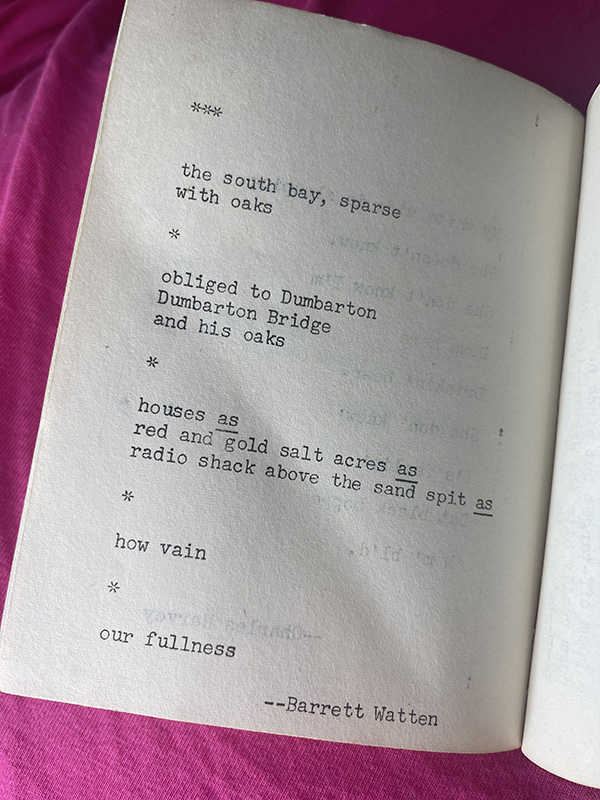
Thanks to the online research of C.V. Henriette, I now have a visual record of my second appearance in a literary magazine, Gum 2, ed. Dave Morice (Iowa City, September 1971). Morice’s goal as editor was to be small and sustainable—in both aesthetic and material terms—a reflection on the political economy of poetry at the time and a counter-cultural alternative. A protominimalism, at the intersection of concrete poetry, midwestern imagism, the New York school, and the not-yet-named Language school (as well as a first instance of “actualism,” the movement that was not one) was the result. The poem was written, likely, at Berkeley under the influence of Robert Grenier, and I gave a copy to Dave after I met him in Iowa City. No title, no capitalization, no regular stanzas, no persona, no narrative, but with the use of asterisks in the mode of Ted Berrigan, Anne Waldman, and later Anselm Hollo.

“obliged to Dumbarton / Dumbarton Bridge / and his oaks” is a triangular pun on the Dumbarton Bridge, a relic of the times and one of the most ungainly bridges ever, crossing the southern San Francisco Bay, and Dumbarton Oaks, the site of the Dumbarton Oaks Conference, the progenitor of the United Nations. Also, there are many oaks in the South Bay, as the poem notes.

In the late summer and early fall of 1944, at the height of the Second World War, a series of important diplomatic meetings took place at Dumbarton Oaks, officially known as the Washington Conversations on International Peace and Security Organization. Delegations from China, the Soviet Union, the United Kingdom, and the United States deliberated over proposals for the establishment of an organization to maintain peace and security in the world. Their meetings resulted in the United Nations Charter that was adopted in San Francisco in 1945. [Wikipedia]

… More

Entry 42: Hello, Indiana!

On 4 December, this year, I was emailed by John Pratt, English teacher at Greensburg High School in Indiana, asking if I would read for his program (virtually), and send a shout out to the students. Greensburg has experienced two waves of COVID and was forced to return to all-online classes; the readings would be an end-of-year bonus for students. I also see it as an effort to communicate between “regions” of the pandemic: Indiana, a red state with huge uptick in cases in December, and Michigan, a blue state where a similar surge was somewhat damped but still compares with other Midwestern states, as I know from the Michigan Coronavirus page [here].

With a population of 11,000, our small town of Greensburg Indiana was hit hard by the pandemic in March and last week it returned with full force. Once again Greensburg High School has been moved to virtual learning. As one of our teachers, I have launched a campaign to provide an inspiring lesson for our over 700 students. It is called The Bucket List—Our Greatest Poets. I have sought out those who I feel would inspire us with a few words. Would you be willing to read a poem for my students? Simply tape yourself saying who you are, give a shout out to Greensburg High School students, then read a poem. Thank you for your consideration and have a great week.

No problem, you bet. On 14 December, I recorded a section from my poem of the COVID duration, “Notzeit (After Hannah Höch),” with a short exhortation to the students to write about what they have learned from strange times:

John Pratt, in turn, posted the video to his Virtual Chautauqua page [here], which provides links to the fifteen poets who responded; I was pleased to see myself in company with Eileen Myles, Martín Espada, and other poets new to me. The readings are marvelous, unified by the prospect of speaking to youth across time zones, and worth the time clicking through. … More

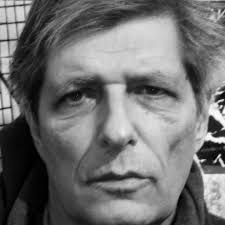
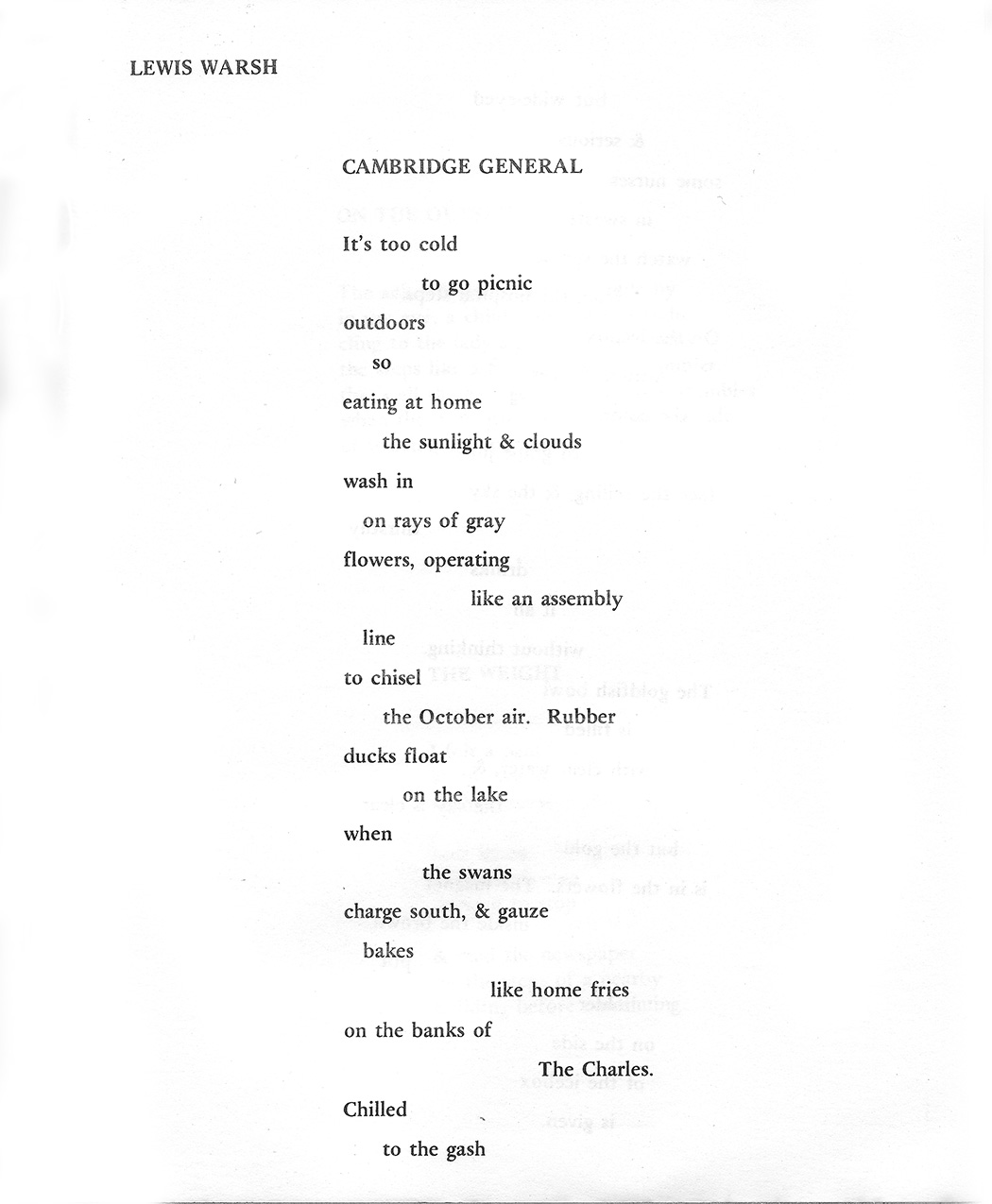
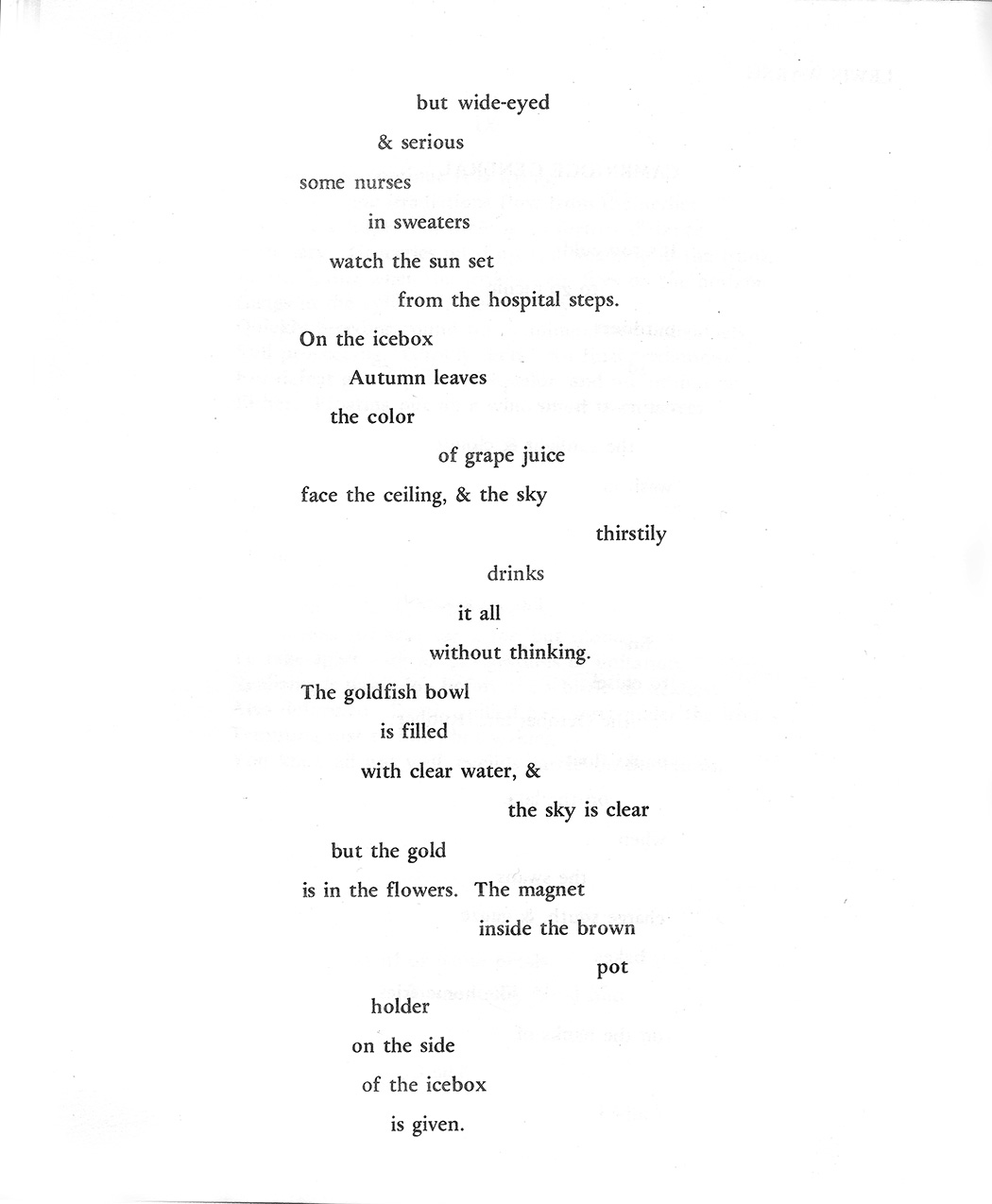
Yesterday I received news that New York poet Lewis Warsh has died. He had been ill, I heard from a distance, and I had sent birthday greetings earlier in the month—unanswered. We had a kind of  . . . rivalrous, or contestatory, poetic conversation over the decades, concerning basic issues of what counts as poetry, what the poetic calling is. The issue was person versus language, if a bit characterized and reduced. We go way back. I met Lewis in Albion, California, up the coast in California, the summer of 1972. I had moved there with Sandy Berrigan, David, and Kate, and Lewis visited on his way down to Bolinas, where I would also see him, and later in Stinson Beach, sharing a beach house with the cartoonist Greg Irons. When I assumed full editorship of This in 1973, taking a turn toward more complex aesthetics, he sent me several works, which I have scanned below. He would have sent them from Cambridge, where he lodged briefly after the West Coast. We wrote a collaboration (now in the archive), and he published my autobiographical writings—some exceptionally raw—in the “Autobiography” issue of The World (28), with its larger than life format and cover drawing by Alex Katz, New York School period style for sure. For the issue of This (4), he sent three works (he had a particular way of calling poems “works,” each being unique):

… More

Archive 06: Leningrad/ATD


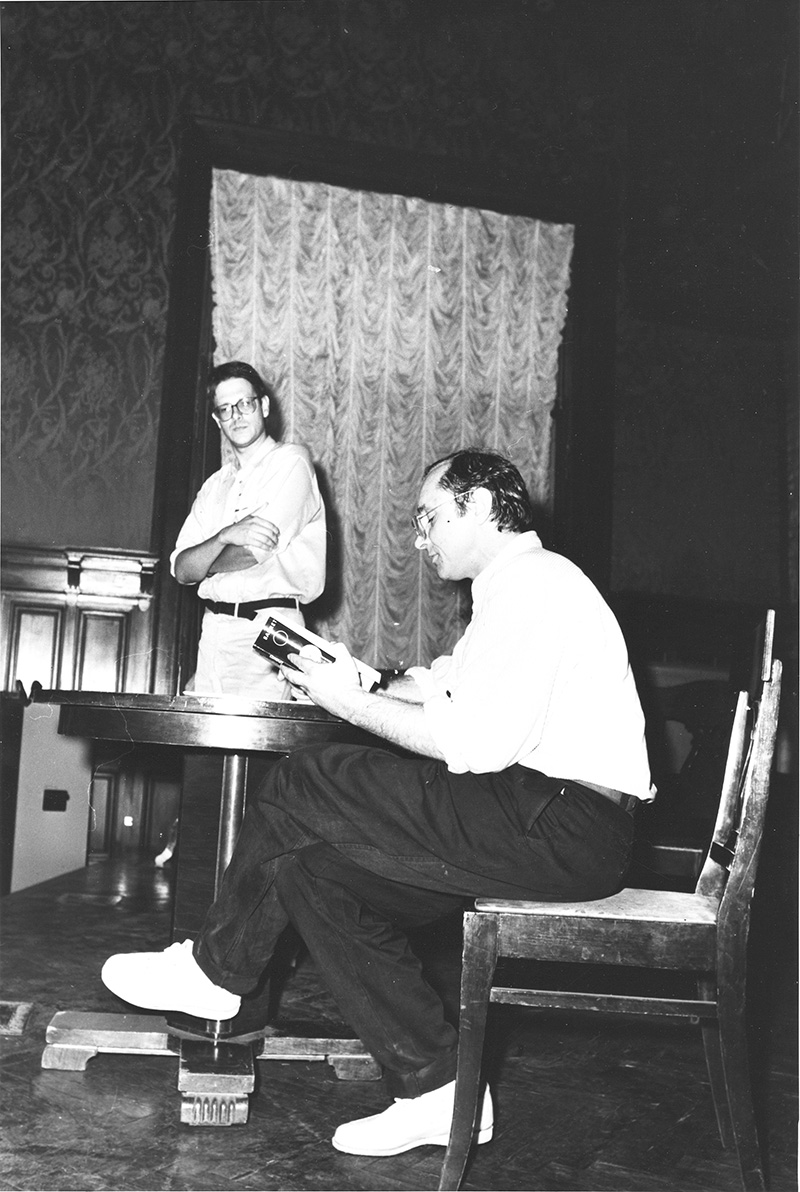
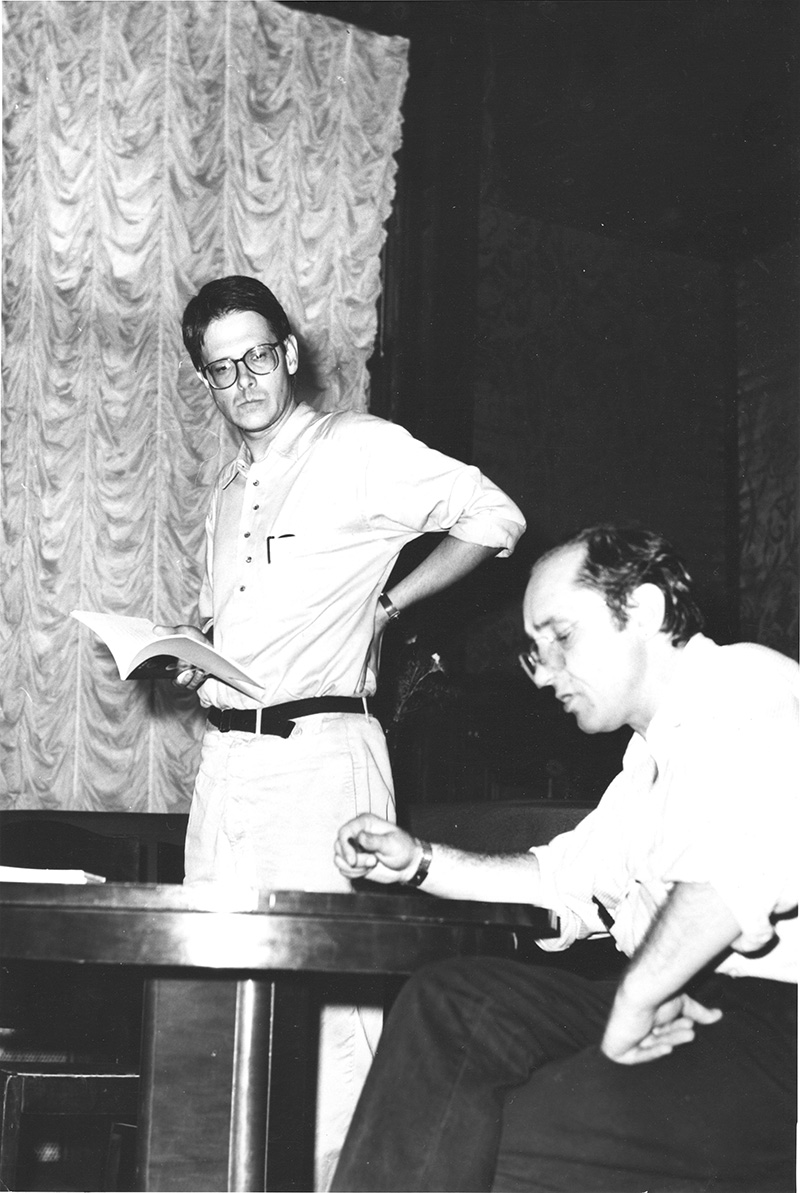
There is a proliferation of anniversary dates this time of year. This one remembers our Summer School in Leningrad, August 1989, during the last days of Perestroika and the Soviet Union itself—thirty-one years ago. An international conference of avant-garde poets would not have been possible previously, and its meaning took part in that nearly evacuated moment—which we record in our nonnarrative history, Leningrad: American Writers in the Soviet Union. The grandiosity of our monumental title betrays the actual import of the event, which was all in the details—an occurrence that could happen once only, as its effective history. Which is always potential, always about to have an effect. Arkadii and I are pictured above, at the reading where I read in English followed by his translation. I would now say that it is the distance between the two figures that is most active and alive with possibility.

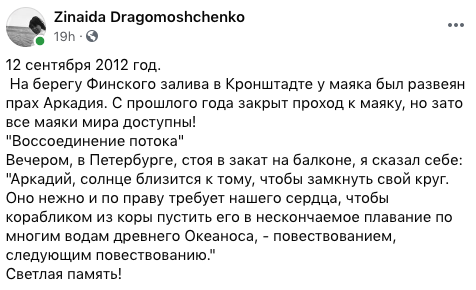
Today I saw Zinaida Dragomoshchenko’s post on, I assume, the scattering of Arkadii’s ashes in 2012, which adds to the historical prompt for my post. At another moment of distance, I want to read Zina’s tribute in Russian, which I screen capture without translating (and as the Cyrillic alphabet does not work on my site). Zina recalls the scattering of Arkadii’s ashes near the lighthouse at Kronstadt, in the Baltic off Petersburg, which has since closed, “but all the beacons of the world are available.” I wonder if the line in quotes, “Vossoyedineniye potoka,” translated as “stream reunion,” is from Arkadii’s works. Streams are coming together, converging. She returns to Petersburg and, speaking to herself, imagines the sun’s closing of a circle and a return “endless swimming” in the stream of Okeanos. She ends, in convergence across the space of eight years, “Svetlaya pamyat’!,” “Bright memory!”

Notes

Photographs: BW and Arkadii Dragomoshchenko, International Summer School, Leningrad, August 1989. Photographer: t/k.
Permission to reproduce screen shot.

Introduction

To be a writer and write things
You must have experiences you can write about.
Just living won’t do. I have a theory
About masterpieces, how to make them
At very little expense, and they’re every
Bit as good as the others. You can
Use the same materials of the dream, at last.

It’s a kind of game with no losers and only one
Winner—you. First, pain gets
Flashed back through the story and the story
Comes out backwards and woof-side up. This is
No one’s story! At least they think that
For a time and the story is architecture
Now, and then history of a diversified kind.
A vacant episode during which the bricks got
Repointed and browner. And it ends up
Nobody’s, there is nothing for any of us
Except that fretful vacillating around the central
Question that brings us closer,
For better or worse, for all this time.

—John Ashbery

Notes and links

Text: John Ashbery, “Introduction,” in A Wave (New York: Penguin, 1985): 34.

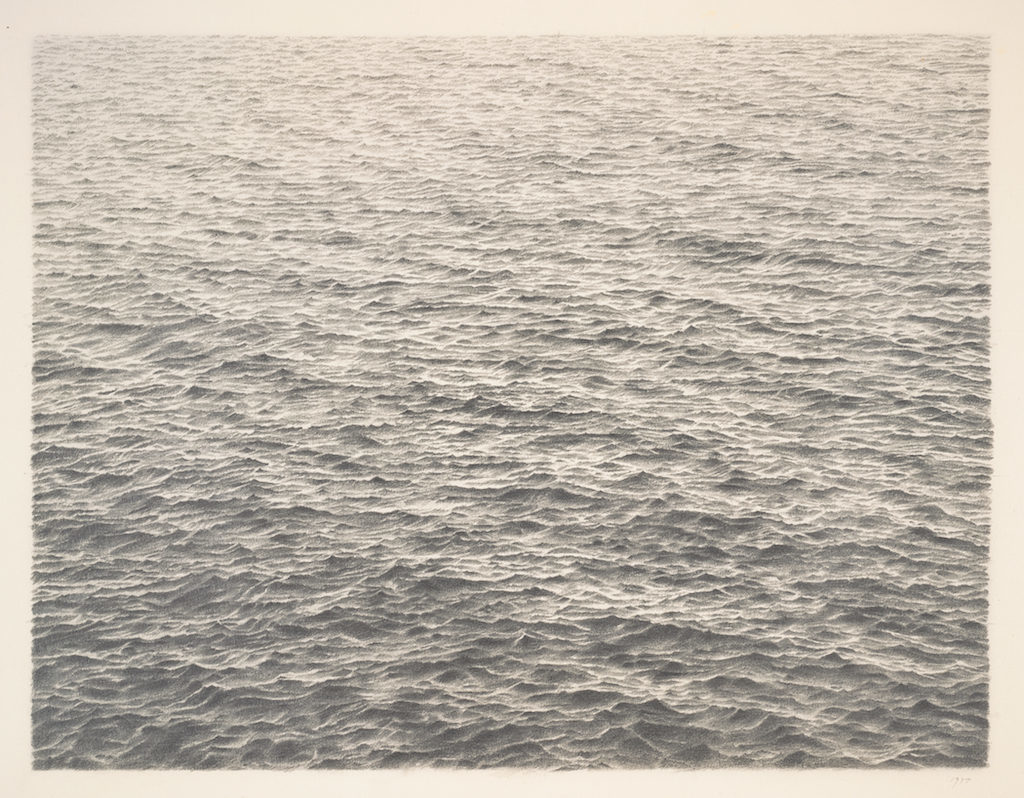
Image: Vija Celmins, Untitled (Ocean), 1977.

Links: Entry 11: “For a Left Ashbery Critique”
Entry 14: “The Perfect Ashbery (Review)”
Entry 36: “Ashbery Alpha and Omega”

Entry 40: Isolate Flecks

It is only in isolate flecks that
something
is given off

No one
to witness
and adjust, no one to drive the car

—William Carlos Williams

21 March 2020

What I am to think about, in a room with others, is the nature of Zero Hour—our new life. Our colloquy is an opening to that question.

22 March 2020

The poet often sees oneself as an isolato, “a person who is physically or spiritually isolated from others.” We are collectively isolated, as well.

This is the common condition we have sequestered ourselves within. These are the occasions for what I am now writing: here begin.

23 March 2020

Putting on Vivaldi to get the morning started, I recognize the theme music Delta Airlines uses on its transatlantic flights, to CDG, FRA, or AMS.

Homeless panhandler on corner of southbound Lodge offramp and Forrest reaches out without direction as I round the corner, and falls over.

“With history piling up so fast, almost every day is the anniversary of something awful.” Under this rubric I find words I intend to use . . .

24 March 2020

Imagining our isolation through multiple visual maps: blue and gray dots colliding; exponential curves ticking upward; geography filling in at a rate.

The graph of deaths doubling every two days, every three or five days, every ten days—these are abstractions, what do they mean in the event?

Although concern increases with the incidence of disease, the percentage gap in belief stays constant at about 40% between red and blue states.

Am I a nonperson in a mask and hat, or the announcement of a social order to come? The learning curve for what counts as human is constant. … More

Document 81: An Example

I was angry with my friend;
I told my wrath, my wrath did end.
I was angry with my foe:
I told it not, my wrath did grow. … More

Document 66: The Bungalows

[In memory of John Ashbery]

ashbery collage 01

THE BUNGALOWS

Impatient as we were for all of them to join us,
The land had not yet risen into view: gulls had swept the gray steel towers away
So that it profited less to go searching, away over the humming earth
Than to stay in immediate relation to these other things—boxes, store parts, whatever you wanted to call them—
Whose installedness was the price of further revolutions, so you knew this combat was the last.
And still the relationship waxed, billowed like scenery on the breeze.

They are the same aren’t they,
The presumed landscape and the dream of home
Because the people are all homesick today or desperately sleeping,
Trying to remember how those rectangular shapes
Became so extraneous and so near
To create a foreground of quiet knowledge
In which youth had grown old, chanting and singing wise hymns that
Will sign for old age
And so lift up the past to be persuaded, and be put down again.

… More