>> Events <<

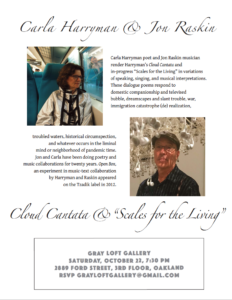
Carla Harryman & Jon Raskin
Cloud Cantata and “Scales for the Living”
Text-based and multi-instrumental performance

Gray Loft Gallery
Saturday, October 22, 7:30 PM
2889 Ford Street, 3rd Floor, Oakland
RSVP grayloftgallery@gmail.com

Poet Carla Harryman poet and musician Jon Raskin musician render Harryman’s Cloud Cantata and in-progress “Scales for the Living” in variations of speaking, singing, and musical interpretations. These dialogue poems respond to domestic companionship and televised bubble, dreamscapes and slant trouble, war, immigration catastrophe (de) realization, dangerous waters, historical circumspection, and whatever occurs in the liminal mind or neighborhood of pandemic time.

… More

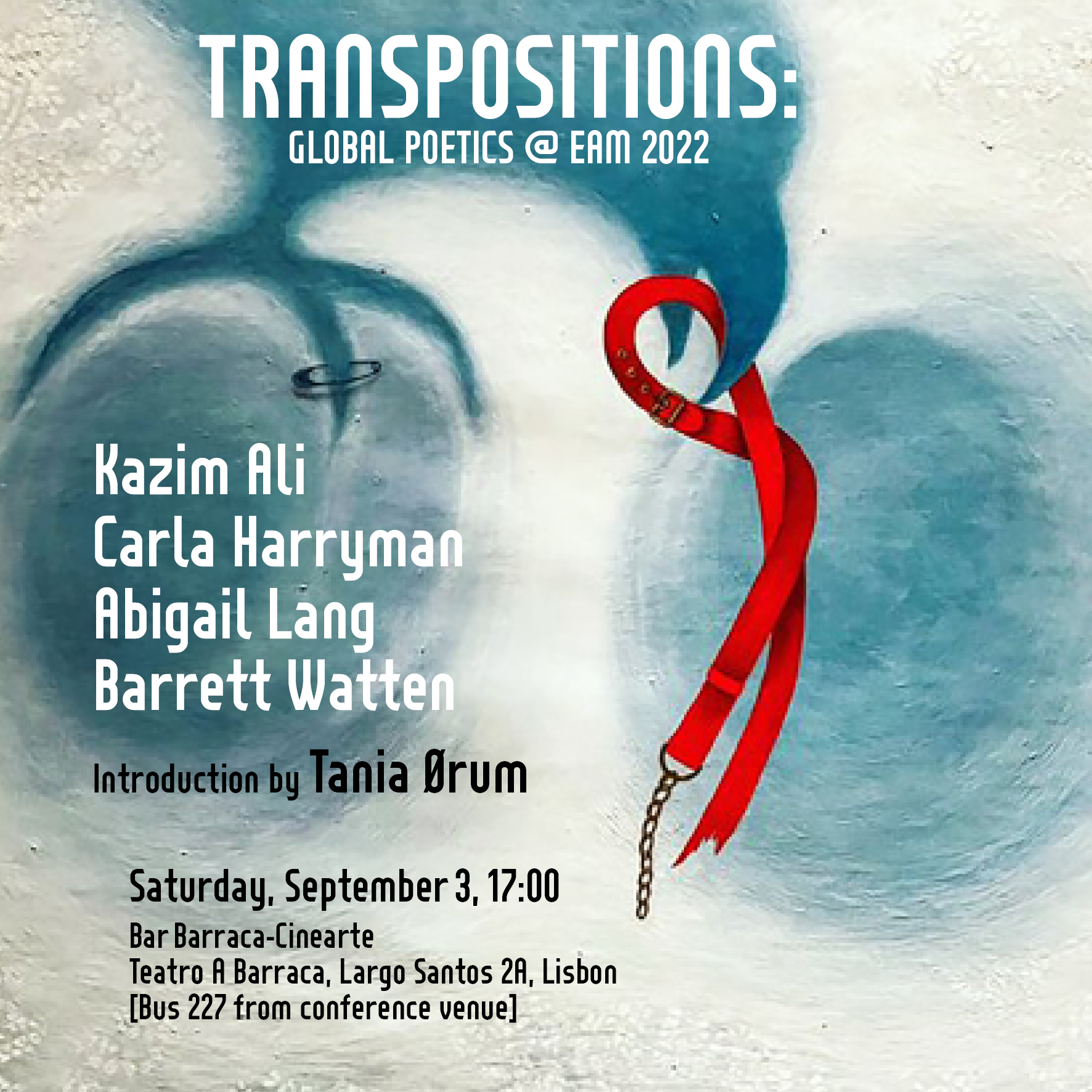
“Transpositions: Global Poetics @ EAM 2022”
Readings by Kazim Ali, Carla Harryman, Abigail Lang, Barrett Watten
Saturday, September 3, 17:00
Bar Barraca-Cinearte, Lisbon, Portugal

Rethinking Histories on a Planetary Scale”
Friday, September 2, 9:30–11:00 and 11:30–13:00
Barrett Watten, Aleksandr Boškovic, Claudia Franken
Lauri Scheyer, Kazim Ali, Abigail Lang

… More

Monday, June 21
Delta DTW > LHR [canceled]

Carla Harryman

What does it mean to travel? And what are the risks? You could hit an iceberg, for example. In this age of global devolution due to war, pandemic, climate change, and supply chain disruption, the risks are increasing. The magic “reward miles” that purchased at least one ticket were offset by ambiguous reentry requirements and increased insurance costs. Our awareness of global supply chain disruptions came with the brutal cancellation of our fully boarded flight. The air conditioning had heated up, needing to be replaced; the parts were in Atlanta, but no means to get them to Detroit; by the time they would arrive, crews had to rotate; no additional crews were available. By the time this was decided we had wandered the Detroit airport for some hours, only then to be automatically rebooked. The gap in expectations was predictive: this would be no easy trip, but still worth the attempt, we believed.

Tuesday, June 22
Delta DTW > IAD
Virgin IAD > LHR

Refreshed by an extra night of sleep before departure, we renewed the attempt. Now we are less concerned with global supply chains, as the aviation network is algorithmically rebooted to our advantage. Now it is a question of mask behavior and the algorithms of disease transmission. Universally, or in the metropole, the “unfulfilled democratic demands” for global travel had become a surge of pent-up consumerism; with the release from austerity, as a form of repression, off came the masks. They were no longer required to board a flight, nor were negative test results required for readmission, at least for passport holders. The politics of the New Normal are us. Willingly confined to our cubic meter of seating, we endured the deprivation of freedom as a contract with global mobility. One flight took us to the sterile, remodeled Dulles Airport, with many murals of JFK, and then onward to Heathrow, on an airline named for the “Virgin Queen” during the heydey of Thatcherism.

Wednesday, June 22
189 King’s Cross Road, London

“Surrealism Beyond Borders”
@ Tate Modern

Our trip was structured around several agendas: for me, catching up with global exhibitions, literary friends, and Berlin; for Carla additionally, a launch of Cloud Cantatas, published by Pamenar Press and delivered that very day in London. After presenting at last November’s virtual conference on surrealism, I had wanted to get to the New York version of the show before it closed in January at the Met, but omicron put an end to that. The Tate Modern was the next venue, the monumental showcase for New British Art responding to the global, decolonial imperative. To what extent this exhibition truly understood or could identify the theoretical horizons of the global dispersion of surrealism was, however, in doubt. Static art-historical orders of style and periodization remained in place, tending toward inadequately framed concepts of history and space. There were groups of painters in Mexico City or Cairo, for example, who carried on the tradition of group activity in surrealism. But what could be seen of the decolonial moment, precisely the moment of surrealism’s global dispersion through emigration and emulation after 1945? There was not nearly enough education on postcolonial liberation, not enough hard connection between the “inner” liberation of surrealism and the politics of liberation as a post-modernity. That said, there were many revisionist moments to be explored: the rise of an African-American “demotic” surrealism with Ted Joans, Amiri Baraka, and Bob Kaufman, for example; or the anti-Eurocentric contributions of second-wave women surrealists, from Leonora Carrington and Remedios Varo to Claude Cahun, Maya Deren, and Ithell Colquhoun, not to mention Lee Miller and Dorothea Tanning. But this was still surrealism as art history, alas. The lesson for global exhibitions is to radically contextualize the exemplary work in an unfolding horizon of global negativity—a globality that is not one thing.

… More

“Modernist Poetics: New Genealogies
of ‘Making the Work’ in Modernity”

Seminar for “Making Modernism”
Modernist Studies Association
Portland, Ore., 27–30 October 2022

NOTE EXTENDED DATE FOR SEMINAR REGISTRATION
AUGUST 31: REGISTRATION HERE

Seminar led by Barrett Watten, Wayne State University
and Herman Rapaport, Wake Forest University
with invited guest Lyn Hejinian, UC Berkeley

Seminar prospectus (to enroll see below)

This seminar takes up the conference rubric, Making Modernism, as a question of “poetics”—a discourse of “making the work.” Poetics may either immanent to a modernist work of art or a supplement to it; it is an aesthetic or theoretical reflection that offers a blueprint for how the “work” is made and how to read it. Poetics may take the form of a separate instance of writing, a preface or explanatory essay external to the work of art, or it may be described or enacted in the work itself, as a set of instructions to the reader on how work may be read. In this seminar, we will seek new ways of understanding modernist poetics, at or beyond the epochal date of 1922, as a response to the crisis of modernity. Modernist poetics is often characterized as “formalist,” after avant-garde manifestos, the New Critics, or the Russian Formalists. For this inquiry, Eliot’s “Notes” to The Waste Land and his editorship of The Criterion would be as important for modernist poetics as the poem itself. Extending this principle, Joyce’s turn to writing “Work in Progress” and its serial publication in transition from 1927 on would depart from the modernist masterpiece into another kind of writing; Stein’s “Composition as Explanation” (1926) would supplement the publication of Geography and Plays (1922); and McKay’s development of vernacular prose romances from Home to Harlem (1928) to Banana Bottom (1933) would augment the formal poetics of Harlem Shadows. After 1922, a reflection on the “making of the work” emerges in numerous works of poetics that address the modern present and its “condition of possibility.” Such a deliberate inquiry into the making of the modernist work motivates the prose/poetry dialectic of William Carlos Williams’s Spring and All (1923); it is found in the self-reflexive explorations of women authors such as Mina Loy, Marianne Moore, Laura Riding, and Djuna Barnes; it extends to the social discourses on poetics in the Harlem Renaissance and the Popular Front; it is everywhere in the manifestos of the avant-garde, especially surrealism; it appears in the turn to fascism in Ezra Pound and Wyndham Lewis; it is central to key works of Critical Theory such as Walter Benjamin’s “The Author as Producer” and Theodor Adorno’s many writings on modernism. This seminar invites literary, historical, cultural, and theoretical inquiry into works broadly seen as “poetics” in modernism. What will count as a key work in modernist/modern poetics is the task of participants to determine; our aim is to establish a broad and productive series of works that represent the aesthetic, cultural, political, and critical “making of the work” under conditions of modernity. In so doing, it seeks a broad discussion on modernist poetics in line with our earlier work on contemporary examples in A Guide to Poetics Journal and Poetics Journal Digital Archive (Wesleyan UP).

… More

Diasporic Avant-Gardes:
East Asian Transitions in Form and Genre

ACLA Virtual Conference, 15–18 June 2022
GUESTS WELCOME WITH REGISTRATION/SEE BELOW
NOTE REVISED SEMINAR SCHEDULE

Organized by Barrett Watten, Wayne State University
and Lauri Scheyer, Hunan Normal University 

Seminar program

Session 1: Diasporic Regions
Thursday June 16, 8:30–10:15 AM PDT/11:30 AM–1:15 PM EDT

Introduction: Diasporic Avant-Gardes

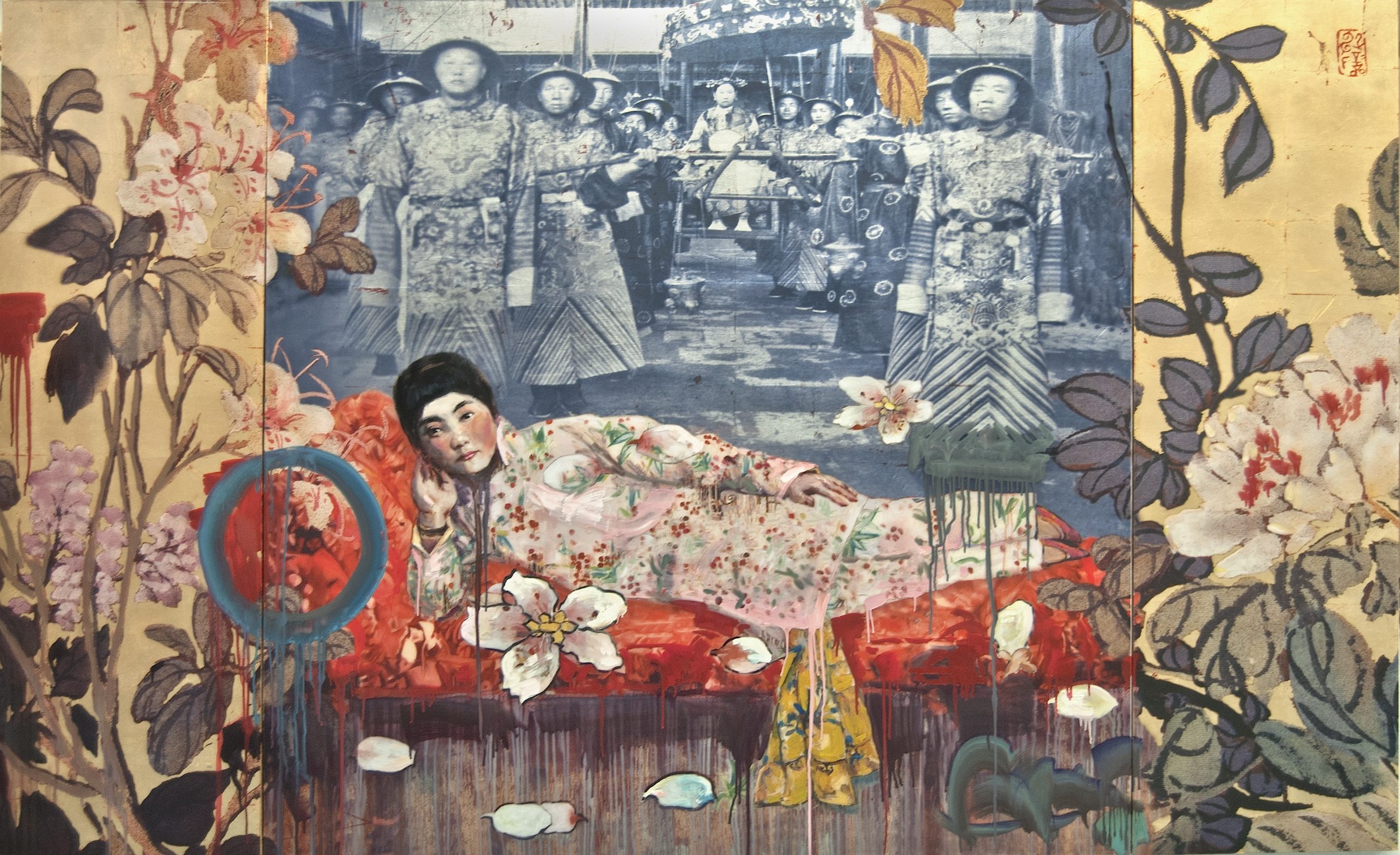
Barrett Watten, WSU: “East Asian/Asian American: Displacement and Innovation in Hung Liu’s Collective Portraits and Tao Lin’s Autofictions”

David Perry, NYU Shanghai: “Internal Migrations, Deep-Time Retreats, and Solastalgia: Anthropocenic Arrivals, Departures, and Exile in 21st Century Avant-Garde Mainland Chinese Poetry”

A.J. Carruthers, Nanjing U: “Avant-Garde Austalgia”

Session 2: Transition/hybridity
Friday June 17, 8:30–10:15 AM PDT/11:30 AM–1:15 PM EDT

Lauri Scheyer, Hunan Normal U: “Asian American/East Asian Identifications with African American Poetry”

Katie Bradshaw, U Tennessee: “The ‘Dragging Foot’ of José Garcia Villa’s Performative ‘Comma Poems’”

Carla Harryman, Eastern Michigan U: “Reciprocal Echoes of Citation and Photographic Document in Mary Kim Arnold’s Essay ‘Litany for the Long Moment’”

Edwin Torres, Poet New York: “The Inter-Lingo of Language-Seeing: between what is heard and what is held onto”

Session 3: Translational Avant-Gardes
Saturday June 18 / 8:30–10:15 AM PDT/11:30 AM–1:15 PM EDT

Lucas Klein, Arizona SU: “‘Rivers of When, Why, and What’: Translational Sinophone Poetry”

Spencer Lee-Lenfield, Yale U: “Diasporic Translation and Historical Emplacement: Emigrant Translators between Korean and English”

Katharine Streip, Concordia U: “J’écoutais les cygnes: Theresa Hak Kyung Cha’s Alchemical Dictation”

Hyunjung Kim, Texas A&M U: “Don Mee Choi’s Salivary Poetics: (Non)silent Translation of Kim Hyesoon’s Poetry”

… More

Sunday, May 15
> Buffalo

Kaplan Harris
Sarah Buckley

Getting on the road, I wrote on Facebook: “Turns out I am driving to Buffalo this very day. What sadness, so terrible. I am sure it is affecting everyone there.” After entering via the Peace Bridge, the first thing I saw was a block party in a Black neighborhood, conveying a somber tone of survival despite everything. Kaplan Harris and his partner Sarah greeted me with exceptional food and conversation, ranging from archives to prison abolition. Later, walking out in the Elmwood District, I wondered how it had been going in Buffalo since when. Everywhere is war, I hear the echoes of Bob Marley in my head as I walk by some loud partying. I exited next day through the fated neighborhood itself.

Monday, May 16
> Germantown/Brooklyn

Ann Lauterbach

Terrific storms accompanied my power drive through upstate New York, blasts of rain pelting in sheets creating maelstroms with each passing truck. Somewhere in the middle of the state, I stopped for gas to find an electrical glitch would not open the gas tank flap. There is no manual override. This event, dramatic perhaps only to myself, needed about an hour of phone calls to a long-distance service expert, after which I was able to re-set the circuit.  Coming down the Hudson and into Germantown, the rain accelerated to the point of zero visibility, in buckets of slushy hail. In from the storm, Ann Lauterbach greeted me from the porch of her restored schoolhouse down the road. Our elegant meeting, with an Italian white and hors d’oeuvre something like a mozzarelline fritte, but with a thicker, seasoned crust (help me out on this one, Ann), led to serious discussion of the crisis of the academy, seen from the perspectives of a liberal arts college and a working-class university. Of the many fine editions on display, I admired chapbooks of Eliot’s Little Gidding and Joyce’s Anna Livia Plurabelle (or was it Work in Progress—same thing). There was an altar to Ann’s friendship with Joe Brainard and portrait of her by Alex Katz. Back on the road, briefly clearing up, I had forgotten my umbrella. The Taconic Parkway beckoned to New York and the overpriced hotel, set between a dialysis center and U-Haul truck return, I had booked in Lower Park Slope.

… More

Friday, April 29
Delta DTW > SFO

> Half Moon Bay/Carmel Valley

Carla Harryman

Saturday, April 30

Memorial for Tim Hill
28 July 1948–18 December 2020

Christine Watten
Jan Watten
Steve Nakashima
Emilie Watten-Imboden
Barbara Johnstone
Michael Pappas
Daniel Strauss
Caroline Strauss
Andrew Johnstone … More

After the Louisville Conference, with COVID numbers in decline, Carla and I headed west for a week on the coast. The trip was not simply restorative but repurposing, reconnecting with friends and family in real time, face to face. And so we saw them, in each instance redefining both time and events that have come between. These friends and family, of long standing and more recent acquaintance, are prime numbers, so to speak, in a series that has many twists and turns. Life histories and practices of art coincide with them, for which they are primes. As we know, a coastline is a fractal, as in the thumbnail sketches below:

Monday, February 28
Delta DTW > SFO
> San Francisco/Stinson Beach

Megan Adams/Camille Roy

Our first stop after arrival at SFO was with New Narrative author Megan Adams/Camille Roy, celebrating her just published collection of stories Honey MineWe admired the art, light, rooms, and overgrown garden of her working-class mansion across from the thronged Daniel Webster School playground, where I first taught Poetry in the Schools. We then walked the streets of Potrero Hill, with its monuments to the history of Language writing still preserved at 235 Missouri Street, 326 Connecticut Street, and the public gym and soccer field at the top of the hill, where the competitive drives of young poets were at play. Just so, New Narrative and Language writing conjoin.

> Stinson Beach

… More

style=

The Louisville Conference
on Literature and Culture since 1900
24–26 February 2017
University of Louisville

Joseph Donahue
Adeena Karasick
Mark Scroggins
Alan Golding
Matthew Biberman
Lauri Scheyer
Judith Roof
Lynn Keller
Aldon Nielsen
Joseph Shafer
Joe Safdie
Jeff Davis
Lisa Shapiro
Norman Finkelstein
Alice Finkelstein
Joshua Corey
Robert Archambeau
Sally Connolly
David Kellogg
Tyrone Williams
Laura Vrana
Johnny Payne
V. Joshua Adams
Charles Altieri
Robert von Hallberg
Oren Izenberg
Rosanna Warren
Richard Strier
John Beer
Brenda Hillman
Kristi Maxwell
Brendan Johnston
W. Scott Howard
Addie Hopes
Peter O’Leary
Stephen Williams
Shannon Tharp
Alicia Wright
Justin Wymer
Leah Nieboer
Benjamin Lee
Karen Hadley
Ali Altaf Mian
Suzette Henke
Ann Hall


Notes and links

Photos: Matthew Biberman

[t/k]

Writing in the Event:
“The Beirut/Hell Remix
(After Etel Adnan)”

Last October I had the good fortune to preview Etel Adnan: Light’s New Measurethe Guggenheim Museum’s career retrospective of Adnan’s visual art, which makes significant reference to her writing. The cross-genre and multi-languaged aspects of her work could not be missed, an opening beyond the usual categories that art history and museum curating maintain. The museum was also making a political point in showing Adnan’s work along with a deep selection of the abstract painting of Vasily Kandinsky. The move from landscape to abstraction unites the two, but the differing contexts for abstraction are equally the point. Eurocentric modernism is in transition, refunctioned as a global cosmopolitanism, which arrives with the breakthrough moment of Adnan’s painting at dOCUMENTA 13 (2012) at what I have described as a “global archive.”

The occasion itself was compelling and bittersweet. Etel herself could not attend the opening but was represented by her partner, Simone Fattal—whose solo show at the Whitechapel Gallery in London was also on the global agenda. With Carla Harryman, we made plans to meet in Paris in November; we would have a French Thanksgiving, the day after the American one. Etel Adnan died on November 14, a Saturday. The news came through friends the next day. From all corners and all kinds of people the reaction was profound: the passing of a figure who had touched many, over many decades. We would still be coming to Paris as travel was arranged and plans had been made; the Omicron curtain had not yet come down. Everything was up in the air, suspended. Simone texted after we arrived; will you still be coming to dinner? Meetings with a remarkable woman on the rue Madame. We discussed everything and nothing as friends came and went. One resonant detail concerned Etel’s daily attention to events in Beirut, from economic collapse to the 2020 explosion. Not coincidentally, the Institut du Monde Arabe was exhibiting visual art referencing Beirut before and after the explosion under the title “Lumières du Liban,” in which Etel and Simone were both strongly present. We told Simone we would attend, and reported back after we did.

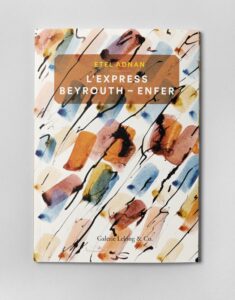
The museum bookstore stocks an impressive array of titles by Adnan, in many languages. I was immediately taken by Galerie Lelong’s 2021 publication of L’Express Beirut–Enfer, which brought together three texts, the first originally written in French and then later published in her English version. Meanwhile, plans that had been under way at the Guggenheim Museum were also up in the air, with the news of Etel’s passing, the onset of the Omicron surge, and the Guggenheim’s new partnership with the Academy of American Poets. In the end, I would agree to provide a written work, on commission, for the tribute to Etel, to be published online in conjunction with a virtual reading by poets who could perform in New York. Both events took place: the reading, while impeded by some gapping due to bandwidth issues, features an epochal performance by Anne Waldman along with tributes by Ammiel Alcalay, Omar Berrada, Stephen Motika, and Asiya Wadud, made available on Vimeo. And my text, “The Beirut–Hell Remix (After Etel Adnan),” along with an explanatory note that appears at the end of the poem, is published at the link below. One can only hope that, in future days, the many facets of this event for Etel Adnan will be seen together.

“The Beirut–Hell Remix (After Etel Adnan)” [link]
Original by Etel Adnan composed 1970; first published 1971
Adaptation/translation by Barrett Watten; completed January 2022
Online publication by The Guggenheim Museum, January 2022

Notes and links

[t/k]