Entries tagged with conferences

CALL FOR PAPERS

Avant-Garde @ Zero Hour:
Destruction and New Meaning

“Crisis”: 7th Biennial Conference of the European
Network 
for Avant-Garde and Modernist Studies

University of Leuven, Belgium
17–19 September 2020

My proposed session(s) stem from on-going work on literary and visual modernism at the “moment” of destruction in 1945: Stunde Null or Zero Hour. I focus on the epochal date of 1945 (Stunde Null or Zero Hour, in its divergent forms across the global territories) as both the end of World War II and an inaugural moment of transition to the global order we now live. For one or more sessions at EAM, I propose to recover and theorize the avant-garde to interpret the “zero hour” of 1945 and explore the historical moment of crisis of 1945—of European destruction, the end of colonial empires, the origins of our global order—as progenitor of new forms of avant-garde writing, visual art, and thinking. I want to access key examples, or a larger overview, of how avant-gardes in Europe, the Americas, and globally gained new impetus from several related projects: overturning the cultural violence of fascism; finding an ethical imperative in “bare life” in the forms of destruction; and resisting recuperation into already existing historical and artistic narratives. What was “new” in 1945 was not “new” in the sense of modernist innovation; rather, it was to see the world as it had never been, as a locus of destruction and creation with historical possibility but also with the undoing of progressive narratives. In this sense 1945 is no longer only an epochal date for the avant-garde per se but a defining moment of modernity, at which its aesthetic, ethical, and historical horizons coincide uniquely. Creation and destruction in modernity at 1945 can be comprehended through the work of a number of avant-garde writers and artists, particularly in their dialectic between “particulars,” unique and intractable values and forms, and “universals,” values and forms as applicable universally, across languages and cultures. Send proposals for interrogating the work of post-1945 avant-gardes, seen in relation to the form of historical crisis of 1945 and its challenge to progressive historicism, by Thursday, January 30, for submission by Saturday, February 1, to:

Barrett Watten, English, Wayne State University
b.watten@wayne.edu or barrett.watten@gmail.com

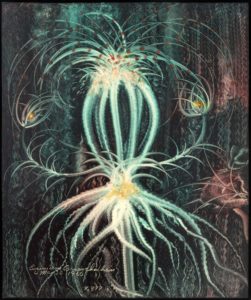
Image: Eugene Von Bruenchenhein, No. 877, May 30, 1960.
CALL FOR PAPERS

Refunctioning Poetics

The Louisville Conference
on Literature and Culture After 1900

University of Louisville, February 20–22, 2020
Organizer: Barrett Watten / contact by September 16

This is a call for one or two participants for a session on the “refunctioning” of literature (focusing on poetry and poetics in terms of “the making of the work” but including other genre possibilities). Recent texts suggesting such a “refunctioned” poetics include Lyn Hejinian’s Positions of the Sun; Kevin Killian’s amazon.com writings; Eugene Lim’s cyber-novels; and others proposed by panel participants. The concept of “Refunctioning” (Umfunktionierung) comes from Walter Benjamin, via Bertolt Brecht, in his keystone essay “The Author as Producer” (1934). How can new forms and genres of poetics be seen as “refunctioning” the aesthetic as political, given that Benjamin’s world has been “refunctioned” in the “new presentism” we live and suffer? Returning to Benjamin’s 1934 essay, in the context of the struggles against fascism but also in contestation with socialist realism, the panel asks, what does “refunctioning” authorship, and the literary and cultural work, mean in the present? Participants may approach this question by rethinking the status of the author; theorizing poetic making from a gendered perspective; seeing material production and digital reproduction as central for rethinking poetics as “the making of the work”; and reading new genres of experimental writing, after the Millennium, that incorporate its precarious presentism.

… More

CALL FOR PAPERS

Modernity @ Zero Hour: 
The Question of the Universal
and the Origins of the Global Order

American Comparative Literature Association
Chicago, March 19–22, 2020

This seminar will address the relationship between literary modernism (traditionally seen as having its end date at 1945, but expanded to include work in genres not usually associated with high modernism) with the Zero Hour of the end of World War II (seen as a crisis of modernity that decisively set in place processes of globalization). Seminar participants will read works of modernism, from American, European, and non-Eurocentric sources, that imagine and constitute while they challenge and critique “the universal” as an entailment of modernist forms (which are often seen as characterized by forms of parataxis and the foregrounding of particularity that suspend any notion of the universal). In the process of critiquing modernist particularity, we will also interrogate the vertical, idealist, and even authoritarian aspects of mid-century modernism and their entailments for the post-1945 order. High modernist authors could include Eliot, Woolf, Williams, Pound, Breton, Stein, Beckett, and so on in the Eurocentric tradition, but these figures may be placed next to lesser-known and nonliterary figures, movements, genres, and works. We would then try to connect the aesthetic “universalist” aspect of these authors and works with political claims for universal ethical and aesthetic values, in historical frameworks that range from the Nuremberg Trials, on the one hand, to the rise of abstraction as a universalist aesthetic, on the other. Finally, we will move from the Eurocentric constructions of universals to query their possibility in “alternative modernities,” represented at 1945 by Russia, China, and India as non-Western states and cultures, along with the decolonizing world, as anticipating non-Eurocentric frameworks for the emergent global order that must be taken into account in any notion of the “universal.” The seminar will expand the implications of modernism for global and transnational pedagogy; should interest students of modernist, transnational, and postcolonial literature; and will engage theoretical concerns of Critical Theory and the gendering of modernity whenever possible.

Submit proposals to ACLA by Monday, September 23
For the ACLA portal: click here
Contact b.watten@wayne.edu or barrett.watten@gmail.com

“Third Factory: Avant-Garde,
Social Construction, and Ideology in the Soviet 20s”

European Network for Avant-Garde and Modernist Studies (EAM)
Universität Münster, 5–7 September 2018

For this year’s EAM, centered the theme of “Realisms of the Avant-Garde and Modernism,” I propose to organize a panel or multi-session series of panels that would revisit the relation of the avant-garde to social construction. Such a project would necessarily be revisionist, in deepening but questioning the role of the avant-garde in the project of social construction, particularly after new archival materials and critical perspectives have become available. But it would also try to refocus interest on the Soviet 20s as scene of a coordinated Gesamtkunstwerk beyond individual artists, works, groupings, or genres that has continued relevance for a global, mediated, ideologically distorted world. … More

Event 83: I Heard (ASAP 9)

ASAP 9
The Arts of the Present

Oakland Marriott Hotel
University of California, Berkeley
26–29 October 2017

Ken D. Allan
Vincent Adiutori
Peter Hitchcock
Annie McClanahan
Regina Weinreich
Erik Mortenson
Tyler Coburn
Sara Blair
Richard Purcell
Daniel Reynolds
… More

Reception Study Society
Seventh Biannual Conference
St. Catherine University, St. Paul
21–23 September 2017

Celebrating Forty Years
of Feminist Reception

Sarah Hagelin
Daniel Morris
Jennifer Freeman Marshall
Burt Kimmelman
Paula Rabinowitz
J. Peter Moore
Susan Wegener
Stephen Paul Miller
Molli Spalter
Isaac Pickell
… More

Seminar: Questions of the Present
in Contemporary Poetics

@ MSA 19 Amsterdam
10–13 August 2017
to register click here

desk 170517

Since 2011, there has been an explosion of new writing in poetics as an academic discourse and a proliferation of new approaches to poetry that unite formal concerns (after Language writing, conceptualism, Flarf, and other avant-gardes) with radical accounts of the millennial present—in a manner reflecting on, but departing from, modernism. This seminar will perform several tasks: first, to survey recent writing in poetics that “question the present,” involving concerns of political economy, ideology and public discourse, documentary and digital sources, gender and sexuality, race and poets of color, hybrid forms, and multi-languaged writing/translation. Then, it will undertake an overview of new forms of writing that engage these questions of the present. Finally, it will ask how poetry and poetics can create new critical and creative, activist and interventionist, initiatives, to counter deformed public discourse(s) of our presentist epoch. What does it mean to question poetics and poetry as a historicism of the present?

Seminar organizer: Barrett Watten
Professor, English, Wayne State University
Contact: barrett.watten@gmail.com
Registration: MSA 19 website here

The Louisville Conference
on Literature and Culture since 1900
23–25 February 2017
University of Louisville

Alan Golding
George Hart
Jennifer Bartlett
Aldon Lynn Nielsen
Diana Rosenberger
Kelly Roy Polasek
Jill Darling
Erik Mortenson
cris cheek
Lisa Hollenbach
Jack Halberstam
Juliana Spahr
James Smethurst
Magdalena Zurawski
Norman Finkelstein
Tyrone Williams
… More

“Other Logics of Writing”
Arkadii Trofimovich Dragomoshchenko at 70
Second International Conference ATD: Variations
24–25 November 2016
Saint Petersburg State University
Brobinsky Palace, Saint Petersburg

Premiya Arkadiya Dragomoshchenko
25–27 November 2016
Novaya Tsena Aleksandrinskovo Teatra
Saint Petersburg, Russia

Zina Dragomoshchenko
Evgeny Pavlov
Elena Dolgikh
Aleksandr Skidan
Selena Valyavkino
Nina Savchenkova
Anna Glazova
Aleksandr Ulanov
… More

Event 63: I Met (Tartu)

Association for the Study
of the Arts of the Present (ASAP)
University of Tartu, Estonia
2–6 September 2016

Johannes Göransson
Carla Harryman
Myka Tucker-Abramson
Joel Tyler Nickels
Joseph Jeon
Jonathan Eburne
Brian McHale
Jaak Tomberg
Märten Rattasepp
Agnes Neier
… More