ENG 5530: Language Writing and Beyond
Wayne State University, Fall 2025

Breaking with custom, I am uploading the syllabus (minus boilerplate and policy) for my “Topics in Poetry” this fall. The reasons are several. Since coming to Wayne State, unlike other major hires of Language writers in the early 90s, I was brought in to teach literature and cultural studies, with my poetry and poetics career a plus but not well understood. Over twenty-five and more years, I crafted a pedagogy designed to bring literature and cultural studies together, and the dissertations I advised reflect that synthesis—while there are several that address modernist and later poetries at a high level of discussion. However, I have never taught a course devoted to my work or literary movement in poetry and poetics per se, and now is the time—again for more than one reason. One, I want this poetry, history, and theory to be as pedagogically known and significant as any other “approach,” at any level of instruction from GenEd (to students in other fields) through the Major and the graduate program—my teaching at three levels as has usually been the case. Then, it is time for an overview of Language writing that takes into account not only its emergence but the controversies and reception issues it produced, followed by its academic reception and gradual departure from the academy, and finally with the evidence of the strong new work that has appeared, from every major figure, since the Millennium. Lyn Hejinian’s death in 2024 is also a turning point: while her work was always written prospectively and toward its continuing, we may now compare her lifelong project—Beginnings, Middles, and Ends at once—to other authors who may be read in that way: Stein, Zukofsky, Riding, Creeley, Hughes, Baraka and so on. Retrospection is one aspect of that reading, but also a careful attention to the values of time, memory, historicity and everyday life in her project. Given many aspects of her uniqueness, constructing comparative frameworks must now also be undertaken across the board: with the original figures, the controversial history, the emergence of new schools and writers where there is variously a connection to an overarching focus on Language as site of meaning making.
Herewith the provisional syllabus, as always a working document that may be cut back or amended as the course unfolds, with many authors and issues overly condensed or regrettably left out. Sixteen sessions, or eighteen, would do more justice, but fourteen 2½-hour classes is what we are given. So forth:
Course description
This course is a unique opportunity to encounter, question, and comprehend one of the significant literary movements of the past fifty years: Language writing (a.k.a. Language poetry or language-centered writing, often associated with the journal L=A=N=G=U=A=G=E). Originating in San Francisco and New York in the 1970s, Language writing overturned conventional assumptions about poetry, rethinking the politics of poetry from the perspective of the materials of language. Key figures of the movement, including your instructor, continue to be highly productive in the decades after 2000; we will chart the movement in its origins, development, and influence or reaction as it continues. We will not ignore the many controversies around Language writing, nor its claims to a politics, nor its development of a poetics. We will position the movement in relation to the many literary and artistic movements that influenced it, and in relation to the “turn to language” in linguistics and philosophy. We will focus on Language writing in terms of individual authors; collective practices; its wider reception; and its influence on later writers and new genres such as flarf, conceptual writing, ecopoetics, and digital writing.
Class Agenda
UNIT I: WHAT IS LANGUAGE WRITING?
Week 1 (August 25): Beginnings and ends
Introduction to Language writing; Kim, “Language Poetry,” parts 1–3 (here)
Historical avant-gardes (dada) vs. Language writing; David Melnick, from Pcoet (pdf)
Sampling Hejinian: Writing Is an Aid to Memory, The Beginner, A Border Comedy, Fall Creek (pdfs)
Language writing’s journals: from A Secret Location on the Lower East Side (online)
Online archives: PennSound, Jacket2, Eclipse, Silliman’s Blog (Wayback machine), ubuweb, barrettwatten.netWeek 2 (September 8): Middles
Lyn Hejinian, My Life and My Life in the Nineties
Hejinian, “The Rejection of Closure” (Poetics Journal); “What’s Missing from My Life” (Grand Piano)
Walter Benjamin, “The Author as Producer” and Hejinian, Positions of the Sun
Article: George Lakoff, “Continuous Reframing” (Poetics Journal)UNIT II: ON THE WAY TO LANGUAGE
Week 3 (September 15): Modernism
Modernists: William Carlos Williams, Spring and All
Gertrude Stein, from Geography and Plays; Louis Zukofsky, from “A”
Language writers: Clark Coolidge; Michael Palmer; Kim, “Language Poetry” part 4.1
Theory: Ferdinand de Saussure; Viktor Shklovsky
Articles: Vladimir Feshchenko, from Russian and American Poetry of Experiment; Alan Golding, “What About All This Writing?”Week 4 (September 22): New American poets
New Americans: Robert Creeley, Pieces (pdf) and from Contexts for Poetry
Charles Olson, poems; from “Projective Verse”; Robert Duncan, poems; from The Truth and Life of Myth
Theory: Martin Heidegger; Ludwig Wittgenstein
Language writers: Robert Grenier, Sentences (online); Ron Silliman, from The Age of Huts; Kim, “Language Poetry” part 4.2
Articles: Barrett Watten, “The Turn to Language and the 1960s”; Lilian Chaitas, from Being Different: American Poetic Avant-GardesWeek 5 (September 29): New York School and proto-Language poets
New York School: John Ashbery, from The Tennis Court Oath and The Double Dream of Spring
Proto-Language poets: Ted Berrigan, The Sonnets; Jackson Mac Low, The Pronouns
Language writers: Charles Bernstein (Controlling Interests); Bruce Andrews (Love Songs)
Theory: Roland Barthes; Jacques Derrida
Articles: Barrett Watten, “Poetic Vocabularies”; Lytle Shaw, on Frank O’Hara; Libbie Rifkin, on Ted BerriganUNIT III: LANGUAGE COLLECTIVITIES
Week 6 (October 6): San Francisco
Barrett Watten, ed., This; Lyn Hejinian, ed., Tuumba Press; Rae Armantrout et al., The Grand Piano
Reading series and art spaces: The Grand Piano; 80 Langton Street; Kim, “Language Poetry,” part 3
Performance: Steve Benson, “Close Reading: Leavings and Cleavings” (Poetics Journal)
Language writers: Bob Perelman; Kit Robinson
Article: Ben Friedlander, “A Short History of Language Poetry”Week 7 (October 20): New York/Toronto/Washington, DC
Bruce Andrews and Charles Bernstein, eds., articles from L=A=N=G=U=A=G=E (pdfs)
Andrews, Bernstein, Ray DiPalma, Steve McCaffery, and Ron Silliman, from Legend (pdfs)
Language writers: Peter Seaton (Poetics Journal); Diane Ward
Articles: Barrett Watten, “The Secret History of the Equal Sign”; Peter Middleton, “L=A=N=G=U=A=G=E and Its Authors”; Golding, “Bruce Andrews, Writing, and ‘Poetry'”Week 8 (October 27): Gender, performance, identity
Language/feminism: Beverly Dahlen, “Forbidden Knowledge” (Poetics Journal); Susan Howe, “My Emily Dickinson” (Poetics Journal)
Language/performance: Carla Harryman, from Animal Instincts
Poets Theater: Harryman, Third Man; “Two Versions of Collateral [Kit Robinson]” (Poetics Journal)
Publications: How(ever) (online); Sophie Seita, from Provisional Avant-Gardes
Articles: Rachel Blau DuPlessis, from The Pink Guitar; Harryman, “Rules and Restraints in Women’s Experimental Writing”UNIT IV: RECEPTION/CONTROVERSY
Week 9 (November 3): The Poetry Wars
Polemics: Poetry Flash, Georgia Review, Partisan Review, Lingua Franca, and elsewhere
Literary history: Chaitas, from Being Different; Kim, part 6; posts on barrettwatten.net
David Melnick, from Men in Aida; Robert Glück, My Walk with Bob
Articles: Chaitas, from “Being Different”; Kaplan Harris, “New Narrative and Language Writing”; Kim, part 6Week 10 (November 10): Academia (Left and Right)
Literary reception: Marjorie Perloff, Charles Altieri, Jerome McGann
Marxist reception: George Hartley, Andrew Ross, Sianne Ngai
Feminist reception: Ann Vickery, Rachel Blau DuPlessis, Laura Hinton
Fredric Jameson, “Postmodernism; or, the Cultural Logic of Late Capitalism”; Hartley, “Jameson’s Perelman” (Poetics Journal)
Barrett Watten, “Language Writing and Late Capitalism”; Christopher Nealon, from The Matter of Capital; Kim, part 5Week 11 (November 17): Language/Poets of color
African American Language writers: Harryette Mullen (Poetics Journal); Julie Ezelle Patton; Tracy Morris; Giovanni Singleton; Douglas Kearney; Tyrone Williams
Asian/Latinx Language writers: Rodrigo Toscano (Poetics Journal); Edwin Torres; Sawako Nakayusa; Prageeta Sharma; Bhanu Khapil; Mia You
Articles: Nathaniel Mackey, “Other: From Noun to Verb”; Fred Moten, from Black and Blur; Kim, part 7
Polemics: Cathy Park Hong, “Whiteness of the Avant-Garde”; Boston Review forumUNIT V: LANGUAGE WORLDS
Week 12 (November 24): Language, disability, environment
Language/disability: Larry Eigner; Hannah Wiener; Joseph Grigely; Michael Davidson
Ecopoetics: Linda Russo, Brenda Iijima, Evelyn Reilly, Jonathan Skinner, Tony Lopez, Adam Dickinson
Articles: Davidson, “Missing Larry”; Jonathan Skinner, “What Sounds”; Lynn Keller, from Recomposing EcopoeticsWeek 13 (December 1): Flarf and Conceptual Writing
Recent anthologies: Kenneth Goldsmith and Craig Dworkin, eds., Against Expression; Drew Gardner et al., eds., Flarf: An Anthology
Conceptual writers: Goldsmith; Dworkin; Rob Fitterman; Monica de la Torre
Flarf: K. Silem Mohammad; Nada Gordon; Drew Gardner; Joey Yearous-Algozin
Articles: Barrett Watten, “Presentism and Periodization”; Brian Reed, on conceptual language; Golding, “Digital Poetics”Week 14 (December 8): Global/Digital Politics
Alan Davies, Name; Jackson Mac Low, The Stein Poems: Barrett Watten, “The Annotated Plan B”; Nada Gordon, AI art and writing
Large Language Models/AI vs. Language writing
Global dispersion and translation
Note on Books
For the class, most of the material will be pdf’s; I am only ordering four titles, and recommending others. Much major early work is out of print and is in need of new editions; the facsimile editions on eclipse are a major resource, as is the substantial online commentary. Overstock from This Press, returned after the collapse of Small Press Distribution, will benefit the students. I am referencing a number of works in poetics, also the history of the “expanding field,” in my and Lyn Hejinian’s co-edited Guide to Poetics Journal, backed up by dozens of articles in Poetics Journal Digital Archive. DIY continues to be a principle of Language writing’s production and distribution. For print editions, this is what I have suggested so far, plus a wide range of anthologies:
PRIMARY TEXTS (***REQUIRED)
Davies, Alan. Name. This Press, 1986. [Publisher]
Harryman, Carla. Animal Instincts: Prose Plays Essays. This Press, 1989. ISBN 978-0935074161. [Publisher]
*** Hejinian, Lyn. My Life and My Life in the Nineties. Wesleyan UP. ISBN 978-0819573513. E-book
Robinson, Kit. The Messianic Trees. Adventures in Poetry, 2009. ISBN 978-0976161264. No e-book
*** Silliman, Ron. The Age of Huts (compleat). UC Press, 2007. ISBN 978-0520250161. No e-book
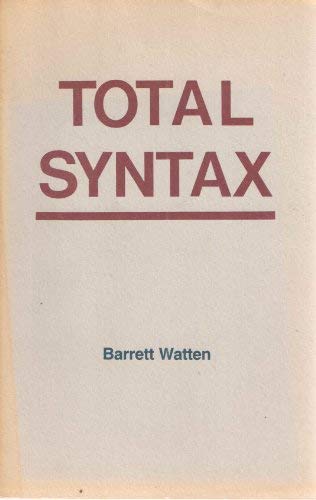
Watten, Barrett. Bad History. Atelos, 1998. ISBN 978-1891190025. No e-book
———. Zone: correlations (1973 2021). Chax Press, forthcoming 2025. ISBN t/k
*** Williams, William Carlos. Spring and All. Facsimile ed. New Directions,ANTHOLOGIES AND JOURNALS (ACCESS T/K)
Andrews, Bruce, and Charles Bernstein, eds. L=A=N=G=U=A=G=E, ed. Bruce Andrews and Charles Bernstein. 1978–80. Available at Eclipse
———. L=A=N=G=U=A=G=E, facsimile ed. University of New Mexico Press, 2000
Andrews, Bruce, Charles Bernstein, Ray DiPalma, Steve McCaffery, and Ron Silliman. Legend, facsimile ed. 1980; U New Mexico P, 2000. Available at Eclipse
Armantrout, Rae, Steve Benson, Carla Harryman, Lyn Hejinian, Tom Mandel, Ted Pearson, Bob Perelman, Kit Robinson, Ron Silliman, and Barrett Watten. The Grand Piano: An Experiment in Collective Autobiography, San Francisco, 1975–1980. This/Mode A, 2006–2010. [Publisher]
Bartlett, Jennifer, Sheila Black, and Michael Northen. Beauty Is a Verb: The New Poetry of Disability. Cinco Puntos Press, 2011.
Bellamy, Dodie, and Kevin Killian. Writers Who Love Too Much: New Narrative, 1977–1997. Nightboat, 2017.
Dworkin, Craig, and Kenneth Goldsmith. Against Expression: An Anthology of Conceptual Writing. Northwestern UP, 2011. TOC and introduction available at Ubuweb.
Gardner, Drew, Nada Gordon, Sharon Mesmer, K. Silem Mohammad, and Gary Sullivan. Flarf: An Anthology. Aerial/Edge, 2017.
Halpern, Rob, and Robin Tremblay-McGaw. From Our Hearts to Yours: New Narrative as Contemporary Practice. On Contemporary Practice, 2017.
*** Hejinian, Lyn, and Barrett Watten. A Guide to Poetics Journal: Writing in the Expanded Field, 1982–1998. Wesleyan UP, 2013. ISBN 978-0819571212. E-book
———. Poetics Journal Digital Archive. Wesleyan UP, 2015.
Killian, Kevin, and David Brazil. The Kenning Anthology of Poets Theater. Kenning Editions, 2010.
Messerli, Douglas, ed. “Language” Poetries. New Directions, 1986. OP
Nielsen, Aldon Lynn, and Lauri Ramey (Scheyer). What I Say: Innovative Poetry by Black Writers in America. U Alabama P, 2015.
Silliman, Ron, ed. In the American Tree, ed. Ron Silliman. National Poetry Foundation, 1986/2001. OP
Watten, Barrett, ed. This. 1971–1982. OP [Publisher]
Links
Entry 67: “Language Notes” here
Document 107: “Archive Seminars” here