>> Events <<


CALL FOR PAPERS

Diasporic Avant-Gardes Noir:
Blackness, Innovation, Futurity

American Comparative Literature Association
Chicago, 16–19 March 2023

To submit a proposal, click here
(deadline: October 31)

“Diasporic Avant-Gardes,” held at UC Irvine in 2004, brought together poets and critics of the African diaspora and Euro-American avant-gardes, published in 2009 as Diasporic Avant-Gardes: Experimental Poetics and Cultural Displacement (ed. Barrett Watten and Carrie Noland). Nathaniel Mackey, Fred Moten, Tracie Morris, Brent Hayes Edwards, Mark McMorris, and Kamau Brathwaite presented creative work; critical work included writing on Aimé Césaire, Brathwaite, Linton Kwesi Johnson, Franco Luambo Makiadi, and Harryette Mullen, and other avant-garde formations. Eighteen years since has seen an explosive emergence of innovative African American/Black diasporic avant-garde writing: Will Alexander, Tisa Bryant, Renee Gladman, giovanni singleton, Duriel E. Harris, Harmony Holiday, Douglas Kearney, John Keene, McMorris, Jonah Mixon-Webster, Julie Ezelle Patton, Tyrone Williams, and others in the 2015 anthology What I Say: Innovative Poetry by Black Writers in America (ed. Aldon Lynn Nielsen and Lauri Ramey), building on the 2006 Every Goodbye Ain’t Gone: An Anthology of Innovative Poetry by African Americans (ed. Nielsen and Ramey). The same period witnessed the emergence of avant-garde studies, in a global, transnational, and diasporic turn that radically expands the Euro-American avant-garde. In his important essay “Otherness: From Noun to Verb,” Nathaniel Mackey theorized Black improvisational or “free” musical forms in relation to “outness,” writing/imagining/playing “outside the box” that comprehends social outsiderness. Fred Moten has described Black creative practice as “in the break” of normative narrative or poetic forms, preserving rupture and discontinuity. More recently Duriel E. Harris calls for poets and performers to explore Black aesthetic practices that at-tend to active aural witnessing across concepts of time, environment, space, ability, embodiment, genre, and historical markers. How do these conceptions of African American/Black diasporic aesthetics chart new paths for avant-garde studies, in its present global moment? This seminar seeks papers at the intersection of radically innovative work by African American/diasporic Black writers, visual artists, or musicians, of multiple global regions or historical periods, that reference, critique, qualify, modify, add to, and/or contest the Euro-American history and theory of the avant-garde. Topics may include individual authors, artists (Jean-Michel Basquiat, David Hammons, Kara Walker), musicians (Albert Ayler, Anthony Braxton, Cecil Taylor), present or past; literary or artistic movements or groupings (Negritude, Black Arts, or Umbra but later AACM or Black Took); new modes of oral and musical performance and written and visual forms; and historical or theoretical connections between African American/Black diasporic artists and “what it means to be avant-garde.”

… More

“Modernist Poetics: New Genealogies
of ‘Making the Work’ in Modernity”

Seminar for “Making Modernism”
Modernist Studies Association
Portland, Ore., 27–30 October 2022

NOTE EXTENDED DATE FOR SEMINAR REGISTRATION
AUGUST 31: REGISTRATION HERE

Seminar led by Barrett Watten, Wayne State University
and Herman Rapaport, Wake Forest University
with invited guest Lyn Hejinian, UC Berkeley

Seminar prospectus (to enroll see below)

This seminar takes up the conference rubric, Making Modernism, as a question of “poetics”—a discourse of “making the work.” Poetics may either immanent to a modernist work of art or a supplement to it; it is an aesthetic or theoretical reflection that offers a blueprint for how the “work” is made and how to read it. Poetics may take the form of a separate instance of writing, a preface or explanatory essay external to the work of art, or it may be described or enacted in the work itself, as a set of instructions to the reader on how work may be read. In this seminar, we will seek new ways of understanding modernist poetics, at or beyond the epochal date of 1922, as a response to the crisis of modernity. Modernist poetics is often characterized as “formalist,” after avant-garde manifestos, the New Critics, or the Russian Formalists. For this inquiry, Eliot’s “Notes” to The Waste Land and his editorship of The Criterion would be as important for modernist poetics as the poem itself. Extending this principle, Joyce’s turn to writing “Work in Progress” and its serial publication in transition from 1927 on would depart from the modernist masterpiece into another kind of writing; Stein’s “Composition as Explanation” (1926) would supplement the publication of Geography and Plays (1922); and McKay’s development of vernacular prose romances from Home to Harlem (1928) to Banana Bottom (1933) would augment the formal poetics of Harlem Shadows. After 1922, a reflection on the “making of the work” emerges in numerous works of poetics that address the modern present and its “condition of possibility.” Such a deliberate inquiry into the making of the modernist work motivates the prose/poetry dialectic of William Carlos Williams’s Spring and All (1923); it is found in the self-reflexive explorations of women authors such as Mina Loy, Marianne Moore, Laura Riding, and Djuna Barnes; it extends to the social discourses on poetics in the Harlem Renaissance and the Popular Front; it is everywhere in the manifestos of the avant-garde, especially surrealism; it appears in the turn to fascism in Ezra Pound and Wyndham Lewis; it is central to key works of Critical Theory such as Walter Benjamin’s “The Author as Producer” and Theodor Adorno’s many writings on modernism. This seminar invites literary, historical, cultural, and theoretical inquiry into works broadly seen as “poetics” in modernism. What will count as a key work in modernist/modern poetics is the task of participants to determine; our aim is to establish a broad and productive series of works that represent the aesthetic, cultural, political, and critical “making of the work” under conditions of modernity. In so doing, it seeks a broad discussion on modernist poetics in line with our earlier work on contemporary examples in A Guide to Poetics Journal and Poetics Journal Digital Archive (Wesleyan UP).

… More

Diasporic Avant-Gardes:
East Asian Transitions in Form and Genre

ACLA Virtual Conference, 15–18 June 2022
GUESTS WELCOME WITH REGISTRATION/SEE BELOW
NOTE REVISED SEMINAR SCHEDULE

Organized by Barrett Watten, Wayne State University
and Lauri Scheyer, Hunan Normal University 

Seminar program

Session 1: Diasporic Regions
Thursday June 16, 8:30–10:15 AM PDT/11:30 AM–1:15 PM EDT

Introduction: Diasporic Avant-Gardes

Barrett Watten, WSU: “East Asian/Asian American: Displacement and Innovation in Hung Liu’s Collective Portraits and Tao Lin’s Autofictions”

David Perry, NYU Shanghai: “Internal Migrations, Deep-Time Retreats, and Solastalgia: Anthropocenic Arrivals, Departures, and Exile in 21st Century Avant-Garde Mainland Chinese Poetry”

A.J. Carruthers, Nanjing U: “Avant-Garde Austalgia”

Session 2: Transition/hybridity
Friday June 17, 8:30–10:15 AM PDT/11:30 AM–1:15 PM EDT

Lauri Scheyer, Hunan Normal U: “Asian American/East Asian Identifications with African American Poetry”

Katie Bradshaw, U Tennessee: “The ‘Dragging Foot’ of José Garcia Villa’s Performative ‘Comma Poems’”

Carla Harryman, Eastern Michigan U: “Reciprocal Echoes of Citation and Photographic Document in Mary Kim Arnold’s Essay ‘Litany for the Long Moment’”

Edwin Torres, Poet New York: “The Inter-Lingo of Language-Seeing: between what is heard and what is held onto”

Session 3: Translational Avant-Gardes
Saturday June 18 / 8:30–10:15 AM PDT/11:30 AM–1:15 PM EDT

Lucas Klein, Arizona SU: “‘Rivers of When, Why, and What’: Translational Sinophone Poetry”

Spencer Lee-Lenfield, Yale U: “Diasporic Translation and Historical Emplacement: Emigrant Translators between Korean and English”

Katharine Streip, Concordia U: “J’écoutais les cygnes: Theresa Hak Kyung Cha’s Alchemical Dictation”

Hyunjung Kim, Texas A&M U: “Don Mee Choi’s Salivary Poetics: (Non)silent Translation of Kim Hyesoon’s Poetry”

… More

CFP FOR PROPOSED SESSION(S)
“Global Parataxis and the Avant-Garde:
Rethinking Histories on a Planetary Scale”

“Globalizing the Avant-Garde”
European Network for Avant-Garde and Modernist Studies (EAM)
Instituto de História da Arte, IHA/FCSH–Universidade NOVA de Lisboa
Lisbon, Portugal, 1–3 September 2022

The conference proposal for EAM’s eighth biannual conference, reconvening in Lisbon after a two-year hiatus in 2020, clearly calls for a critical reassessment of the Eurocentric history of the avant-garde, given the multiple writers, artists, styles, and movements that bear similarities and links to the historical avant-gardes as they develop culturally but also regionally specific projects that challenge the given accounts of what is “avant-garde.” Otherwise put, if global avant-gardes overall conduct a “systemic detotalization” of the global system through radical formal means, what does that mean if the “global” is open, not yet determined, always in process, even violently contested across multiple regions. An open horizon of the avant-garde may indeed be the project of global exhibitions such as Documenta, the Venice and São Paolo Biennales, and others, often involving conceptual, site-specific, performative strategies but also new forms of positive representation. The recent handbook Global Art by Jessica Lack (2020) summarizes a compelling range of multiple movements and styles, from anti-Imperialist and revolutionary movements to movements founded at moments of independence, as acts of resistance, as interrogations of identity and collectivity, and as overtly political artistic practices. In literature, the shift of comparative literature away from Eurocentric literariness and toward a more complex account of multiple languages, diasporic histories, and possibilities of translation create opportunities for rethinking the avant-garde as always addressing cultural displacement as much as metropolitan location; here the convulsive growth of global cities comes into view in work from East Asia, South Asia, the Middle East, and Africa in particular. This Call for Papers seeks to establish a multiple, decentered, global or planetary frame for the avant-garde(s), in the present, recent past, or longer history. Presentations on specific writers, artists, styles, or movements as sites of inquiry; or rethinking of what terms such as “global,” “planetary,” or “world” mean for the avant-garde in an era of pandemics and climate change, as well as political antagonism and the aporias of global capitalism will be most welcome. At the intersection of radical particularity and detotalized globality may arise new approaches that augment and depart from the historical avant-gardes.

The conference proposal deadline is Saturday, January 15. Please submit an abstract and bio for consideration by Friday, January 14 to Barrett Watten, barrett.watten@gmail.com.

Links and Notes

For PDF flyer, click here; for EAM conference site, click here.

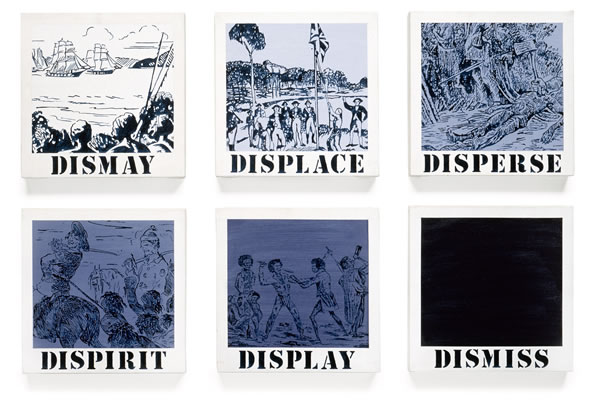
Image: Gordon Bennett, untitled, 1989; from Global Conceptualism: Points of Origin, 1950s–1980s, Queens Museum, 1999.

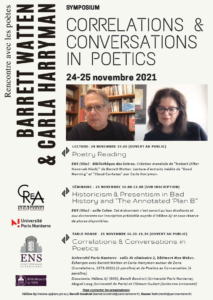
Barrett Watten & Carla Harryman
Correlations & Conversations in Poetics
24–25 November 2021

[NOTE CORRECTED SEMINAR START TIME!]

  • Poetry Reading / 24 November 19:00 / open to the public / notice of attendance requested / contact Hélène Aji (below)
    Ecole normal supérieure (rue d’Ulm) / Bibliothèque des letters

World premiere of “Notzeit (After Hannah Höch)” / Barrett Watten
Reading from “Good Morning” and “Cloud Cantatas” / Carla Harryman

  • Seminar / 25 November 9:00–10:00 / by registration
    [NOTE CORRECTED SEMINAR START TIME!]
    ENS (rue d’Ulm) / salle Celan / open to students and doctoral students on prior registration / contact  Hélène Aji (below)

“Historicism and Presentism in Bad History and ‘The Annotated Plan B'”

  • Roundtable / 25 November 16:30–18:30 / open to the public / notice of attendance recommended / contact Hélène Aji (below)
    Université Paris Nanterre / salle de séminaire / 2 Max Weber

“Correlations & Conversations in Poetics”

Exchanges with Barrett Watten on Zone (Correlations, 1973–2021) and Carla Harryman on Poetics of Conversation
Discussants: Hélène Aji (ENS); Benoît Bondroit (U Paris Nanterre); Abigail Lang (U Paris); and Clément Oudart (Sorbonne U)

Policies, media, and contact

Due to COVID precautions in Paris institutions, attendance at events at ENS is limited to 30 (reading) and 35 (seminar). Please contact Hélène Aji to place yourself on the list for the reading or to register for the seminar (students and graduate students). Attendance for the roundtable at Paris Nanterre is limited 25; contact Hélène Aji to guarantee your place.

Present plans are to make high-quality videos of the reading and roundtable, to be edited and uploaded in the near future; interviews with Barrett and Carla will be made by the ENS library and uploaded to YouTube.

Hélène Aji helene.aji@ens.psi.eu
Benoît Bondroit benoit.bondroit@parisnanterre.fr
Naomi Toth ntoth.parisnanterre.fr
Barrett Watten barrett.watten@gmail.com

CALL FOR PAPERS

Diasporic Avant-Gardes:
East Asian Transitions in Form and Genre

American Comparative Literature Association
National Taiwan Normal University, Taipei
15–18 June 2022

Barrett Watten, English, Wayne State University
Lauri Scheyer, British and American Poetry
Research Center, Hunan Normal University 

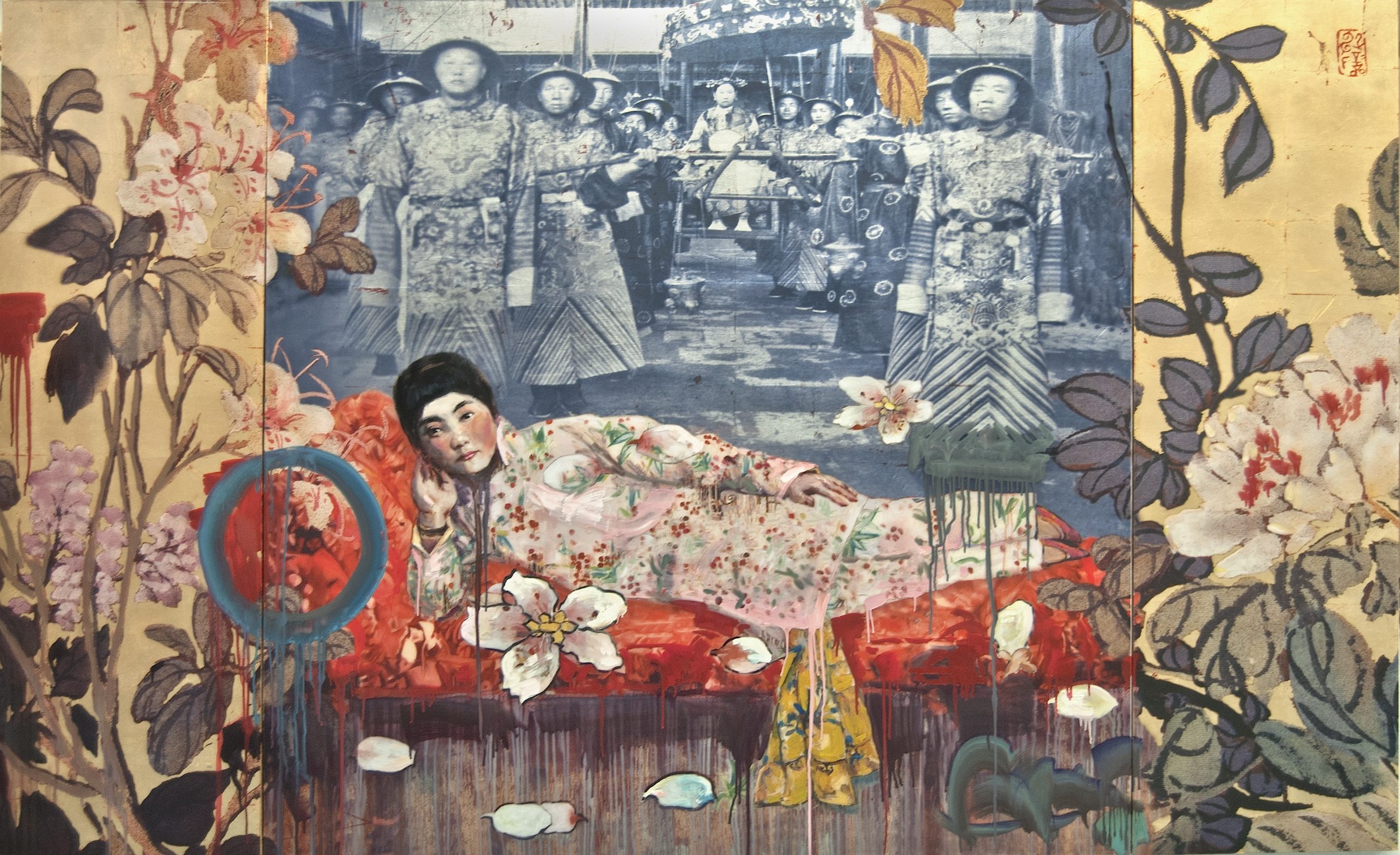
This seminar continues the work of Diasporic Avant-Gardes: Experimental Poetics and Cultural Displacement (ed. Barrett Watten and Carrie Noland; Palgrave, 2009)—a collection of essays addressing the intersection of diasporic literatures and the European avant-garde, with examples from African, Maghrebi, Jewish, and Hispanic diasporas. A decade later, much new work has appeared on innovative forms and genres of poetry, prose, visual art, and media reflecting the diasporic experience of East Asians over two centuries of global migration. On the one hand, the emergence of self-described avant-garde movements that engage and depart from the Euro-American model, particularly in Japan and China but at differing moments in the 50s/60s and 80s/present, has been recognized in major exhibitions. Global figures such as Yoko Ono, Yayoi Kusama, Ai Wei-wei, Cai Guo-qiang, and Huang Yongping critically address issues of material form, cultural translation, commodification, economic dispossession, and global migration. The work of experimental East Asian poets such as Kim Hyesoon, Ito Hiromi, and Hsia Yu opens the way toward a developing canon of women authors in translation and has led to critical reflection on translation itself. Asian American poets with differing histories of emigration have developed a range of innovative forms, from authors such as John Yau, Mei-mei Berssenbrugge, Pamela Lu, and Tan Lin to Don Mee Choi, Sawako Nakayusa, Mary-Kim Arnold, and Ocean Vuong. New prose genres have appeared after the examples of Maxine Hong Kingston and Yoko Tawada in innovative fictions by Tao Lin, Eugene Lim, and Karen An-hwei Lee. The reception of Asian American visual artists from Nam June Paik, Theresa Hak Kyung Cha, and Tehching Hsieh to the current exhibition of Hung Liu points toward the global transition of strictly Eurocentric theories of the avant-garde. This seminar seeks papers that explore individual artists and movements; reflects on their innovations of form and genre; and theorizes experiences of cultural distinctiveness in terms of migration, displacement, cultural heritage, appropriation, linguistic and stylistic hybridity, radical iconoclasm, and syncretic identity—seen in a productive dialogue with or a decisive reconceptualization of Euro-American avant-garde movements.

Submit proposals to ACLA by Sunday, October 31 here
For PDF flyer, click here; for online seminar page, here
Contact barrett.watten@gmail.com for more information

N.B. “In view of the ongoing pandemic, the 2022 conference may need to be moved online again. The board has developed a contingency plan and will make a final decision in January 2022″—ACLA.

Notes

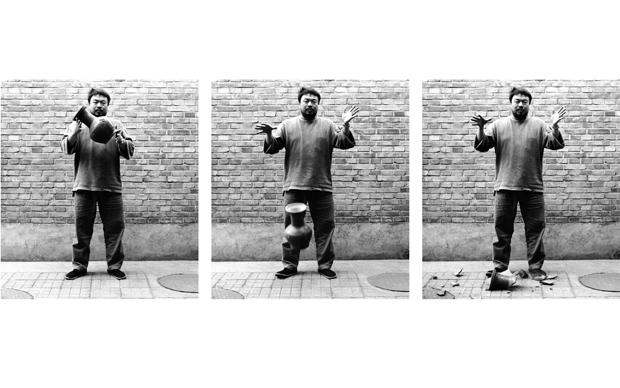
Ai Wei-wei, Dropping a Han Dynasty Urn, 1995

Document 93: Global Ideation

The global circulation of ideas advances with the publication of the Journal of Foreign Languages and Cultures, vol. 5, no. 1, edited by Laurie Scheyer from Hunan Normal University. As with last year’s special forum on “Modernity @ Zero Hour,” this issue contains a set of papers—distributed through a capacious issue with numerous related themes—that developed in an online webinar, “Avant-Gardes @ Zero Hour,” which took place during conditions of COVID in March 2021. The webinar itself, thanks to Zoom, was itself global and involved participants from seven time zones, from New Zealand to Moscow. It also could include a performance event, the in-time screening of Carla Harryman’s “Occupying Theodor W. Adorno’s Music and New Music: A Re-Performance,” originally proposed for the canceled EAM conference in Fall 2020. In this best of all possible worlds, our proposed event went forward; papers were presented, comments generated, drafts revised, and the results are now distributed to the world at large. Below I list the contents and link to the six papers that were the result of that effort, seen as part of a larger conversation in a global framework. Indeed my own contribution, “The Global Archive and the Future of Poetics,” looks at the form of the global exhibition after the German documenta, but it easily applies to what we are doing here. … More

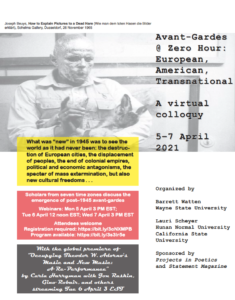
Avant-Gardes @ Zero Hour: European, American, Transnational
Monday, April 5–Wednesday, April 7

A virtual colloquy featuring 16 scholars, writers, artists
& the global premiere of Carla Harryman’s “Occupying
Theodor W. Adorno’s Music and New Music: A Re-Performance”
attendees welcome; registration required; click here

Originally organized for the 2020 conference of the European Network of Avant-Garde and Modernist Studies (EAM) conference in Ghent, Belgium, canceled due to COVID-19 (here), and following last year’s virtual colloquy on “Modernism @ Zero Hour” (here). The seminars have  been reorganized and expanded, with participating scholars and artists from seven nationalities and time zones, and with the addition of the streaming of Carla Harryman’s revised production of “Occupying Theodor W. Adorno’s Music and New Music,” originally staged at dOCUMENTA 13 (2012). The colloquy takes up transnational approaches to the emergence of avant-garde art and practices after the metahistorical date of “Zero Hour,” 1945—the end of the war which is not one—to comprehend the profound reflection on destruction, displacement, and a new global order in post–1945 movements and works.

Organized by Barrett Watten, English, Wayne State University
and Lauri Scheyer, British and American Poetry Research Center,
Hunan Normal University
Sponsored by Projects in Poetics and Statement Magazine,
California State University, Los Angeles
… More

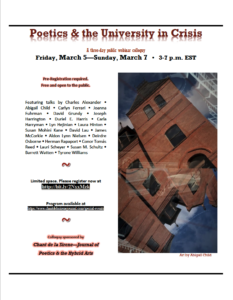
Poetics & the University in Crisis
Friday, March 5–Sunday, March 7 / 3:00–7:00 P.M.
featuring 22 poets, critics, teachers, artists
free registration required; click here

A virtual colloquy on the role of poetics in the American university in crisis, for a nation also in crisis. The humanities and arts continue to be major targets of increasingly austere budgets—and so, too, has critical thinking. How can poetics—as inventive, intellectually engaged creative series of practices and modalities of thought—offer an intervention into this moment? How can the university re-embrace the necessity of art based in critical thinking and open inquiry that includes the aesthetic and the political? The three days of this colloquy will aim to unite creative poetic practices with analytical critique and pedagogy from a wide range of voices, methods, points of view.

… More

CALL FOR PAPERS

Avant-Gardes @ Zero Hour:
European, American, Transnational

American Comparative Literature Association
Virtual conference, 8–11 April 2021

This seminar continues the work of “Modernism @ Zero Hour,” focusing on European, American, and transnational avant-gardes after the epochal moment of “Zero Hour,” 1945. At a moment of crisis and renewal, modernity is disclosed in a process of “systemic detotalization” that new avant-garde tendencies interrogated in forms of mimetic activity, at once preservative and self-undoing. The destruction of European cities, the displacement of peoples, the end of colonial empires, political and economic antagonisms, the specter of mass extermination, but also new cultural freedoms are enacted in a broad range of aesthetic, philosophical, and political forms, differing substantially from the historical avant-garde. What was “new” in 1945 was to see the world as it had never been, as a locus of destruction and creation on a global scale. Seminar topics could include transnational routes for the avant-garde: the global influences of surrealism and existentialism; the ethical imperatives of “bare life” and abstraction; the eruption of absurdism; cross-racial aesthetic motives and possibilities; the circulation of new cultural forms such as American jazz in Europe or New Wave film in the U.S.; the tension between avant-gardes, state formations, and ex/repatriation; and aesthetic movements of the global South that oppose the spatial hierarchy of prior avant-gardes. In each instance, radical form addresses modernity in crisis and the inauguration of a new global order in unique ways.

Submit proposals to ACLA by Saturday, October 31
For ACLA portal, click here; for seminars, click here
Contact barrett.watten@gmail.com for more information

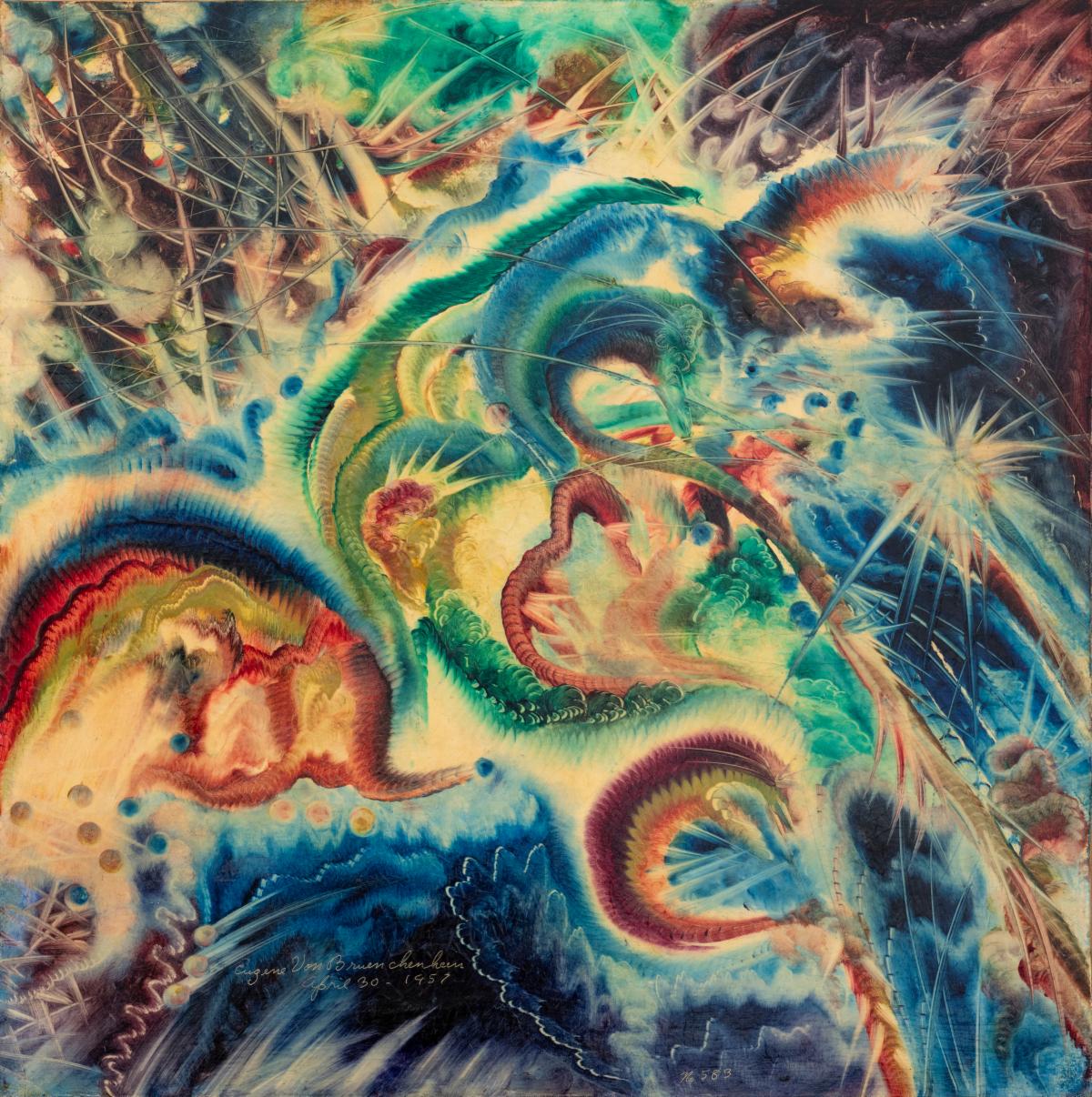
Image: Eugene Von Bruenchenhein, No. 583, 30 April 1957