Published on The Nation (http://www.thenation.com)
Vanishing Points: Language Poetry Remembered
Barry Schwabsky | January 12, 2011
That book was Ron Silliman’s Ketjak. Silliman was part of a group of poets writing mostly in the San Francisco area or in New York City and whose work was called Language poetry or Language writing. Ketjak was not necessarily typical of the work these poets were producing, but it seemed to epitomize one side of the group’s efforts, which Silliman was to dub “The New Sentence,” a kind of writing that “occurs thus far more or less exclusively in the prose of the Bay Area.” Its characteristics, he said, include: “1) The paragraph [rather than the stanza] organizes the sentences; 2) The paragraph is a unit of quantity, not logic or argument; 3) Sentence length [rather than the line] is a unit of measure; 4) Sentence structure is altered for torque, or increased polysemy/ambiguity.” Eschewing argument and narrative, the juxtaposition of these “torqued” sentences focuses attention on the surface of the text—a literary equivalent to the emphasis on the flatness of the picture plane in Modernist painting. Other poets whose work, or some of it, seemed to me to emerge fruitfully in this mode included Lyn Hejinian and Barrett Watten. If Ashbery’s Three Poems was the nearest precursor I could see to the “new sentence” side of Language writing, that book’s predecessor, The Tennis Court Oath, seemed to stand somewhere behind Language’s other side. There were no sentences in this mode, which involved applying such a strong torque to syntactic structure, and sometimes even to the word itself, as to break it into fragments that can be recombined with utter arbitrariness. The Tennis Court Oath favored aggressive disjunction, with the abrupt shift from one form of meaning to another resulting in a litany of blind-side connections. Although this kind of writing was more assiduously practiced by others, Silliman sometimes took it up as well, as in the opening lines of “Force,” published in 1983:
The audients of politics
in the –torium sounds
eye is for fours
is thus tragedy first
then farce, majestic speech
muttered under morning’s breath
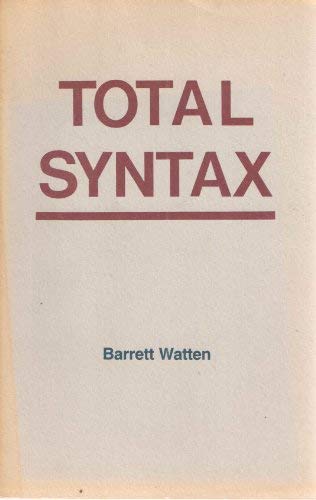
Such poetry could have a very distinct range of subject matter—in “Force,” something like the metaphorical relation between politics and theater—refusing to resolve itself into anything like a statement about its subject, even an implicit one. In such writing, unlike that of Ketjak, the perceptible world seems very much at a distance; attention is sharply focused on the textual apparatus of thought, which appears as a kind of darkness that separates us from things, perhaps because we feel ourselves to be merely an audience before which power plays out its preordained scripts. But as Watten argued (with reference to the work of Clark Coolidge, who might be thought of as the intermediary between the Ashbery of The Tennis Court Oath and Language poetry), such writing depends not, as it may appear, on a removal of syntax but rather on its totalization, such that each unit (typically the line) takes on a metonymic relation to any other—a “total syntax.” The lyric drama of address counts for nothing in such aggressively disjunctive work.
Along with the new sentence and total syntax, there was a third leg to Language writing: poetics. These poets considered it part of their job description not only to write poetry but also to write about poetry, not so much by producing criticism of particular works as by accounting for the task of the poet and the nature of writing. L=A=N=G=U=A=G=E, the best-known periodical associated with the movement, edited by the New York poets Bruce Andrews and Charles Bernstein between 1978 and 1981, consisted primarily of statements on poetics; it was in a certain sense succeeded by Poetics Journal, edited by Hejinian and Watten starting in 1981. This was the era when “French theory” was being assimilated into American intellectual life, and the propensity of the Language poets to engage in fairly abstract discussions of poetics was often seen as reflecting the trend. Yet what’s striking, if you turn back to the pages of L=A=N=G=U=A=G=E, is the paucity of references to Roland Barthes, Jacques Derrida or Michel Foucault, let alone to the less-familiar French figures who are more specifically associated with the study of poetics, such as Gérard Genette and Tzvetan Todorov, who co-founded the French journal Poétique in 1970. Not that the Language poets lacked theoretical reference points—Wittgenstein was regularly cited—but at least in their early years, a systematic engagement with theory was rare. Theirs was a mostly homegrown and autodidactic poetics, often speculative and insecure, on the edge between dialectical and self-contradictory, and wavering between straight essayistic prose, diaristic notes-to -self and a sort of ventriloquism in which statements are sounded out in order to see and hear how they echo. Little of it is now of much use in thinking about the problems of poetry. Rather, it’s valuable as evidence of what a particular group of brilliant and ambitious young poets were collectively worrying about as they were pushing themselves to invent new ways to write. Their poetry was not so much theoretical as methodical, characteristically expressing itself in expansive rather than compact forms, book-length works or sequences rather than discrete poems.
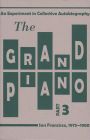
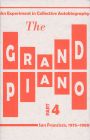
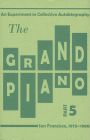
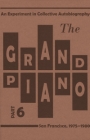
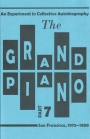
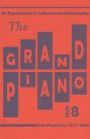
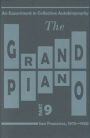
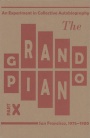
Thirty years on, Language writing is not exactly the literary establishment, notwithstanding the complaints of those who continue to begrudge it any standing whatsoever. But simply by persisting it has become hard to ignore: last year Rae Armantrout won the Pulitzer Prize and the National Book Critics Circle Award, and Bernstein had a book of selected poems published by Farrar, Straus and Giroux; Hejinian is a chancellor of the Academy of American Poets. Yet to a great extent the Language poets continue to exemplify the DIY approach that has always been their modus operandi. One example is the serial publication, starting in 2006 and concluding last year, of The Grand Piano, a ten-volume “experiment in collective autobiography” by ten poets associated with the Bay Area branch of Language writing—Steve Benson, Carla Harryman, Tom Mandel, Ted Pearson, Bob Perelman and Kit Robinson, along with Armantrout, Hejinian, Silliman and Watten. The volumes were brought out by the imprint Mode A, an offshoot of This Press, founded in 1974 and still run by Watten, whose publications include the original edition of Silliman’s Ketjak in 1978.
The Grand Piano is named for a coffeehouse on Haight Street in San Francisco where a weekly reading series was held from 1976 through 1979; several of the book’s contributors were organizers of the readings, and all of them took part. The grand piano is surely the most bourgeois of musical instruments, but the coffeehouse that took it as a namesake was located in the heart of the West Coast’s best-known bohemia. The duality is appropriate for this group of white, middle-class, university-educated poets who had not taken any of the obvious routes into the professions and seem to have subsisted on various forms of marginal employment during the five-year period on which the autobiography is focused. Later, some of them would return to the university to pursue careers in academia, much to the disgust of those convinced that bohemia is forever. There’s an at-looseendedness to the life that these poets describe themselves as leading in the 1970s that now seems impossible, the economy of urban life being so different. But while there is inevitably some nostalgia to these backward glances, the depiction of the times is hardly idyllic. The reader is always at least vaguely aware of a kind of unease that the writers notice in their younger selves. In general, The Grand Piano is good at rendering the conflicted feelings, uncertainty and self-questioning of an aesthetic in progress. It’s been called an attempt to “control the discourse” around Language poetry, but reading the books makes that niggling charge hard to sustain; for that matter, the ten poets don’t even control one another’s discourse, let alone anyone else’s. To their credit, they seem less to be historicizing their accomplishment than dehistoricizing it—recollecting the time when it was not yet history, when its intentions were still hazy, its meanings uncodified.
Where the books disappoint is in their structure, or lack thereof. Each of the ten writers contributes to each volume, always in a different, arbitrarily pre-established order. Forgoing chronology, the series begins with a loosely thematic focus. In the first volume, Perelman leads off with a proposition: “that we consider a basic issue facing writers: love.” But after a few volumes the idea that each would be thematically unified seems to have been abandoned (or else interpreted so loosely that you’d need to be a mind reader to divine what the theme might be). The result is that, despite each book being a wonderful read, with a wealth of anecdote, critical insight and even, sometimes, the thing itself, poetry, the sequence starts to feel static, like a sitcom in which each week all the main characters are still in the same situation they were at in the beginning of the last episode, and the episode before that, and so on—a kind of highbrow Friends.
Source URL: http://www.thenation.com/article/157693/vanishing-points-language-poetry-remembered