Entries tagged with Language writing

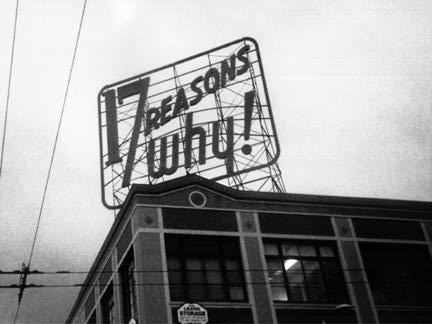
Entry 24: 17 Reasons Why!

6a00d834520c3e69e2011168d315a9970c

17 Reasons Why! 

“17 Reasons Why!” is a key site in the cognitive map of San Francisco during the period in which Language writing emerged, the 1970s. The cryptic formula, for which no adequate explanation has been given, overlooked the Mission District at the intersection of 17th and Mission—and yet also seemed hardly to be there. Its address was always already iterative and non sequitur, always a prompt for questioning. I left the Bay Area before it came down in 2000, but it has a solid place in the firmament of urban legend, as in this article, from which we learn: “The 17 did refer to the fact the store stood on the corner of 17th Street. But what were the reasons? ‘People would ask what the 17 reasons were, and we would guff it off. There were no 17 reasons,’ [the former owner’s son] said.”

[To be contd.]

Announcing publication of
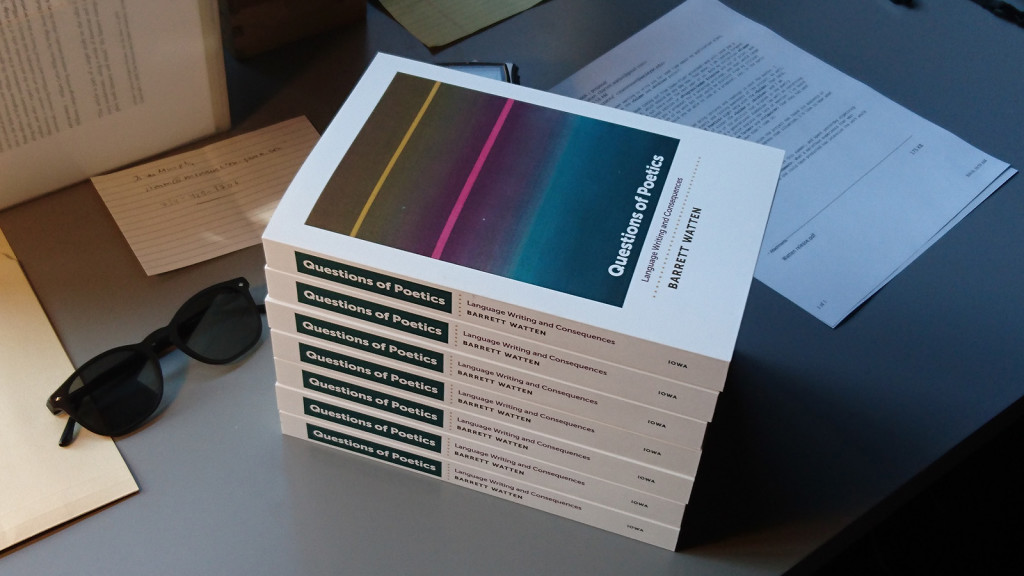
Questions of Poetics: Language Writing

and Consequences


41sw0hBUqdL


Questions of Poetics is full-on Watten, a book with sharp edges, relentless intelligence, and an unwavering conviction that the arts have serious work to do.”
—Peter Nicholls, author, George Oppen and the Fate of Modernism

Questions of Poetics represents a major statement by one of the highest profile poet-critics of the day. Its arguments concerning genre, form, particularity, and negativity represent a solid, easily grasped, portable way of thinking about the ongoingness of the avant-garde, its continual diversification and reinvention. Moreover, Watten offers a persuasive reappraisal of Language writing and its place in American literary history.”
—Brian Reed, author, Nobody’s Business: TwentyFirst Century Avant-Garde Poetics

Official release date: September 1, 2016. For the University of Iowa Press flyer, see here; for ordering options, see here.

I was in New York for a purpose—for one thing, I had not been for a while and it was time to catch up. At a conference in Boston, I received a phone call from Kit Robinson, in the middle of a session on surrealism no less, that Ted Greenwald’s health was failing. I made plans to visit as soon as the semester was over; a day was arranged, a plane flight, a hotel booking, and other appointments fell into place. I’ve outlined what I did over the four-day weekend here. The time was specified for 2 P.M. Ted was chipper over the phone: “I have an earlier appointment, but I can see you then.” He books his time like a New Yorker, I noted; I don’t, in some unstated way assuming every event is its own uniqueness, even if that has long since become unworkable as a way to manage time. (So it came to pass that I work the day shift on the assembly line of Modernity Inc., headquarters in Detroit. But what’s the difference? Differing cultural styles of time management all depend on the same passage of time.) I was nervous about the event; he had not overprepared it. … More

New in 2015:cover

“Language Writing”
an essay by Barrett Watten

The Cambridge Companion to
Modern American Poetry
ed. Walter Kalaidjian

Table of contents:

1. The emergence of ‘the new poetry’
John Timberman Newcomb
2. Modern American archives and scrapbook
modernism / Bartholomew Brinkman
3. Experimental modernism
Alan Golding
… More

GP completespread

Luke Harley, “Poetry as Virtual Community: A Review of The Grand Piano: An Experiment in Collective Autobiography,” Jacket2, 7 February 2013. Click here.  

In part due to its demanding format—ten volumes by ten authors, published over a five-year period (2006–10), totaling over 1600 pages—and in part due to the difficult questions of poetics and community it raises, The Grand Piano has only now, more than two years after the last volume saw the light, received the kind of engaged and comprehensive review that will help open its project to readers in all its multiple dimensions. Barry Schwabsky’s 2011 review in The Nation, uploaded to this site, was likewise welcome as an enthusiastic introduction to a broader readership, one that perhaps had not heard of Language writing and would like to know more. Harley’s review, on the other hand,  assumes not only familiarity but positional engagement with the movement, these authors, this writing. Working through the debates of the 70s and 80s, as we did in The Grand Piano, Harley’s discussion extends literary history into the concerns of the present; it becomes, as Foucault would have said, a work of effective history. In so doing, his review joins Eleana Kim’s 2001 online history of Language writing to offer a broad overview of the movement, contributing to the work of documenting the past history and present possibility of language-centered poetics. Going beyond mere narrative history, critical readings like Harley’s reinterpret the effort to document the movement as a reenactment of its polemical force—from the archival matter of readings, talks, magazines, and books to its real-time engagement. Given the depth of discussion Harley and predecessors have initiated, one can only hope they will encourage more. La lutte continue!

 ... More

A resonant passage from Lyn Hejinian’s The Book of a Thousand Eyes, which should have wide circulation (and links) for pedagogical and moral purposes.

I am a failed fire chief
I am a failed thief

Didn’t I fail at the wrong thing, aren’t I a failure at failure

Failure is inevitable
I am a fan of failure
I am a failure flailed by failure
I leap into failure
I relish the self-pity that’s produced by the self-loathing that comes as a consequence of failure

The sauce has curdled, the meat is tough, the custard is runny—the meal is a failure

Failure is the offshoot of argument—but then failure occurs too from a lack of it
Moral failure
… More

A scripted, multivocal performance based on excerpts from the ten-volume The Grand Piano will be delivered by eight of the project’s authors: Rae Armantrout, Steve Benson, Carla Harryman, Lyn Hejinian, Tom Mandel, Ted Pearson, Kit Robinson, and Barrett Watten at UC Berkeley and Small Press Traffic, San Francisco. At Berkeley, the event will be moderated by Jasper Bernes; in San Francisco, it will be preceded by a 45-minute group discussion including the audience, moderated by David Buuck, on the values of collective art practice from the 70s to the present.

Holloway Reading Series
Maude Fife Room, Wheeler Hall
University of California, Berkeley
6:30–8:00, Friday, November 18

  • Information here   

Timkin Hall, California College of the Arts
1111 Eighth Street, San Francisco
5:00–7:00, Sunday, November 20

  • Information here   

… More

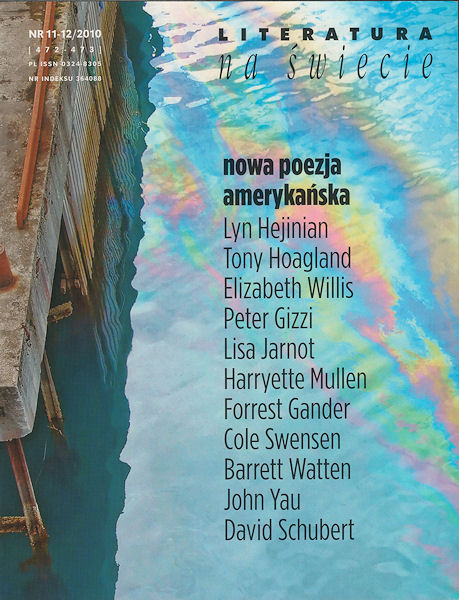
Nowa poezja amerykanska (New American Poetry), special issue of Literatura na swiecie (Warsaw) no. 11–12 (2010). Featuring poetry translated into Polish by Lyn Hejinian, Tony Hoagland, Elizabeth Willis, Peter Gizzi, Lisa Jarnot, Harryette Mullen, Forrest Gander, Cole Swensen, Barrett Watten, John Yau, and David Schubert; with essays, reviews, and interviews; www.literaturanaswiecie.art.pl.

… More

At our recent conference in Mainz, Germany, on collectivity and literature, David Simpson (a critic of romanticism who made the theory/cultural studies turn in the 70s and has produced a number of significant and wide-ranging works since then) presented a keynote lecture titled “After 9/11: The Fate of Strangers,” on the position of the foreigner (stranger; étranger; Fremde) in writing. Simpson cited a range of post–9/11 fiction and the spontaneous outpouring of poetry opposed to American military intervention in Iraq and Afghanistan. I mentioned that, through the last decade, poets had also been interested in the status of other languages in their work as foreign and strange, and were investigating questions of alterity, opacity, and mistranslation through a range of experimental strategies. An example of the preservation of an individual word as “stranger” in a language appears with the German context of Fremdwörter, which are generally pronounced as closely to their original language as possible. Adorno had written, suggestively, on this embedding of the other in German: “Die Fremdwörter sind die Jüde der Sprache” (Foreign words are the Jews of language). A bit later, Simpson asked me for particulars of this practice (Cary Nelson also wondered what the hell was interesting about opacity and mistranslation; I responded that it was a site of cultural learning). I had just seen three readers in Berlin exploring the poetics of multi-languaged embedding and mis/translation (Eugene Ostashevsky, Uljana Wolf, and Christian Hawkey, with the texts by recently deceased Russian poet Alexei Parshchikov added to the mix) at an art space in Prenzlauer Berg, Berlin, named (significantly) “Ausland.” Not feeling that all the examples I knew of were coming to mind readily, I took the question to Facebook and have started a short bibliography. The criteria for inclusion here are: investigatng the opacity and otherness of multiple languages using experimental techniques; interrogating translation as a cultural politics; and publishing the results after 2001 (with a few exceptions). The list will be updated as more titles become available (contact b/c at barrett.watten@gmail.com).

Multi-Language Poetry After 2001
(compiled by Barrett Watten and friends; in process)

Dorantes, Dolores. SexoPUROsexoVELOZ and Septiembre. Trans. Jen Hofer. Kenning Editions, 2008. “Translator’s Note.” Other language (OL): Spanish.

Funkhouser, Chris. “perdido em transcreation: chuck(l)in’ globalization.” OL: French, Spanish, Portuguese. Available here.

Hadley, Jozuf Bradajo. 2 Poems. With CD. Tinfish, 2006. OL: Hawaiian Pidgin.

Iijima, Brenda. Glossematics, Thus. Least Weasel, 2011. OL: t/k.

Kanae, Lisa Linn. Sista Tongue. Tinfish, 2001. OL: Hawaiian Pidgin.

Karasick, Adeena. The House that Hijack Built. Talonbooks, 2004. “Phat Freitag” and  the homolinguistic translation of the Sefer Yetzirah (The Book of Letters). OL: Hebrew, German.

———. Amuse Bouche. Talonbooks, 2009. “What Have You Done with My Cabbala?” OL: Hebrew.

Kim, Myung Mi. Commons. U California P, 2002. “Works.” OL: Korean.

Lang, Abigail, and Thalia Field. A Prank of Georges. Essay Press, 2010. “From a poetry translation workshop hosted by Tamara Foundation in Paris, 2008. OL: French.

Stalling, Jonathan. Yingeleshi: Sinophonic English Poetry and Poetics. Denver: Counterpath, 2011. OL: Chinese.

Torres, Edwin. The All-Union Day of the Shock Worker. Roof, 2001. “A Nuyo-Futurist’s Manifestiny.” OL: Spanish.

———. The Popedology of an Ambient Language. Atelos, 2007. “The Impossible Sentence”; “Transla-lation-tion.” OL: Spanish.  

Tuntha-obas, Padcha. composite. diplomacy. Tinfish, 2005. OL: Thai.

Zolf, Rachel. Neighbour Procedure. Coach House, 2010. “Innocent Abroad.” OL: Hebrew, Arabic.

[More entries t/k]
 

I Met (The Alphabet)
25–26 March 2011
“The Alphabet: A Symposium
on Ron Silliman’s Long Poem”
University of Windsor
Windsor, Ontario, Canada

Rae Armantrout
Brian Ang
Braydon Beaulieu
Pierre Beaumier
Louis Cabri
Jeff Derksen … More