Entries tagged with poetics

Entry 68: Language Notes II

ENG 5530: Language Writing and Beyond
Wayne State University, Fall 2025

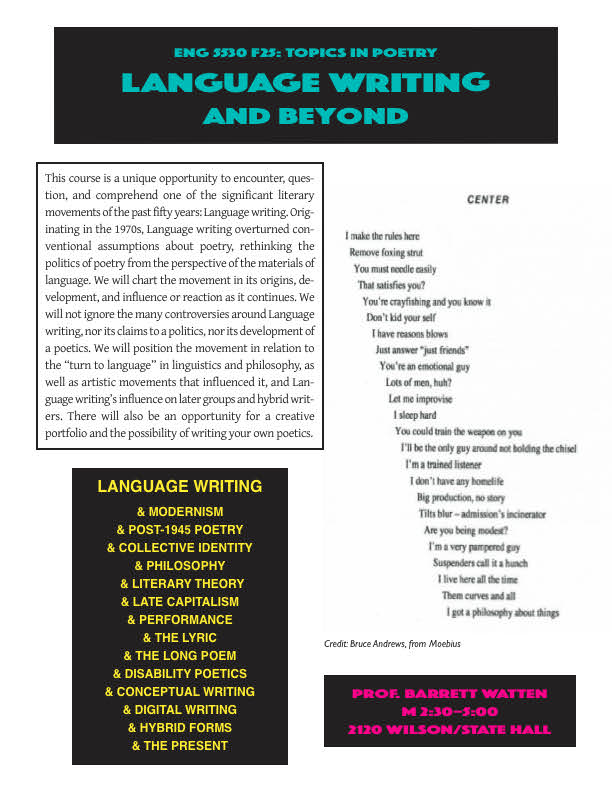
Breaking with custom, I am uploading the syllabus (minus boilerplate and policy) for my “Topics in Poetry” this fall. The reasons are several. Since coming to Wayne State, unlike other major hires of Language writers in the early 90s, I was brought in to teach literature and cultural studies, with my poetry and poetics career a plus but not well understood. Over twenty-five and more years, I crafted a pedagogy designed to bring literature and cultural studies together, and the dissertations I advised reflect that synthesis—while there are several that address modernist and later poetries at a high level of discussion. However, I have never taught a course devoted to my work or literary movement in poetry and poetics per se, and now is the time—again for more than one reason. One, I want this poetry, history, and theory to be as pedagogically known and significant as any other “approach,” at any level of instruction from GenEd (to students in other fields) through the Major and the graduate program—my teaching at three levels as has usually been the case. Then, it is time for an overview of Language writing that takes into account not only its emergence but the controversies and reception issues it produced, followed by its academic reception and gradual departure from the academy, and finally with the evidence of the strong new work that has appeared, from every major figure, since the Millennium. Lyn Hejinian’s death in 2024 is also a turning point: while her work was always written prospectively and toward its continuing, we may now compare her lifelong project—Beginnings, Middles, and Ends at once—to other authors who may be read in that way: Stein, Zukofsky, Riding, Creeley, Hughes, Baraka and so on. Retrospection is one aspect of that reading, but also a careful attention to the values of time, memory, historicity and everyday life in her project. Given many aspects of her uniqueness, constructing comparative frameworks must now also be undertaken across the board: with the original figures, the controversial history, the emergence of new schools and writers where there is variously a connection to an overarching focus on Language as site of meaning making.

Herewith the provisional syllabus, as always a working document that may be cut back or amended as the course unfolds, with many authors and issues overly condensed or regrettably left out. Sixteen sessions, or eighteen, would do more justice, but fourteen 2½-hour classes is what we are given. So forth: … More
“Particularity, Nonnarrative, and Global Poetics:
Critical Regions of Cultural Transmission”

CALL FOR PAPERS/MULTI-SESSION PROPOSAL
SUBMIT BY OCTOBER 2, 12:00 P.M. PST

American Comparative Literature Association
Palais des congrès de Montréal
February 26–March 1, 2026 /submit proposal here
… More

Entry 67: Language Notes

This fall, I continue an adventure of some 50 years with the literary movement with which I am associated, Language writing, once so-called and now so inscribed. ENG 5530 is a dedicated “Topics in Poetry” course, addressing students at all levels at Wayne State University. For some, this will be a first encounter with poetry; others are already writing in ways identified by their teachers as “aha! Language writing!”; and others are taking a literature or creative writing elective with, hopefully, open minds and interest. I want to approach the topic with new eyes and ears, and thus have not given much thought as the opening of school approaches to how, precisely, I will proceed. In moving forward, I will be retrospectively assembling a curriculum but not in any linear fashion—that end has already taken place. How then to redefine, redeploy, rethink Language writing while constructing the course of study that opens new issues and opportunities?

My first thought was to provide a useful historical background, summarizing the “tale of the tribe” without dwelling on it. One divergence from the canonical narrative already appears—as Language writing gathered momentum and a degree of institutional recognition, there was a kind of mimicry of the Pound tradition and its “tale of the tribe,” a concept that is in need of historical and cultural correction. “Tribe” is not an auspicious term, for example, and the fact that there might be one “tale” that would hold it together even less so. The Orono conferences, importantly, were the site for a shift from the Pound model to an increasing pluralism, that over the decades (30s, 50s, 60s, 40s, and 70s) had increasingly to do with departing from a single narrative. Still, some kind of historical or periodizing ground is needed.

The best source I know for that was a series of online essays by Eleana Kim, written in 1994 and published on Gary Sullivan’s web site Readme, which is no longer online. Nada Gordon, however, has archived the series on the Wayback machine and I was able to download and pdf the series, with the addition of the bibliography from Nada directly. I have assumed that Kim is the same person as the UC Irvine Professor of Anthropology (here), but that needs to be confirmed. If so, she likely wrote the history as a graduate student, as she began publishing in Korean Studies about 2000. I suspect there is a connection, however, as the account of Language writing has a political awareness, sense of inclusion and exclusion, and critical astuteness about dominant narratives that could well connect to a cultural anthropologist. When that is determined I will repost, but this stands for one of the questions that now could be asked as the course unfolds: Why did Eleana Kim write on Language writing, and what does she think now? How did this very well written, politically savvy narrative become forgotten and erased, and why?

Eleana Kim, “Language Poetry: Dissident Practices
and the Makings of a Movement”

Note to the archived publication: “This essay was written in 1994 and, with the exception of minor editing for clarity, has not been rewritten. It does not, in other words, take into account material published in the years since.”

Part 1: “What is Language Poetry?” here

Part 2: “Tradition and Communal Praxis” here

Part 3: “San Francisco, circa 1975” here

Part 4: “Theory, What Theory?” here

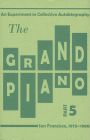
Part 5: “Rumor in the House of Fame” here

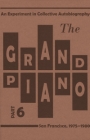
Part 6: “The New Americans vs. the Treed Americans” here

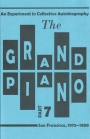
Part 7: “Inclusions” here

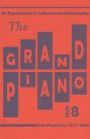
Part 8: Bibliography here

Bear in mind that this was written in 1994; thus the bibliography is out of date. It would be important, first, to establish a 90s bibliography, but even more to track the works that have appeared since the millennium. That body of work could lead to an entirely different narrative. As well, the emergence of two immediate offshoots of Language writing, Flarf and conceptual writing; the influence of Language writing on poets of color; its relation to New Narrative, hybrid writing, disability aesthetics, digital writing and AI—all would need to be taken into account, which is precisely what I plan to do over the next fourteen weeks. Stay tuned for more posts as decisions get made on what to read and feedback happens on how that reading takes shape.

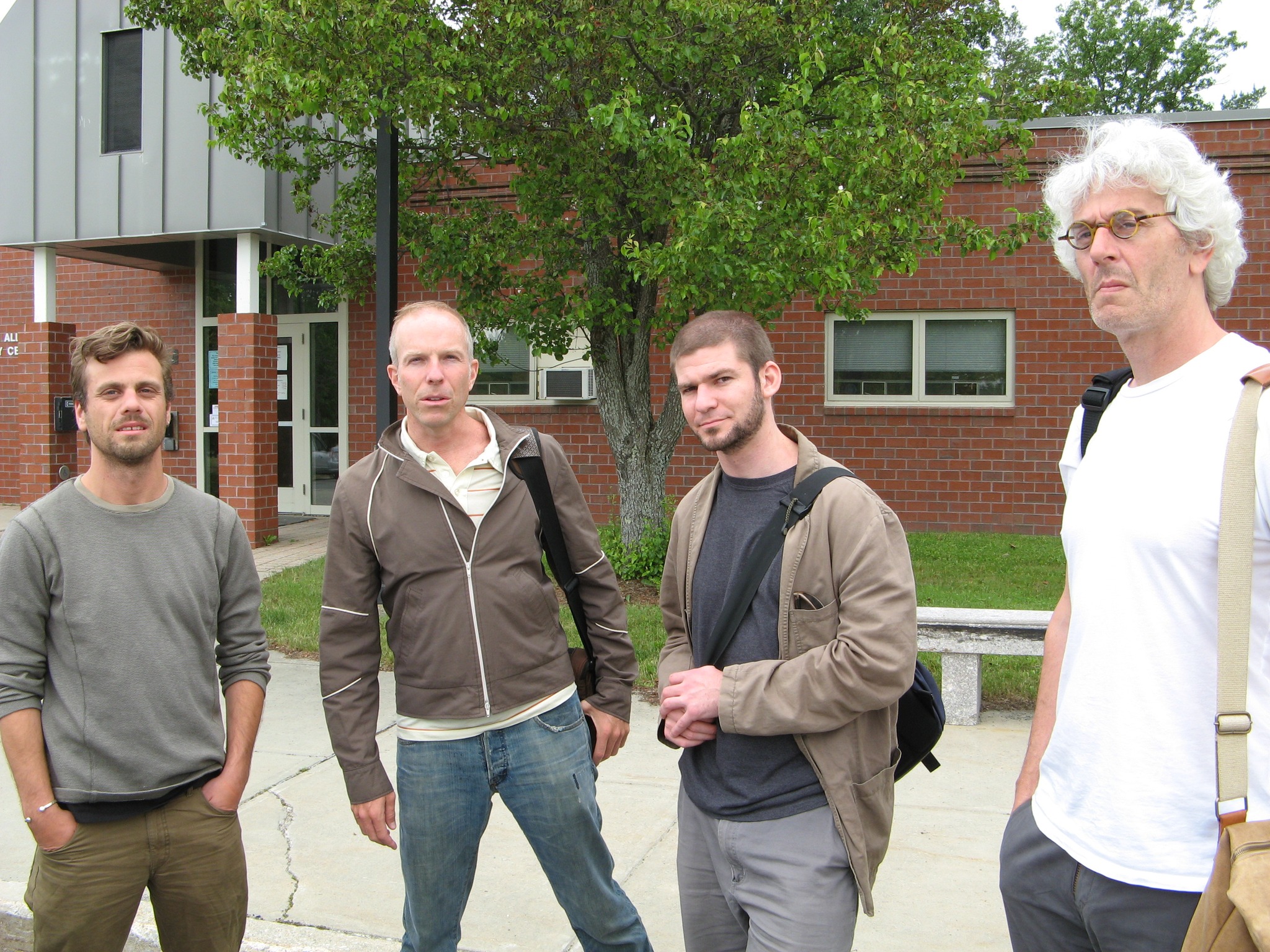
In 2013, I took the stage at a session of the Modern Language Association in Boston, on a panel hosted by the Marxist scholar Jason Baskin on “Marxism and Modernist Studies.” My hope was to extend an argument I raised about Language writing and neoliberalism at the 2008 Orono Conference to an account of modernist poetics—expatriate poet Eugene Jolas’s editing of transition magazine in the 20s and 30s. But I also wanted to start a dialogue, even a polemic, with the new school of Marxist poet-critics I had encountered there: Joshua Clover, Christopher Nealon, and Ruth Jennison. With Clover’s recent, untimely death, various tributes and memories have circulated, for example this Orono photo by Patrick Pritchett. I had some memories of Clover too, some of them benign and some less so, which when I mentioned them led to a considerable reaction and disclosure of an antagonistic post mentioning me, linked here. The link to Clover’s writing online led to the “blog” published in 2019 (see here for full discussion). It turns out Clover had published an anonymous hit piece on the “blog,” which up until then I could not place or interpret. The scene he describes, it turns out, was the session at MLA Boston in 2013. The main argument of my paper has since been published (see here), but without the opening polemic with Clover, Nealon, and Jennison. To understand, and refute, Clover’s anonymous “blog” post as participating in the larger group take-down of my work and person, it is necessary to return to the traumatic scene itself, which Clover describes in these terms: … More

Surrealism in Paris
October 2024

Surrealism, as many of us had conceived of it for years, should not be considered as extant except in the a priori nonspecialization of its effort. I hope it will be considered as having tried nothing better than to cast a conduction wire between the far too distant worlds of waking and sleep, exterior and interior reality, reason and madness, the assurance of knowledge and of love, of life for life and the revolution, and so on. —André Breton, Les Vases communicants (1932; English trans. 1990)

In the spirit of a thought experiment, I offer my time spent in Paris attending the International Society for the Study of Surrealism (ISSS) conference on Surrealism, one week before the American election, as charged with the co-presence of dream and reality. The first reality was Paris itself as elective site of a transformative moment—the 100th anniversary of the First Manifesto of Surrealism. Being in Paris at that time, as it condenses all time passing between that moment and the present, had the feeling of co-presence of many moments all aware of each other and on the same level though not directly in contact. The crowds going about their business under a gray sky, during a school holiday where there was some release of tension and many children and families on the street, were not in direct contact with us streaming in cab or Uber to specific destinations, for instance the conference venue at American University Paris (AUP). Those presenting in multiple rooms, with visual aids and in three languages, were not aware of the cabs or Ubers picking passengers up and dropping them off. Just so, the meticulously curated book display of surrealism was not aware of the content delivered above. The array of editions, including many facsimiles of original texts, had a remote and uncanny feeling, as with the difference between books being opened and closed. The conference, as site for special knowledge (of “specialists in revolt”), was removed from the “nonspecialization” of lifeworld unaware of it outside. … More

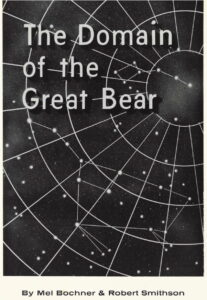
In a postscript to her major biocritical reassessment of Robert Smithson and his oeuvre (Inside the Spiral: The Passions of Robert Smithson), Suzaan Boettger recalls the arrival by mail of the just-published collection of The Writings of Robert Smithson (1979), edited by Nancy Holt and designed by Sol LeWitt. This watershed publication—at the boundary of literature and art, production and reception, content and design—truly launched Smithson into the “Domain of the Great Bear,” his art-historical destiny in the starry night. She sees it as a biographical convergence, writing in her copy:

“This book arrived in the mail on my birthday, 1979, as I was on my way to deliver my first lecture—on earthworks.” While I had prepared by reading Smithson’s texts published in periodicals, the collection’s appearance on the day of my lecture seemed nothing less than serendipitous. (339)

… More

A Poetics of Encounter:
Dialectic of Outside with the Beats

Read at “Can We Teach the Beat Generation?”
Discussion organized by Erik Mortenson and Tony Triglio
Session 228, 5 January 2024, 10:15–11:30 AM, Loews 3rd Fl.
Modern Language Association, Philadelphia 

“The transmission of poetry is a passion unlike any other.”
“I too have started a riot in the academy.”

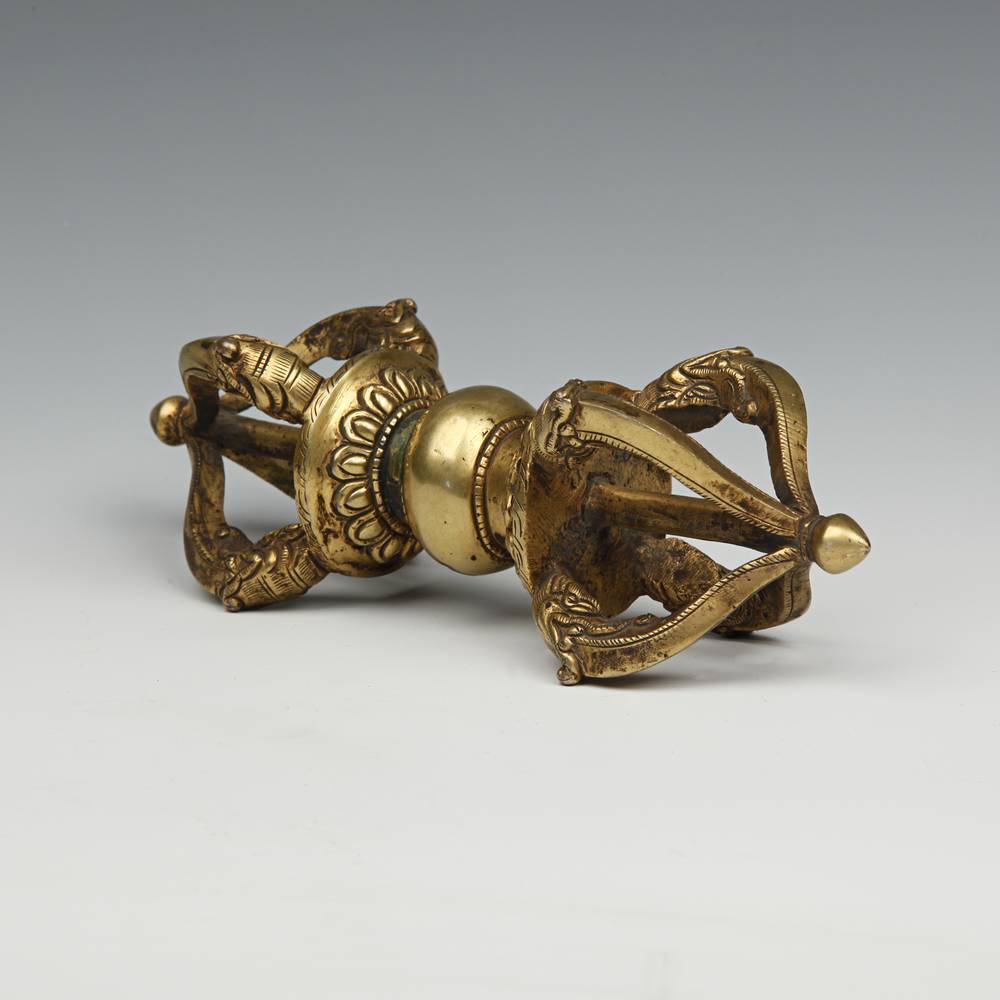
In this note, I want to call up certain moments of encounter that were, as with the visual image of a “diamond thunderbolt” or dorje, immediate, double-faced, and bivalent: outward in the transmission of poetry, from the Beats or New Americans and others; and inward, toward self-formation and a long process of professionalizing within the Academy. In charting such a poetics of encounter, I draw from my presentations at the “decades” poetry conferences at University of Maine, Orono, in the 90s and 00s that I, in the company of a shifting assemblage of poet/critics, took part in. I connect these moments to Steven Belletto’s genealogy of three early moments of encounter between Beats and the Academy: Jack Kerouac’s intervention at a symposium sponsored by Brandeis University in New York, 1958; Diana Trill­ing’s reaction to Allen Ginsberg’s being given an “unofficial” reading at Columbia, that same year; and Gregory Corso’s rebuttal to a symposium on the Beats in Wagner Literary Review, 1959. These are part of series of breakthrough moments: the Gallery 6 reading, San Francisco, 1955; Ginsberg’s appearance in Time magazine, 1959; the Vancouver Poetry Conference, 1963; the Berkeley Poetry Conference, 1965. What makes the first three definitively “Beat” aligns with two concepts from my essay on Michael McClure: antagonism and holism. In challenging the Academy’s scholastic pedagogy—I often thought of the English Department in the 60s or 70s as a kind of monastery, corridors filled with the brethren nodding to each other under hooded robes—the Beats took a position Outside that was, at the same time, subject to everything—“Is there a world?,” Kerouac asked; “Man does not exist,” opined Corso. The nature of this encounter between an unregulated Outside and a self-regulating Inside points to a dialectic of the Academy whose stakes are not only literary, pointing toward our volume’s significance not only for Literary but University Studies. … More

Scaffolding Repetition: Gertrude Stein,
Language Writing, Electronic Dance Music
(online here)
eLyra 22, special issue on “Poetics and Politics
of Repetition,” ed. Bruno Ministro, 25 December 2023
(online here)

Abstract: This essay takes up the critique of repetition in Gertrude Stein, her claim to have written a “continuous present” that “begins again and again” and “includes everything” versus her later qualification that repetition is always shifting in terms of “insistence” and “emphasis”. Even so, Stein focuses on the unfolding of the verbal material primarily in a linear fashion, though resonances and overtones abound. In Electronic Dance Music, from Detroit to Berlin techno, one finds more vertical layerings and “scaffolding”—a term taken from Soviet psychologist Lev Vygotsky—as a way of building up sonic elements in pleasurable and meaning-bearing ways. Using these two contrasting models of repetition, I read three language-centered poets—Ron Silliman, Leslie Scalapino, and Marjorie Welish—in terms of their complex forms of temporality in poetic form, seen in terms of Stein’s often repeated framework of “beginnings, middles, and ends”. I conclude with a discussion of ”vital movement” in the electronic dance music of Berlin DJ Ellen Allien.

Keywords: Modernism, avant-garde, repetition, language writing, poetry, electronic music, American, Berlin

… More

MATERIAL TRANSMISSIONS:
DEMOTIC SURREALISM/HIERATIC LANGUAGE,
SAN FRANCISCO, 1975–1980

Plunged each day into the fog of received ideas, man is led to conceive
of all things and to conceive of himself through a dizzy series of quickly
hidden stumblings, of false steps rectified as best as possible.

—André Breton, “The Automatic Message” (1933)

… More

SESSION PROPOSAL WITHDRAWN

Poetry, Translation, and Crisis:
From the Post-Soviet Moment
to War and Emigration

American Comparative Literature Association
Montréal, 14–17 March 2024

Due to the difficult circumstances of the global present,
the organizers have canceled this session proposal.
Stay tuned for plans for a virtual colloquy in 2024.  

In 1989 and 1990, eight American avant-garde poets traveled to then-Leningrad to meet with Soviet counterparts, experimental poets working under quasi-nonofficial conditions during late Perestroika. These meetings followed extensive travel and translation activities in the 1980s. Among then-Soviets, the poetic schools of “metarealism” and “conceptualism” were well represented—by poets such as Arkadii Dragomoshchenko, Alexei Parshchikov, Nadezhda Kondakova, Ivan Zhdanov, Ilya Kutik, Nina Iskrenko, Dmitrii Prigov, and Lev Rubinshtein. These events and developing contacts led to the publication of the collectively authored Leningrad: American Writers in the Soviet Union and a flurry of translations. Three decades later, the dialogue between American poets and poets of the former Soviet territory, including both Russia and Ukraine, has continued. A comprehensive anthology of American experimental poetry, Ot “Chiornoi gori” do “Yazikovo picmo” (From Black Mountain to Language Writing), appeared from NLO in late 2022, with a publication event in Moscow and subsequent online reading. Other translations are imminent or postponed under the present circumstances, while interest in and translation of two generations of poets, now disrupted by war and emigration, continues. This session solicits contributions on past and on-going translinguistic, transcultural projects from both periods: the post-Soviet moment and now. What “cultural work” is being undertaken and advanced in these works of translation and affiliation, crossing over global spaces of conflict and establishing global poetic networks? The session language will be mainly in English, but contributions in Slavic languages are encouraged, and hopefully English translations can be arranged.

… More