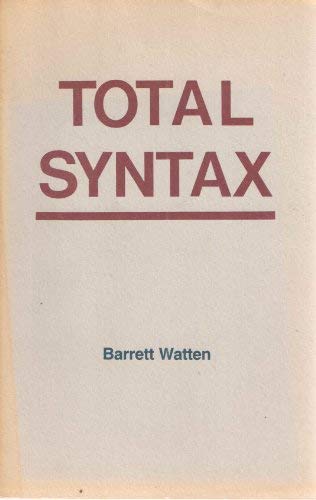
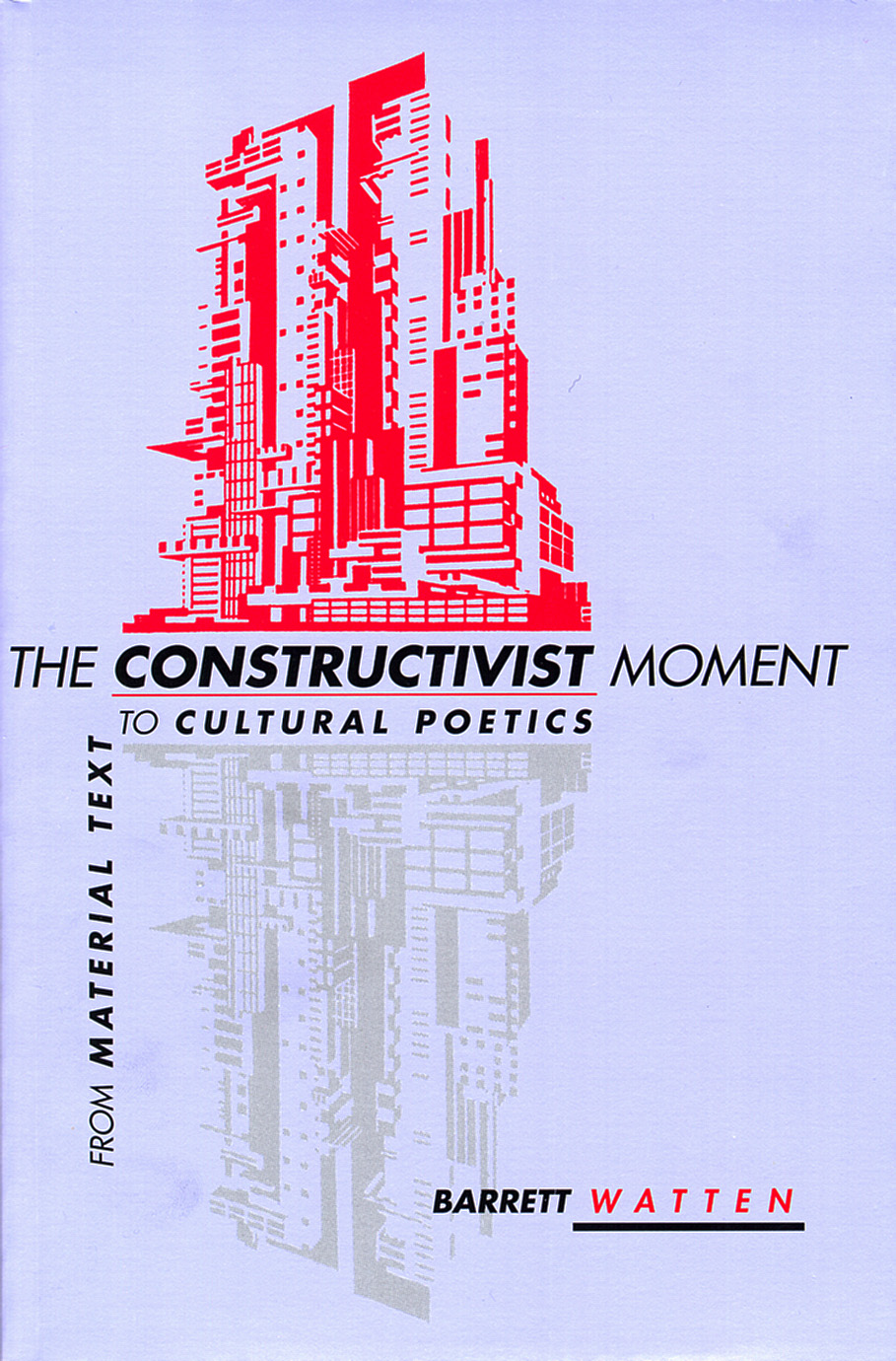
 Here I begin to list the twelve literary figures who contributed to the “blog,” and try to summarize what they posted, and why I think they did it, to provide context and answer them. Pursued to its fullest extent, this effort could become an allegory of literary desire, a record of botched communication, or worse, an indictment of bad faith. It could be an exegesis of the fallen state of society or the literary community, or only a local account of a crisis at my university. It is intended as a matter of record, as an explanation, and a moment of reflection or even contrition. It should be clear that none of these accounts had much to do with Wayne State; the open call of the “blog” by a few students and faculty was an opportunity to sound off on a controversial literary figure or extract payback for past history stretching back decades. At the same time, the events themselves may provide some light as literary history, as a site for learning and edification, a chance to readdress the record or individual persons, in the hope of putting this “troubling and troublesome” series of events, as one witness saw it, to rest.
(Before beginning, I should mention the “politics of the name” it takes up. I was being called out and named and, in response, have returned the favor; some of those named may be disturbed to see their names in this account. But I cannot do anything about that; the material is out there, under your names. It is clear that social media—and Twitter, a.k.a. X—must bear a major responsibility for the dissociation, but also pain and humiliation, when one’s good name is repeatedly invoked in this way—as mine certainly was.)
Joshua Clover
Joshua Clover was a West Coast poet, graduate of the Iowa Writers Workshop (as I am), until his premature death a Professor at UC Davis, and a major figure in Left academia (here). His post was originally anonymous and I had no idea who wrote it. After his death, however, a disturbing social media post about me surfaced (here) that placed Clover as one of the authors on the blog. The causes of this dissensus are politically, personally, and psychologically complex; I discuss in detail his narrative of our encounter at the 2013 MLA Boston, the literary debate it records, and his false claims here.
Since then, I have located another document that explains the antagonism. This was a work published by the young poet in the San Francisco magazine Zyzzyva in 1993: “Modern Language Association Annual (Near Mission Dolores)” (9, no. 1 [Fall]: 8. The poem records a first encounter with me at the 1991 MLA in San Francisco (I was then an academic editor at Berkeley while working on my Ph.D.). I had just attended a session that included a paper by Marjorie Perloff in which she claimed that the only African-American poet worth reading was Nathaniel Mackey (or something to that effect). On leaving the crowded session, Clover (whom I did not know) followed me out and wanted my take. Whatever I said, this is what he made of it:
“I couldn’t afford the Marxist cash bar. Business is so bad South of Market
the artists deluge some desiccated warehouses where we reproduce reflexively
& New Langton is filled with bodies — What is Barrett Watten thinking?
Imagine the 20th c. not as a sphere but a house with 1919 come home to roost
outside the candyglass clerestory windows (this is easier if you don’t have physics) —
Marjorie Perloff (Barry’s right: A racist): There’s exciting writing about architecture now. . . .
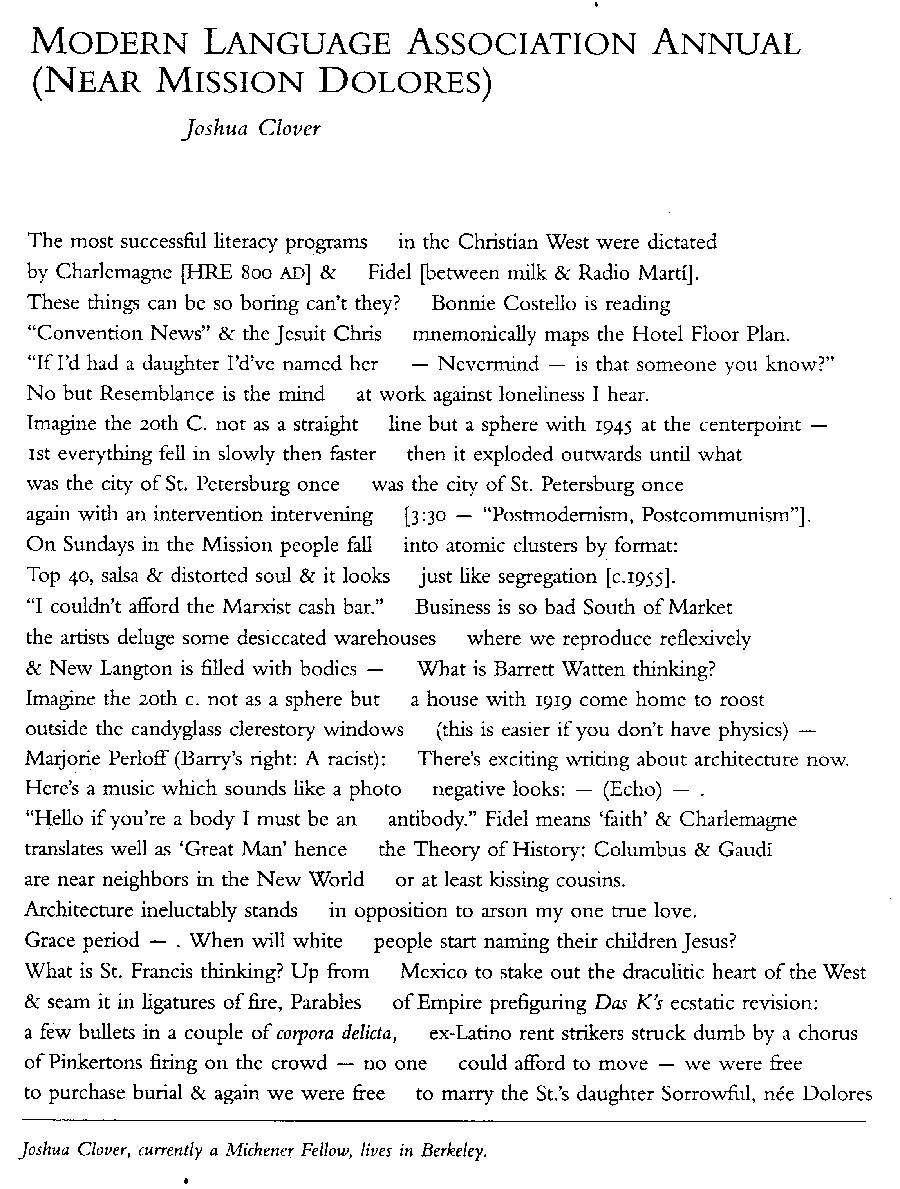 I didn’t think much of the poem (on left)—a notebook mashup of an overly impressed young poet. But I did mind being quoted as saying Marjorie Perloff was a racist (and anyone who knows her can understand why; Perloff took revenge for criticisms or slights, and this is well beyond that; more t/k). I wrote Clover a strong and quite nasty letter, sent via Zyzzyva editor Howard Junker, telling him that if he wanted to call someone out he should do so on his own dime. Given world and time, I want to write a more complete analysis of the aggressivity in Lacan’s terms involved in this exchange (both his and mine, as I responded aggressively). Next time I saw Clover, or he saw me, was at my lecture for the 2000 Orono Conference, which he would later disparage me for (here), then at Orono in 2008 (here). The series of events is entirely overdetermined but has a psychoanalytic explanation at its core: I had insulted Clover as a young poet; he at one time admired me as aspirational, an “Ego Ideal” or imagined interlocutor (“What is Barrett Watten thinking?”); I had called him out; and he worked to extract vengeance for that over the next three decades.
Lynn Crawford
Crawford’s account of “a group of Detroit based writers/artists/thinkers work[ing] together to launch a journal” in 2005–6 is short on details but does not hesitate to claim that I “treated [her] with disdain and responded with rage whenever I made a suggestion [I] did not approve of.” This is far from an accurate narrative of what took place, a false and embellished account. In 2005 a group, at Crawford’s invitation, began to meet to discuss the formation of an independent art criticism/cultural journal. The group basically consisted of Crawford; three Detroit-based artists; and four poets/scholars from outside Detroit then teaching at Wayne State. We met informally at her house. The idea was to rectify the perceived lack of any venue for informed art criticism in Detroit, basically a company town whose visual arts were dominated by the Detroit Institute of Arts (DIA). But on the horizon was something new: the coming launch of MOCAD (Museum of Contemporary Art in Detroit).
Crawford was writing for major journals (Artforum, Art in America) and had the Detroit “beat” whenever a worthy enough show came up. I had written art criticism for the West Coast journal Artweek for five years before arriving in Detroit, and was disappointed to find that there was 1) little going on in the visual arts here and 2) no place to publish art writing. My disappointment also coincided with a feeling of being a permanent outsider, lacking some form of essence or cred, a feeling anyone new to Detroit can recognize. The project was initially collective and cooperative, with decisions being made in a group format. The consensus was to find a way to publish independently, outside any organization—particularly the established museum, but also the new alternative museum just starting up. After a decade of arts organizing with New Langton Arts in San Francisco, I saw an opening for something that might make the cultural landscape in Detroit more fluid and various.
 We began with some rough design ideas; my mockups (here and here), amusing from this distance, show the corporate/arts environment to be a major negative motive. The project would be titled Detroit, I.e., which could be shortened to DIE (a pun on DIA). Negativity and attitude seemed right in relation to the institutional lifeworld. We also talked about connecting with serious designers (two were mentioned) and started to plan articles. I was then awarded a Fulbright to Germany and was out of the loop for the fall of 2005, while making contact with art in Berlin that I would be happy to connect with Detroit. The next thing I heard was that the journal was somehow going to be sponsored by MOCAD and that Crawford was up for a position on their board. Her narrative severely diminishes the stakes of this decision (“whenever I made a suggestion he did not approve of” meant “to affiliate the journal with MOCAD” and represent our efforts to them).
I was, in fact, quite angry that this had taken place, both in substance and procedure as I had been out of the country. As well, a designer was decided on—Danielle Aubert—without discussion that I was aware of, and she was eager to move into an artworld opening such a publication might provide. As I recall, my questioning of the venue culminated in Crawford agreeing to back off for the time being, with those remaining of the group trying to continue independently. There was not a group consensus about affiliating with MOCAD (or not) at this point. However, without Crawford’s involvement the project was not going to go anywhere either. I proposed that the remaining group meet, and we did; the consequences were fatal (more t/k), and I backed out. Those remaining with the project continued under the auspices of MOCAD, where Crawford would serve as board member for over a decade, and would publish I believe two issues of Detroit, I.e., with Aubert as designer (here).
 These events occurred in 2005–6, but it was not until the “blog” opened for business in 2019 did Crawford say or do anything about it. Over a thirteen-year period, there was a split between the “insider” status that Crawford enjoyed and those who did not want to make the move to MOCAD. This kind of debacle is typical of Detroit, where optimistic start-ups fade on a regular basis—as true in the arts as it is in real estate or restaurants. It’s a stalemate that only serves the gatekeepers. Fortunately there are new generations of artists and writers emerging in the past decade, but a cultural logic of siloing still obtains.
Crawford took an opportunity to settle scores on the “blog.” I can make an apology now, but it is a little late in the game. I should not have reacted as strongly, but then as now I have very little good to say about the arts in Detroit given my experience. And I don’t think, however welcoming the “insiders” thought they were to my coming here, that I was ever more than an “outsider” to them. Crawford has continued her role as arts curator with the Three Fold project and things go on as they do—a mere twenty years on.
Michael Cross
This was a graduate student, and now poet/teacher, at SUNY Buffalo when I was interviewed for the Gray Chair in 2004. The search itself was the site of high drama in the poetry world: the search was to replace Charles Bernstein, just after Robert Creeley had left for Brown, with Susan Howe about ready to decamp. There was a significant power vacuum to fill, and much projection and anxiety. Cross has little to say about the visit, and what he does say is false. The female student who asked a question was likely Jessica Smith (see here), as part of a normative Q&A. This is an example of sheer opportunism in recycling fifteen-years-old gossip after the mob action began and joining in the pile-on. Cross’s literary affiliations, from a recent series of online posts, also suggest an anti-Language, “process poetics,” bias.
An entirely trivial and projective account of my campus visit as a candidate for the Gray Chair at SUNY Buffalo in 2004. This hire was very politicized among graduate students, who had an inordinate influence in the process (as per a review of hiring practices at Buffalo I learned of later). The larger antagonisms here concern controversies in the avant-garde poetry community and competition between student factions. Over the two days of the campus visit, I had many positive interactions with faculty and students. After the hire was decided, I heard many apologetic remarks that I was not more favorably considered. Marjorie Perloff’s objection to my candidacy (more t/k) was a direct factor in that outcome. [2019 note]
Craig Dworkin
Of all the fabricated motivations for payback, Dworkin’s tops the list. The anecdote he relates in his post is false: it never happened, likely it is a moment of pure projection due to conference anxiety. I have no recollection of attending Dworkin’s talk, but if I was reacting to someone’s paper, even animatedly, it was certainly appropriate behavior at a conference. This is simply projection and/or embellishment based on no verifiable facts. What I do recall as fact is a moment from the E-Poetry conference at Buffalo (2001), where I had given a paper titled “Beyond the Demon of Analogy: www.poetics.” My original note narrates the interaction:
What is significant about my relation with Dworkin is his online poetics site Eclipse, which reprints literary journals and chapbooks from the formative years of Language writing in pdf format. At [the 2001] conference, Dworkin announced his project and said that he would upload facsimiles of my literary journal This, one of the founding publications of the movement. From the back of the room, I said, “We’ll see about that!” and then told Dworkin he would have to ask my permission (those were in early days of “open source” publishing on the internet). Over the succeeding [twenty] years, Dworkin has asked me many times for permission to reprint my work in this format, which I regard as inadequate. . . . Dworkin falsely claims I have been rude to him, when in fact what I have done is say “no” to many (but not all) of his requests to republish my work on his web site.
There have been many objections to the online “warehousing” of ephemeral publications and sound recordings online, e.g. at Eclipse and PennSound. The reason is simple: seeming to provide open-source access, these publications remove control (both authorial and media access) of literary materials. As one critic (David Lau) has pointed out, they perform a kind of monetizing of digital property; they amount to real estate of the ephemeral. I have every right to approve (or disapprove) of the republishing of journals and books I wrote or edited on such sites, but Dworkin in several instances has gone ahead without permission. His announcement at the conference was the height of the “open source” ideology that everything that exists in print can be instantly made instantly available—a belief that is now long over.
What is regrettable is that Dworkin took this refusal—again, my right as author, editor, and publisher—personally. And it is not even the case that I refused everything: the index to This remains available on Eclipse. But there are other reasons, I think, that Dworkin cooked up his narrative of being offended in order to join in the mob: my discussion of his work in Questions of Poetics: Language Writing and Literary History. In chapter 3, I discuss the appropriation work of Kenneth Goldsmith, Rob Fitterman, and Vanessa Place as a “radical historicism of the present” (17). In doing so, I distinguish between two tendencies of conceptual writing, which I term “Left” and “Right” conceptualism (after the Marxist critique of “Left” and “Right” Hegelianism). Framing that, I critique conceptualism’s own account of its history:
While Dworkin’s criteria for conceptual writing make a significant distinction in relation to conceptual art, he is only partly successful in distinguishing conceptual writing from Language writing or later post-avant developments (as well as from earlier figures such as David Antin and Kathy Acker). To begin with, he represents convincingly—although by means of an art historical and formal rather than cultural or historical framework—the tradition of conceptual art, its practices of nomination and rematerialization in the 1960s, leading to practices of inauthenticity and appropriation by the 1980s. His account of conceptual art is primarily a postmodern, language-centered one, while it is also restricted in terms of both form and genre. (155)
I go on develop my distinction between Left/Right conceptualisms in a comparison between Robert Fitterman’s Metropolis XXX and Dworkin’s Parse:
These two works vary widely, in fact, in their negotiation of the gap between form and history; we may provisionally contrast Fitterman’s contextualist and historicist poetics as a “Left conceptualism” to Dworkin’s appropriated and procedural work as a “Right conceptualism.” In Fitterman, a partly procedural, partly authorial reinscription of vernacular nonaesthetic language from fifteen sources . . . constructs a potential allegory of their epochal frame: global late capitalism and its reduction of everyday life to reified exchange. [On the other hand,] the use of materialist irony as conceptual frame is pushed to the limit in Dworkin’s Parse, which laboriously recodes a grammar textbook by substituting the names of grammatical parts of speech for each word of the text, resulting in an obdurately unreadable work that can only be understood as the result of the decisions that created it. [161]
Generous readers can follow the discussion of periodizing claims in conceptual writing in Questions of Poetics, pp. 157–64. I believe it is a fair account. Not only that, I reprinted pages from Goldsmith’s Day and Dworkin’s Parse, asking and obtaining permission for both (something Dworkin often neglected to do). The entire essay—”Periodizing the Present: Language Writing, Conceptual Art, and Conceptual Writing”—might have been a watershed in critical discussions of three intersecting areas of “critical art practice.” But no, it was all too much. Rather than engaging, the principles simply backed away. This was also the period in which conceptual writing, the “next thing” everyone had to pay attention to, suddenly lost its charge after the Michael Brown debacle (here). Dworkin’s contribution to the pile-on, in relation to the 2001 conference and Eclipse, is simply payback, and the timing in relation to my 2016 chapter is suspicious as well. Dworkin continues to do important work in poetics and has many interesting students (one of whom criticized him over this). It would be nice to see him remove this shabby moment from the internet.
Lisa Jarnot
 Next on the literary payback list comes Lisa (now Isaac) Jarnot, whose motives as biographer of Robert Duncan are even more transparent. Jarnot first claims I sent them a letter when they were Director of the Poetry Project reading series, some time in the 90s, unfairly complaining about their curating of a reading I had just given. I cannot recall this interaction, but maybe so: Jarnot is known as feisty and ironic, and perhaps I was channeling that tone in dealing with them. This is the kind of communication a program director might receive. What is not trivial is that they put up their account as a part of the pile-on, not very professional for a director in fact.
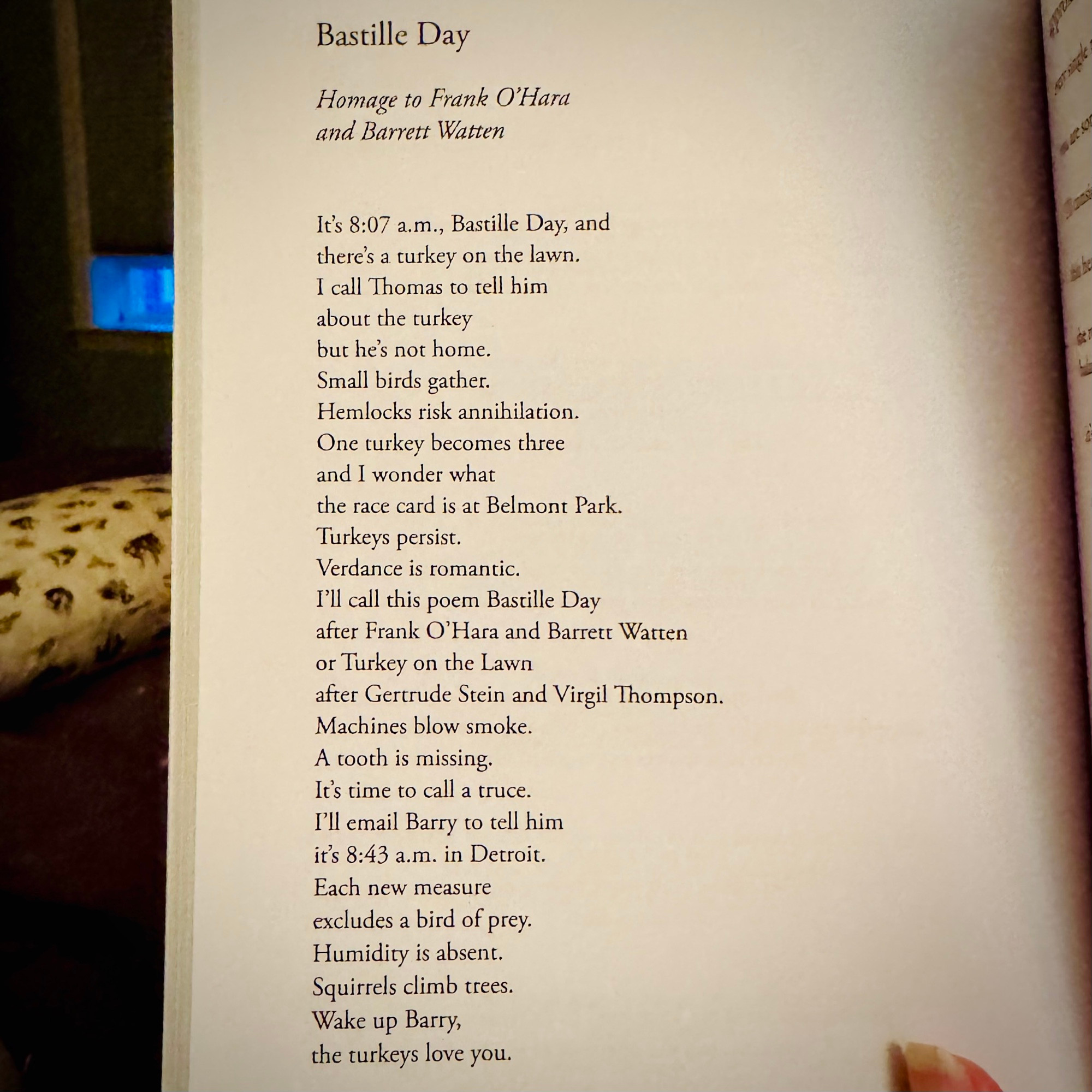
Jarnot has a strange attitude toward me and my work. At one point, they wrote a parody of my poem “Complete Thought” where, I recall, they substituted a number terms relating to “pigs” or “shit” for the original. I need to search the archive for proof, but the impact remains. Only just now, they published a poem (which I saw on BlueSkySocial under the heading “It’s time for a truce”) titled “Bastille Day” (left) “after Frank O’Hara and Barrett Watten” that reads, “I’ll email Barry to tell him / it’s 8:43 in Detroit” and ends, “Wake up Barry, / the turkeys love you.” There are thus comparisons to barnyard animals, turkeys and pigs, in the two poems (there may also be a third poem out there). Our main interaction, however, concerned their chapter on the Poetry Center event in 1978, which I have processed to exhaustion (here). In 2019, however, there was much to be resolved about that moment, as witness a series of interactions with Kent Johnson (here). With the ceasing of publication of Dispatches from the Poetry Wars, which regularly featured comment on the debate, the antagonism has subsided, but it was very active when Jarnot was writing their biography and when they posted on it.
An aspect of the event concerned a tape recording that was made and archived at the American Poetry Archive; I did not give permission for it to be publicly circulated. It was, however, and Jarnot had obtained a copy. My use of legal language had to do with copyright protection for this material. We had many email exchanges, and I was in fact quite concerned that I would be misrepresented—[they] devoted nearly an entire chapter to the encounter (and I ended up liking it). This kind of pitched exchange is common in literary affairs; it was ethically conducted, and in no way abusive or inappropriate. [2019 note]
Our correspondence was simply a negotiation between an author over being quoted directly by a biographer; I stuck to my position that I did not want the exchange to be misrepresented, as it had been many times (for instance in the claim that I had been pushed off the stage by Duncan, which did not occur—interesting as well as this was not seen as an instance of abuse of a young poet by a much older figure, which it was). Jarnot and I resolved the issue, and the chapter ended on a complimentary note that they relay, quoting Duncan saying, “Don’t ever underestimate Barrett Watten.” I saw that as a tip of the hat, from not only Duncan but Jarnot.
Why would Jarnot misrepresent either of these interactions as abuse? One would have to go deep to answer that, but on the surface I would suggest that this is the logic of the mob: that the collective dissociation of the group reinforcing each other’s reaction simply triggers more of it. As well, the dissociation and then triggering lead to false narratives that suddenly seem to be true: that I was doing anything but dickering over copyright in this instance. It would be nice if Jarnot would ask themself if this was really necessary and, like Dworkin and others, take this material down. Even more interesting would be to cycle the diffidence into more pig and turkey poems.
(N.B. I have been told that the author is now known as Isaac Jarnot and has changed pronouns; I am referring here to the author of the 2019 post, and of the poem that popped up on BlueSkySocial. In this post, I will change pronouns to they/them as plural since I am talking about both past and present names. It is interesting how the pronouns change the discussion, perhaps shifting the ground of antagonism to something else.)
Jennifer Nelson
While Dworkin, Jarnot, and even Clover had long-term interactions with me that led them to the “blog,” that is not the case with Jennifer Nelson. I had never heard of this person. She was at a literary/art event curated by Ugly Duckling Presse at the Salt & Cedar printing studio in Detroit in 2014. It seems she had a book published by Ugly Duckling and is an art historian in Chicago. There was a talk on the artist Carl Andre by a New York-based art critic. “Ugly” is the word for how he retailed the tragedy of Ana’s death, as if to an audience in the provinces that may have never heard of it. Carla Harryman, who also attended, agrees that his presentation was truly objectionable. I knew Ana Mendieta at Iowa, and encountered her later in the 70s in Oaxaca, Mexico.
I did not like the guy’s tone and from the back row intervened: “I knew Ana Mendieta.” On the “blog,” however, this turned into a defense of Carl Andre, which it certainly was not. Someone must have posted that online, and Nelson actually states, “Sorry for my limited helpfulness because I can’t recount the words used.” She does recall “the physicalized aggression with which he used his lumberingness to attempt to silence dissent,” which is entirely false. I was in the back row (where she could not have seen whether I was “lumbering” or not) and projected my voice with emphasis to object to the way Ana and her death were being salaciously described. The speaker continued with whatever he had to say, which was overall insufferable.
Notes and links
“Literary Contexts” will continue on the next page.
Page 12: “The Tragedy is Farce”
Page 12.1: “Literary Contexts II”
Page 12.3, “Academic Contexts I”
Page 12.4, “Academic Contexts II”
Page 12.5, “Academic Contexts III”Entry 66: “Antagonism and Left Poetics”