Entries tagged with poetics


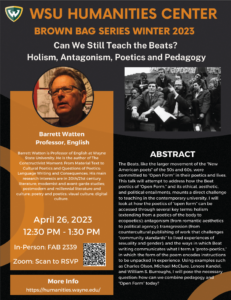
Can We Still Teach the Beats?:
Holism, Antagonism, Poetics,
and Pedagogy

A talk by Barrett Watten

Wednesday, April 26
WSU Humanities Center
12:30–1:30 PM, 2339 F/AB
In person/Zoom (here)

This talk will be drawn from a theoretical and historical reading of Beat poets Michael McClure (famous for transgressing species barriers and writing in “beast” language; now seen as a pioneer ecopoet as well as a poet writing at the intersection of language and the body) and Lenore Kandel (famous for her 1960s sex-positive collection The Love Book and other erotically charged writing; she is now seen a proto-feminist representative of the 60s sexual revolution). Both poets were subject to censorship in the 60s—McClure for his play The Beard, featuring a dialogue between Billy the Kid and Jean Harlow; and Kandel for The Love Book; both would be vindicated in the long run. Encompassing this moment are the poetics of “open form” promulgated by Charles Olson and others, as the pedagogical framework for Black Mountain College through the 1950s, and at later experimental programs. In adapting my research to the present talk, the question on the table is how to teach the work of the Beat poets today, with their expressive/embodied excesses and absolute refusal to comply to with normative decorum. This is not a hypothetical question. The recent decision at Cornell University not to require trigger warnings for difficult material was a significant pushback against content restrictions in the classroom, and supported the discretion of faculty to present course material. But this issue is not simply a matter of Right or legal guidelines; how does one present and interpret the transgressive work of an earlier period, both as a research topic and a teaching occasion? How did the Beats themselves imagine their work as “teaching, and being taught,” as we see in the publicity photo of Allen Ginsberg from 1965? How do we contextualize their historical present from the perspective of ours? The stakes for our pedagogy in the increasingly corporatized university are high. … More
Questions of Value: Rethinking the Discourse
of Valuation in Literature and Art

The Louisville Conference on Literature and Culture
Saturday 2:00 PM – 3:30 PM Room: Humanities 109
Chair: Barrett Watten, Wayne State University

Barrett Watten, Wayne State University
“Questions of Value: Poetics as Living Labor
and the Specter of Past Work”

David Kellogg, Coastal Carolina University
“Literary Values after the End of Curation:
Broadening the Scope, Limiting the Claims”

Tyrone Williams, University at Buffalo
“’Bessie, Bop or Bach’: Iconoclasm, Coterie, and/or
Communalism in Montage of a Dream Deferred

Adeena Karasick, Pratt Institute
“In the Value of the Shadow of. . . : Questions of
Value in 21st Century Art and Literature”
… More

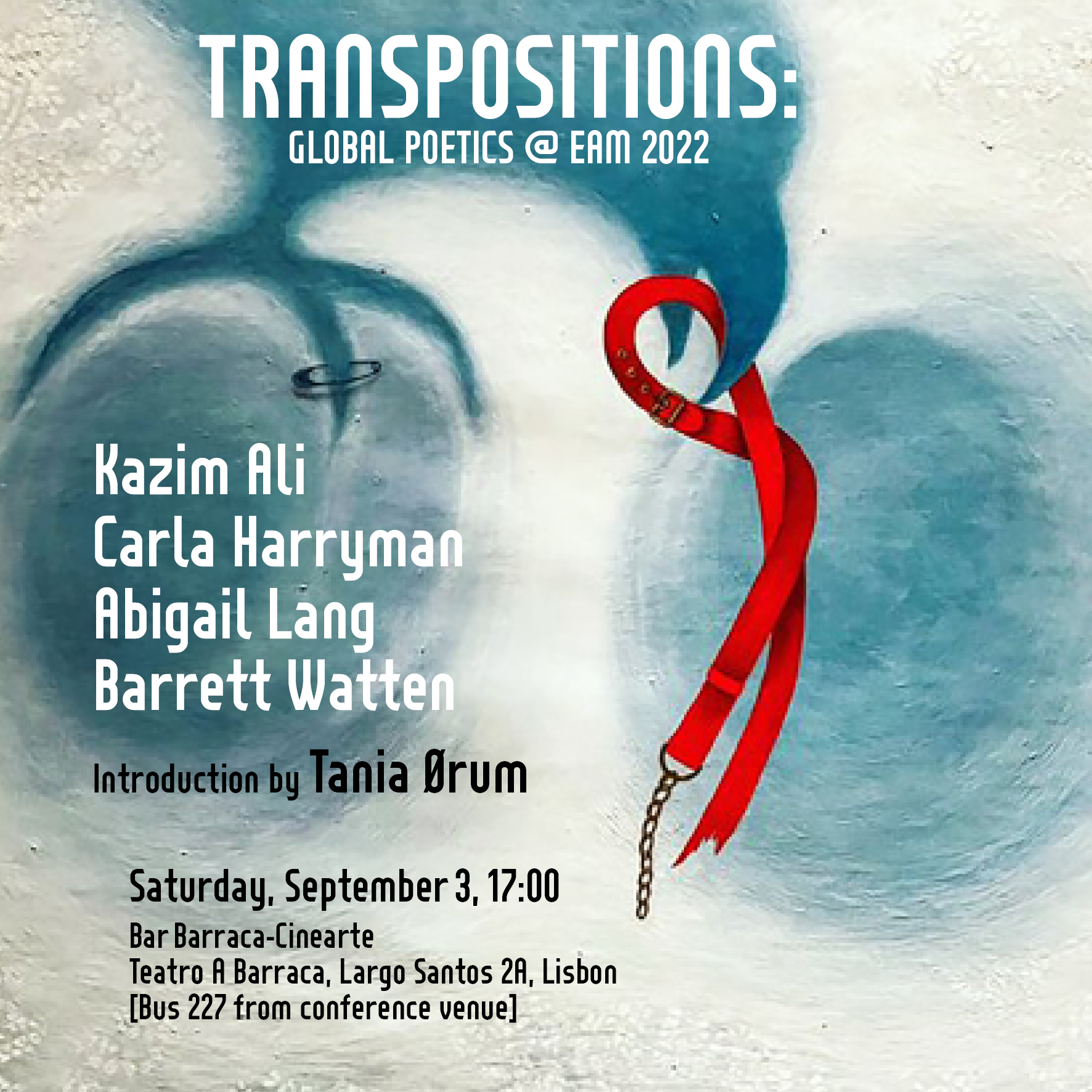
“Transpositions: Global Poetics @ EAM 2022”
Readings by Kazim Ali, Carla Harryman, Abigail Lang, Barrett Watten
Saturday, September 3, 17:00
Bar Barraca-Cinearte, Lisbon, Portugal

Rethinking Histories on a Planetary Scale”
Friday, September 2, 9:30–11:00 and 11:30–13:00
Barrett Watten, Aleksandr Boškovic, Claudia Franken
Lauri Scheyer, Kazim Ali, Abigail Lang

… More

“Modernist Poetics: New Genealogies
of ‘Making the Work’ in Modernity”

Seminar for “Making Modernism”
Modernist Studies Association
Portland, Ore., 27–30 October 2022

NOTE EXTENDED DATE FOR SEMINAR REGISTRATION
AUGUST 31: REGISTRATION HERE

Seminar led by Barrett Watten, Wayne State University
and Herman Rapaport, Wake Forest University
with invited guest Lyn Hejinian, UC Berkeley

Seminar prospectus (to enroll see below)

This seminar takes up the conference rubric, Making Modernism, as a question of “poetics”—a discourse of “making the work.” Poetics may either immanent to a modernist work of art or a supplement to it; it is an aesthetic or theoretical reflection that offers a blueprint for how the “work” is made and how to read it. Poetics may take the form of a separate instance of writing, a preface or explanatory essay external to the work of art, or it may be described or enacted in the work itself, as a set of instructions to the reader on how work may be read. In this seminar, we will seek new ways of understanding modernist poetics, at or beyond the epochal date of 1922, as a response to the crisis of modernity. Modernist poetics is often characterized as “formalist,” after avant-garde manifestos, the New Critics, or the Russian Formalists. For this inquiry, Eliot’s “Notes” to The Waste Land and his editorship of The Criterion would be as important for modernist poetics as the poem itself. Extending this principle, Joyce’s turn to writing “Work in Progress” and its serial publication in transition from 1927 on would depart from the modernist masterpiece into another kind of writing; Stein’s “Composition as Explanation” (1926) would supplement the publication of Geography and Plays (1922); and McKay’s development of vernacular prose romances from Home to Harlem (1928) to Banana Bottom (1933) would augment the formal poetics of Harlem Shadows. After 1922, a reflection on the “making of the work” emerges in numerous works of poetics that address the modern present and its “condition of possibility.” Such a deliberate inquiry into the making of the modernist work motivates the prose/poetry dialectic of William Carlos Williams’s Spring and All (1923); it is found in the self-reflexive explorations of women authors such as Mina Loy, Marianne Moore, Laura Riding, and Djuna Barnes; it extends to the social discourses on poetics in the Harlem Renaissance and the Popular Front; it is everywhere in the manifestos of the avant-garde, especially surrealism; it appears in the turn to fascism in Ezra Pound and Wyndham Lewis; it is central to key works of Critical Theory such as Walter Benjamin’s “The Author as Producer” and Theodor Adorno’s many writings on modernism. This seminar invites literary, historical, cultural, and theoretical inquiry into works broadly seen as “poetics” in modernism. What will count as a key work in modernist/modern poetics is the task of participants to determine; our aim is to establish a broad and productive series of works that represent the aesthetic, cultural, political, and critical “making of the work” under conditions of modernity. In so doing, it seeks a broad discussion on modernist poetics in line with our earlier work on contemporary examples in A Guide to Poetics Journal and Poetics Journal Digital Archive (Wesleyan UP).

… More

In Questions of Poetics, I wrote that, in contrast to André Breton’s motto “I seek the gold of time,” what I wanted is more like the “currency of history.” All this bears on the question of value, of course. Breton’s wish to alchemically transform desire into substance is inscribed on his tombstone, where it is still doing its work. In another present, I see history as a gold mine of another sort, making meanings that circulate and become value. Such is the task of the poet, broadly put, writing works that will be circulated until they find their meaning and use. It is also the task of the literary historian, to establish the contexts, motives, situations in which such meaning may be made. There needs to be more literary history, not of the old, positive kind but one addressed to the making of value in poetics as history. This could begin with the work of an archive, as an assembly line of parts for meaning making—eventually tending toward a form of comprehension, like the work of literary history depicted above.

Lilian Chaitas’s Being Different: Strategies of Distinction and Twentieth-Century Poetic Avant-Gardes contains, in my reading-in-progress, the best account of the debates on early Language writing I know. Published in 2017, it is a meticulously detailed, 435-pp. account of American poetic avant-gardes from the New Americans to Language writing, drawing its theory from Renato Poggioli and Pierre Bourdieu, with a glance back to Alan Golding’s From Outlaw to Classic (1995). Originally it was a 2013 dissertation written to German standards under the direction of Bernd Engler at the University of Tübingen, where not coincidentally I was hosted as a Fulbright scholar in 2005 and staged a raucous conference on Authorship and the Turn to Language that December—a currency of history itself. But I did not know the work existed until a section of the last chapter, retelling the 1978 Duncan/Watten cataclysm in microscopic detail, turned up as a pdf on Dispatches from the Poetry WarsI finally located a copy on Amazon.de, which arrived last month from a warehouse in Nijmegan, Netherlands. The last chapter, “Language Poetry in the 1970s and 1980s,” is what concerns me here—and which so impressed me that I provide it in three separate pdfs (here and below), one for each of the major sections. These address, in turn, “The So-Called ‘Language’ School”; “The Duncan/Watten ‘debat/cl/e'”; and “Stalin as Linguist.” … More

Document 93: Global Ideation

The global circulation of ideas advances with the publication of the Journal of Foreign Languages and Cultures, vol. 5, no. 1, edited by Laurie Scheyer from Hunan Normal University. As with last year’s special forum on “Modernity @ Zero Hour,” this issue contains a set of papers—distributed through a capacious issue with numerous related themes—that developed in an online webinar, “Avant-Gardes @ Zero Hour,” which took place during conditions of COVID in March 2021. The webinar itself, thanks to Zoom, was itself global and involved participants from seven time zones, from New Zealand to Moscow. It also could include a performance event, the in-time screening of Carla Harryman’s “Occupying Theodor W. Adorno’s Music and New Music: A Re-Performance,” originally proposed for the canceled EAM conference in Fall 2020. In this best of all possible worlds, our proposed event went forward; papers were presented, comments generated, drafts revised, and the results are now distributed to the world at large. Below I list the contents and link to the six papers that were the result of that effort, seen as part of a larger conversation in a global framework. Indeed my own contribution, “The Global Archive and the Future of Poetics,” looks at the form of the global exhibition after the German documenta, but it easily applies to what we are doing here. … More

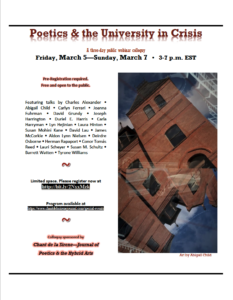
Poetics & the University in Crisis
Friday, March 5–Sunday, March 7 / 3:00–7:00 P.M.
featuring 22 poets, critics, teachers, artists
free registration required; click here

A virtual colloquy on the role of poetics in the American university in crisis, for a nation also in crisis. The humanities and arts continue to be major targets of increasingly austere budgets—and so, too, has critical thinking. How can poetics—as inventive, intellectually engaged creative series of practices and modalities of thought—offer an intervention into this moment? How can the university re-embrace the necessity of art based in critical thinking and open inquiry that includes the aesthetic and the political? The three days of this colloquy will aim to unite creative poetic practices with analytical critique and pedagogy from a wide range of voices, methods, points of view.

… More

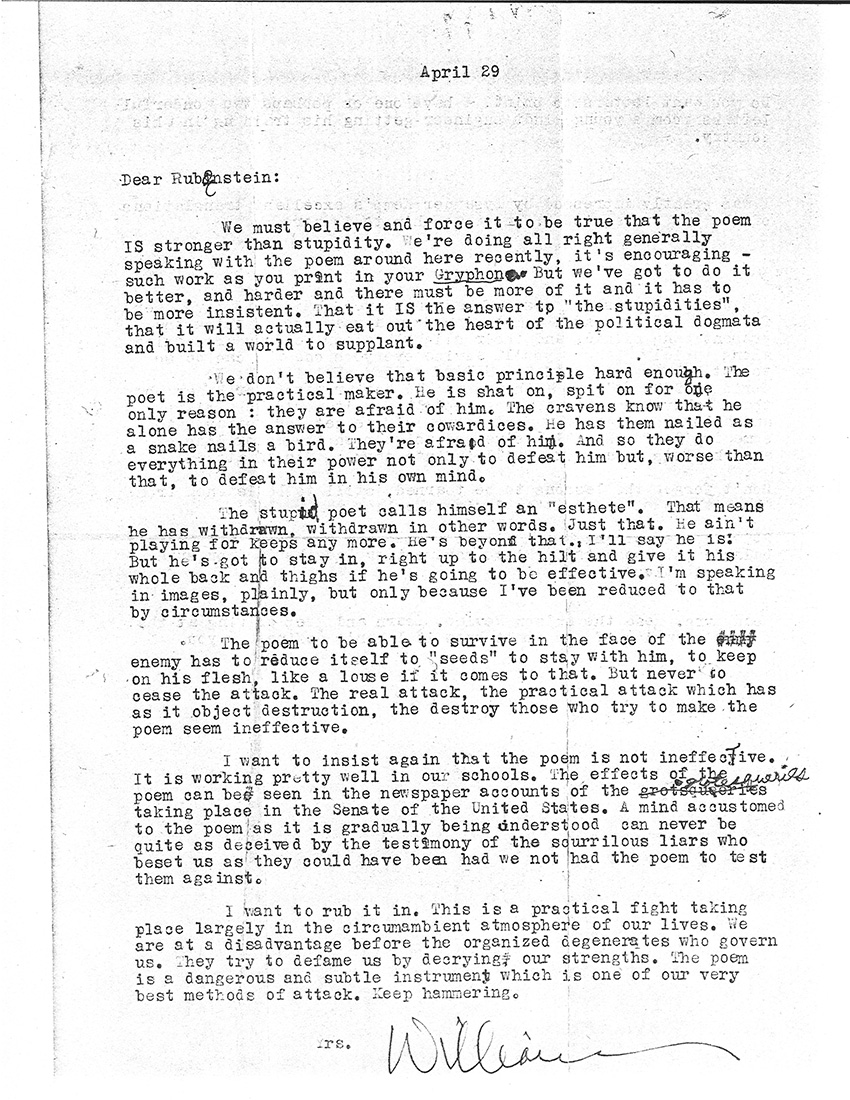
Working through my archive, a copy of the above letter from William Carlos Williams, dated “April 29” and addressed to a “Rubenstein,” turned up. Given the degraded quality of the Xerox, it must have been passed around from hand to hand, and is now far removed from its origins. I have no idea how it came into my possession; my impulse was to distribute it forthwith as widely as possible, given our situation four days before a decisive political event. It does not appear in Williams’s Selected Letters, but an article from the William Carlos Williams Review (here) gives a thumbnail history. The addressee is Richard Rubenstein, editor of a little magazine The Gryphon, a poet associated with the emerging Beat movement in San Francisco who died of the effects of psychiatric treatment in 1958. The date is 29 April 1950, at which time Williams was recently investigated by the House Un-American Activities Committee (HUAC) for his association, I now believe is likely, with Popular Front groups in the Spanish Civil War but reputedly for his friendship with Ezra Pound, which resulted in his being denied appointment as the Poetry Consultant to the Library of Congress in 1949. In its resistance to the “stupidity” of “political dogma,” Williams writes: “A mind accustomed to the poem as it is gradually being understood can never be quite as deceived by the testimony of the scurrilous liars who beset us as they could have been had we not had the poem to test them against.” Four days before our opportunity to run the scurrilous liars out of power, his words have a new force.  … More

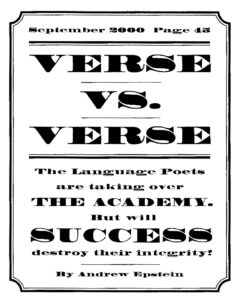
Twenty years on, it is timely to reread the kind of discourse—or brazen publicity—that was circulated about Language writing and the academy, and indeed the entire project of poetics that was imagined as their synthesis, about 2000. In the two decades that followed, everything has changed in terms of the “horizon of expectation” that led to this premature discussion of the dominance of Language writing in the academy; in 2020, I will say confidently from my experience, and what I know of others’, that such a thing never happened. Perhaps it was meant not to happen, and the provocative title page to the September 2000 article in Lingua Franca by Andrew Epstein may be the reason why. As I work through my archive, I am finding numerous such signposts to futurity that did not arrive, while at the time I was caught up in the process, let us charitably say, of negotiating the “stakes at the table” of the future of Language writing. Why this discourse was misdirected, and for whose interests, will be the substance of my reading below; those interested may find, in the interest of time travel, the full text of the article here… More

Document 83: @ Louisville


Ahead of our “nonsite” event in Louisville Friday, I wanted to put the record of my contributions to the Louisville Conference up, to point to the critical and poetic work that has scarcely been considered in this instance. Content—not just projection—matters. I have added a sentence or two to each title, along with publication history, to give a sense of what my path through Louisville has been. The Louisville Conference has indeed been important for me, and I am deeply grateful for and committed to it. But I never shouted anyone down at this conference, though I did go on too long a couple of times early on.

Nonsite event

“Cancel Culture as Unfree Speech: Parrhesia @ The Louisville Conference,” independently organized, The Brown Hotel, Louisville, February 2020.

A brutal rationalization takes place in the neoliberal university beyond the wildest dreams of Mario Savio; the degradation of speech we have suffered is its symptomatic manifestation. The university has achieved a condition of unfree speech that has spread, in viral fashion, from the central core of the administration to the department and classroom, each internalizing and performing its version of the paranoia and defensiveness of the larger polity, where it reigns unchecked.

Lectures and panel presentations

“Refunctioning Surrealism: Eugene Lim’s Dear Cyborgs and Karen An-hwei Lee’s Maze of Transparencies,” The Louisville Conference on Literature After 1900, canceled February 2020. … More