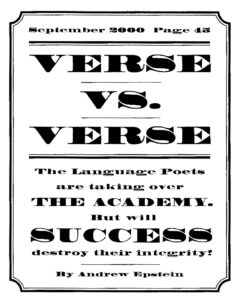
Twenty years on, it is timely to reread the kind of discourse—or brazen publicity—that was circulated about Language writing and the academy, and indeed the entire project of poetics that was imagined as their synthesis, about 2000. In the two decades that followed, everything has changed in terms of the “horizon of expectation” that led to this premature discussion of the dominance of Language writing in the academy; in 2020, I will say confidently from my experience, and what I know of others’, that such a thing never happened. Perhaps it was meant not to happen, and the provocative title page to the September 2000 article in Lingua Franca by Andrew Epstein may be the reason why. As I work through my archive, I am finding numerous such signposts to futurity that did not arrive, while at the time I was caught up in the process, let us charitably say, of negotiating the “stakes at the table” of the future of Language writing. Why this discourse was misdirected, and for whose interests, will be the substance of my reading below; those interested may find, in the interest of time travel, the full text of the article here. … More
Entries tagged with poetics
February 18, 2020
Document 83: @ Louisville
Ahead of our “nonsite” event in Louisville Friday, I wanted to put the record of my contributions to the Louisville Conference up, to point to the critical and poetic work that has scarcely been considered in this instance. Content—not just projection—matters. I have added a sentence or two to each title, along with publication history, to give a sense of what my path through Louisville has been. The Louisville Conference has indeed been important for me, and I am deeply grateful for and committed to it. But I never shouted anyone down at this conference, though I did go on too long a couple of times early on.
Nonsite event
“Cancel Culture as Unfree Speech: Parrhesia @ The Louisville Conference,” independently organized, The Brown Hotel, Louisville, February 2020.
A brutal rationalization takes place in the neoliberal university beyond the wildest dreams of Mario Savio; the degradation of speech we have suffered is its symptomatic manifestation. The university has achieved a condition of unfree speech that has spread, in viral fashion, from the central core of the administration to the department and classroom, each internalizing and performing its version of the paranoia and defensiveness of the larger polity, where it reigns unchecked.
Lectures and panel presentations
“Refunctioning Surrealism: Eugene Lim’s Dear Cyborgs and Karen An-hwei Lee’s Maze of Transparencies,” The Louisville Conference on Literature After 1900, canceled February 2020. … More
September 8, 2019
Document 80: Refunctioning Poetics
CALL FOR PAPERS
Refunctioning Poetics
The Louisville Conference
on Literature and Culture After 1900
University of Louisville, February 20–22, 2020
Organizer: Barrett Watten / contact by September 16
This is a call for one or two participants for a session on the “refunctioning” of literature (focusing on poetry and poetics in terms of “the making of the work” but including other genre possibilities). Recent texts suggesting such a “refunctioned” poetics include Lyn Hejinian’s Positions of the Sun; Kevin Killian’s amazon.com writings; Eugene Lim’s cyber-novels; and others proposed by panel participants. The concept of “Refunctioning” (Umfunktionierung) comes from Walter Benjamin, via Bertolt Brecht, in his keystone essay “The Author as Producer” (1934). How can new forms and genres of poetics be seen as “refunctioning” the aesthetic as political, given that Benjamin’s world has been “refunctioned” in the “new presentism” we live and suffer? Returning to Benjamin’s 1934 essay, in the context of the struggles against fascism but also in contestation with socialist realism, the panel asks, what does “refunctioning” authorship, and the literary and cultural work, mean in the present? Participants may approach this question by rethinking the status of the author; theorizing poetic making from a gendered perspective; seeing material production and digital reproduction as central for rethinking poetics as “the making of the work”; and reading new genres of experimental writing, after the Millennium, that incorporate its precarious presentism.
June 23, 2018
Document 75: Radical Particularity

Throughout Questions of Poetics, I use radical particularity as a critical concept to discuss the making and interpretation of Language writing and other forms of art—but also its limits as a pre-given or “one-size-fits-all” concept. Language writing may be characterized, in almost every instance, by the foregrounding or highlighting of the “radical particular,” but this does not simply guarantee the success of its aesthetics or politics, nor does it distinguish its use of the radical particular from other art practices. I see the focus on the “radical particular” as common to the avant-garde, as having a critical potential that is the beginning, not the end, of its politics:
Radical particularity has a long history in avant-garde practice—indeed, it may be the formal feature most characteristic of the manifold histories of the avant-garde, from Dada’s cut-ups to surrealism’s found objects to imagism’s direct treatment to Language writing’s parataxis, continuing in myriad ways in present poetry and art. The priority of parataxis (or principle of equivalence) over hypotaxis (or principle of subordination) has, in itself, even been taken as the key principle of Language writing’s claim to a politics, as if the mere foregrounding of the materiality of language would overturn the Symbolic Order, mirroring or subverting the equivalence of the commodity form and exchange value by bringing material social relations to consciousness and thus negating them. What remains to be shown are the precise relations between materiality, signification, criticality, and form such that the agency of the work is not reduced to a universal effect, good for every occasion. (8)
May 6, 2018
Entry 34: Lost America

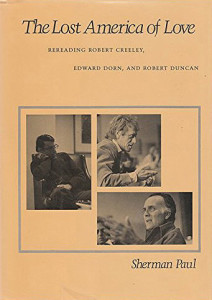
The question of my relation to the New Americans over the long decades since the ’70s has recently come up. In working through my last post, a response to a review that framed my 2016 book with a retelling of the poetic debacle of 1978, I linked to an essay I published in 2000 (per copyright date; it likely appeared in 2001) that was, at the time, my critical and historical assessment of some of its major figures: Robert Creeley, Edward Dorn, and Robert Duncan. Duncan (1988) and Dorn (1999) had already passed, and I do not think I sent the essay to Creeley, with whom I maintained good relations at the time (Creeley died in 2005). Creeley tended to glaze when I sent him offprints of my critical writing, for instance the essay on “poetic vocabulary” that links Jackson Mac Low and BASIC English, to which he wrote a one-word response: “Impressive.” Only later did I find, via a comment Creeley dropped in conversation and a letter in his Selected Letters, that BASIC English had been an influence on his work, after a high school teacher asked to write an essay using its minimal vocabulary.
The events of September 2001 decisively changed the focus of thinking through the poetics of the New Americans onto a more immediate political situation; the broad expanses of time needed for genial conversation on poetry and poetics would be displaced by a militarized discourse of threat, reprisal, and nonexistent WMDs. The essay itself was a kind of swerve, using a request from editor Timothy Murphy for a contribution for a volume of the academic journal Genre to be titled “Desert Island Texts,” with a prompt something like, “what one book would you want to have if stranded on a desert island.” … More
March 31, 2018
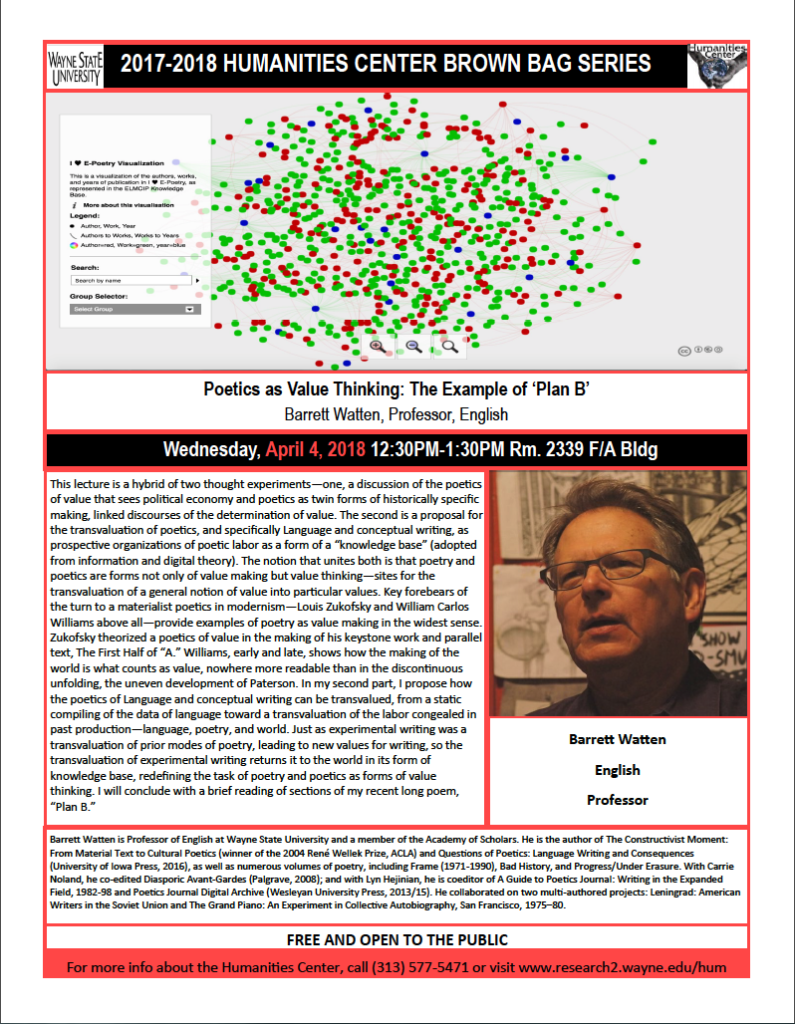
Document 70: Poetics as Value Thinking
Poetics as Value Thinking:
The Example of “Plan B”

Wednesday, 4 April 2018, 12:30–1:30 PM
2339 F/AB, Wayne State University
This lecture is a hybrid of two thought experiments—one, a discussion of the poetics of value that sees political economy and poetics as twin forms of historically specific making, linked discourses of the determination of value. The second is a proposal for the transvaluation of poetics, and specifically Language and conceptual writing, as prospective organizations of poetic labor as a form of a “knowledge base” (adopted from information and digital theory). … More
Six Moments of Occupy:
Transvaluations of the Symbolic
Humanities Center Faculty Fellows Symposium
Wayne State University, 23 March 2018
[excerpt from the introduction] Occupy was, and continues to be, an event; we speak of “the event of Occupy” much as we refer to the “event of 9/11.” To begin with, the concept of “revolution” in Occupy—as distinct from other specific moments such as Tahrir Square or anti-austerity Greece—oscillates between “radical particularity” of material conditions (such that every local instance of Occupy, from Zucotti Park to to Oakland to Paris to Moscow, could be seen to have substantially different strategies and goals) and a utopian horizon that must be preserved as an abstract totality: “We are the 99%.” … More
November 4, 2017
Entry 31: Generation
Generation n. 1 All of the people born and living at about the same time, regarded collectively; ‘one of his generation’s finest songwriters.’ 1.1 The average period, generally considered to be about thirty years, in which children grow up, become adults, and have children of their own; ‘the same families have lived here for generations.’ 1.2 A set of members of a family regarded as a single step or stage in descent; as modifier, in combination ‘a third-generation Canadian.’ 1.3 A group of people of similar age involved in a particular activity; ‘a new generation of actors and directors.’ 1.4 A single stage in the development of a type of product or technology; ‘a new generation of rear-engined sports cars.’ 2 mass noun The production or creation of something; ‘methods of electricity generation’; ‘the generation of wealth.’ 2.1 The propagation of living organisms; procreation. Origin Middle English: via Old French from Latin generatio(n-), from the verb generare (see generate).
May 14, 2017
Document 50: Poetics as Value Thinking
Poetics as Value Thinking:
Transvaluations of Language Writing
Presented at Fondation des Etats-Unis, Paris
sponsored by Double Change/Ecole normale supérieure
15 March 2017
This lecture is a hybrid of two thought experiments—one, a discussion of the poetics of value that sees political economy and poetics as twin forms of historically specific making, linked discourses of the determination of value. The second is a proposal for the transvaluation of poetics, and specifically Language writing, as a prospective organization of poetic labor as a form of a “knowledge base” (adopted from information and digital theory). The notion that unites both is that poetry and poetics are forms not only of value making but value thinking—sites for the transvaluation of a general notion of value into particular values. … More
Poetics as Knowledge Base:
The Example of “Plan B”
Presented at the Louisville Conference
on Literature and Culture after 1900
24 February 2017
This paper is a thought experiment that reads experimental poetry and poetics in relation to the concept of “knowledge base”—even as poetic attempts to create a knowledge base itself. The making of poetry has always been attended by some kind of “lore,” the necessary but often obscure or intractable set of background knowledges and beliefs that are crucial for its understanding—T.S. Eliot’s notes to The Waste Land or Louis Zukofsky’s parallel texts for “Mantis” are modern examples of this. Historicism in poetics depends on accessing and developing this lore, which it extends to more nuanced contexts; at the same time, theory-based approaches creates a metadiscourse of key concepts that may become part of the knowledge base of poetics. From the romantics to the postmoderns, the construction of such a knowledge base is a necessary entailment of “the making of the work in its condition of possibility”—the task of poetics as a discourse. I want to look at a range of ways this knowledge base is represented and accessed, from the archiving of writings in poetics to modernist and postmodern concordances to major works (such as Zukofsky’s “A”) to online poetry/poetics archives to recent experimental methods. What would a rigorous use of the concept of “knowledge base” in computing and information theory bring to understanding poetics in such terms? … More