 As a specialist in revolt, I am subject to frequent unanticipated reactions (possibly part of the plan all along). Heading out to the part-time East Bay address I share with an unnamed co-conspirator in late October, I was looking forward to participating in a group reading celebrating fifty years of Roof magazine, organized by James Sherry, with a cast of West Coast poets many of whom date back to its inception. Let us say that the poetry of history includes many contingent events, accidents, or misfires, and that goes for the history of poetry as well. Due to a minor chain reaction whose traces have been almost entirely erased, the reading had to be rescheduled at the last moment and held at a private residence. In the end, due to another unnamable contingency, I could not attend and was thus unable to read my work.
In the lexicon of my work, these are “Non-Events”—as the surrealists say, “in an unusually pure form,” thus worthy of reflection. That October 23 (a Friday) I had spent the day writing a new piece for the reading, using individual lexia from the first poem in Zone, “Period Style,” to provide interpretants for sentences demonstrating the use of the term period style in my critical writing (here). In Jackson Mac Low’s work, especially the recent Complete Stein Poems, there is meticulous attention to every formal move involved in his machine-generated writings-through of poems based on Gertrude Stein’s middle-period work—though little discussion, as I have pointed out, of why her middle-period work is favored over her writing from its beginning or end. Such an overview might be decisive, even theoretically necessary. One might likewise interrogate the micro-decisions that led to my sampling procedures, the choice of texts, and their final form, but also the macro-narratives that motivated them. That I will attempt at some level of generality, once having reproduced the work I did not read at the event I could not attend:
Correlation of “Period Style”
A ritual beginning to transcend.
. . . from the broad economic periods of Mandel and Jameson, while refusing to reduce periodization to a mere succession of period styles.
“All right.” The story basically concerns the key to
success, a case in point irony. You forget the rest of it.An analogy to the market creeps into the concept of period style, in the notion of competitors eliminating each other by formal innovation and succession . . .
Sound deteriorates in direct ratio to the distance from
the ear.“Period style” is thus a retrospective denial of prospective address, misreading as it negates the very contexts that gave 1970s art meaning.
It sticks to the page, cast upon a white wall.
The ascription of period style in this sense coincides with the repressive regimes of Pinochet, Reagan, and Thatcher: forget your utopian hopes—you lost.
The woman leaves or drops off coat, hat. With a little
distance it didn’t matter quite so much anymore.The limit case of such a dropping away is when the social and artistic overdetermination of motives collapses into period style—this is the “death of the avant-garde.”
His oscillations caused only disbelief, no matter how
careful he was. Voices had become a disaster.It is with that task—to separate the critical agency of Language writing from any tendency to stabilize it in a period style—that I approach recent examples.
Allows scrutiny as its most unconquerable act. As a city,
substituted for the war.. . . within the context of Language writing’s dialectic of radical particularity and formal agency, I see a refutation of its critics’ attempts to contain it as a period style.
All history is taken aback. Causes a tentative movement
outward, changes into its opposite.To counter the charge of a period style . . . I will start with the textual and historical attributes of Ron Silliman’s now complete The Alphabet (2008).
One man’s ownership of a word. She felt better
afterwards.See introduction, n. 10, for Perloff on Language writing as “period style of the 1980s”; she criticizes Language writing in the same terms she used to praise it in 1985.
Allows pleasure as its most difficult act. It has become
unmanageable.. . . in the process of which, the difference between Language writing as an active method and the static description of a period style comes clear.
Not as a symbol, in no sense standing for.
It was publicized by Al Filreis, “Language, Period Style of the 80s” (2008); Kenneth Goldsmith cited it in Harriet (2008); it was picked up in Steve McCaffery’s “Language Writing,” in Cambridge Companion (2012); it was posted in Commune Editions’ commentary in Jacket2 (2014).
To die from an average of grace.
“But this does not mean that there is any great honor is achieving a period style. . . . As soon as one has become evident, another begins to emerge within or alongside it.”
Anonymity is far away. But with feelings adrift, it didn’t
matter quite so much anymore.Returning to the historical emergence of Language writing makes it possible to recover its prospective horizons from the literary entropy of “period style.”
Taking things one at a time. The routines are set off by
the words.To counter Perloff, we will need to distinguish between the prospective and retrospective horizons of Language writing to answer the charge of a static, atemporal period style.
She knew if they could always be a spectator as you were
being a victim, we would not have to wait for time to pass.The provocative phrase “period style” stands for a reductive attempt to create a logic of avant-garde succession where innovative form advances from one period to the next.
The pictures are set off by the frames. A clear tone
breaking down to weaker overtones.Language writing is more aligned with Laclau and Mouffe’s notion of “discursive formation” of subject positions akin to new social movements than a “period style.”
A facile mind is much less than what it imitates, rubbery
and unconscious as it seems. Gold is reduced to lead.Language writing’s political motives were suppressed in its early reception by Marjorie Perloff, for whom the “turn to language” in poetry was no more than a period style.
The ratio of image to desire is one. A fact of personal
history. A monument by design.The politics of neoliberalism and Language writing’s radical use of political economy are the focus, as are the ways its new genres and forms are irreducible to a period style.
By a subtle change of logic, the collapsing walls were
pushed back.Even at the origins of Language writing, we must reject the notion that its contributions were merely a period style; many authors foreground language in similar ways.
The subtitles were in French, they couldn’t understand a
thing.Briefly citing three Language writers, she claims: “The defeat of reader expectation—a kind of cognitive dissonance—is central to these poems”: a period style.
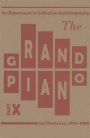
 Even without the polemical introduction, which I planned not to read (see below), I anticipated this work might cause a riot—though most likely a riot that would take the form of suppressed discomfort, coughs, and giggles. What, then, were my larger motives for taking the time to craft this piece (and reproduce it here)? In what way were they an appropriate homage to the magazine Roof, whose fiftieth anniversary is being marked coast to coast by readings and other celebratory events? This comes down to two questions: 1) what is Language writing and what do we think it is now; and 2) what was Roof’s contribution to Language writing in its emergence, if in either case not reducible to a “period style”? I recall, apart from the varying content of Roof as it appeared (which was not stabilized around the forthcoming Language canon, though it did include all the major figures), that it was its image-forbidding (Bilderverbot) cover, with nothing but typography, and that very inky and black, which brought the disparate poetics together. Was this a “period style” then, or is it still active? Note that the commemorative issue of Roof XI is immediately identifiable by that graphically emphatic cover. If not a brand, then a device: it still occasions a response and a rethinking.
In a comment stream on Facebook, I encountered this remark from a contemporary publisher of Language writing, to quote: “James may be the last man standing still speaking about ‘Language’ poetry—good for him.” Curious from a publisher of Language writing who must still have some interest in that “period style.” What is at issue, however, is the mere mention, or unceasing repetition, of the group name itself (about which so much has been written). We approach the asymptote of what critic Paul Mann, in his infamous work of criticism, called “The Theory Death of the Avant-Garde,” an entropic heat-death when the original provocation of a movement disappears into clouds of documentation, exhibition, literary history, and theory. But if the avant-garde has no enduring force, why would the mere mention of the term “Language writing” at a reading for Roof magazine imaginably burn down the house, or even be mildly controversial? Haven’t we learned to keep our mouths shut about it? Here there is indeed a key to the collective non-event that occurred: a kind of reaction formation to Language writing, boiled down to an abstract remainder that barely exists and would be unpleasant to hear of. Hence my strategy for the event itself: I wanted to to provoke a discussion on whether the term is still admissible. In either case, admissible or not, what is it doing in the halls of its own endless reflection, if not telegraphing some calcified “period style”? The non-event speaks.
Notes and links
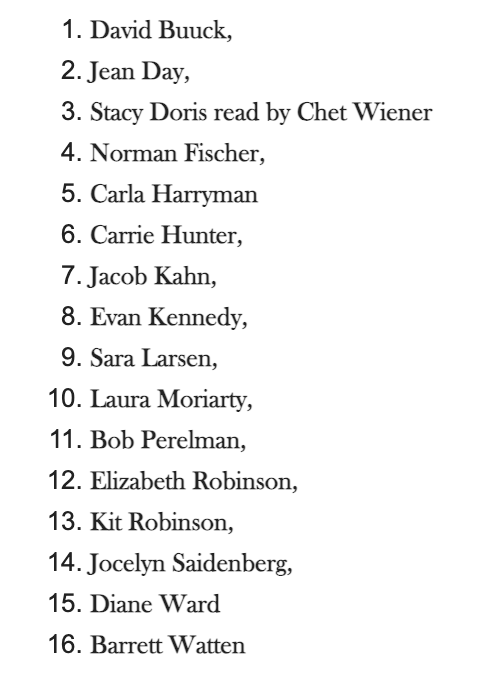
Image: publicity for Roof/Segue reading, October 23, 2026
Polemical introduction: “An online commentator, I have heard, has just described my critical work Questions of Poetics as imperialist and hegemonic—strong language indeed! While my book does make strong claims, they are in the context of critiquing, and revising, the history of Language writing after 2000, among many topics. One of its major polemical goals is to defend Language writing from the charge of being a ‘period style’—a term first used by Marjorie Perloff and taken up by others to dismiss Language writing’s continuing relevance. I argue that Language writing has been widely influential, among many tendencies; it is a part of the literary history and poetic resources of the present. That does not make it the Third Rome, no.”
“Document 73: Period Style”: here