>> Documents <<

Document 106: Various Devices!

FOR IMMEDIATE RELEASE! 

VARIOUS DEVICES:
SELECTED WRITINGS

BY CARLA HARRYMAN

MOSCOW: POLYPHEM, 2024

[for Russian text, click here]

Polyphem, an independent press in Moscow, announces publication of a comprehensive, bilingual edition of the writings of Carla Harryman.

The works, chosen by editor Vladimir Feshchenko, represent the full range of her pioneering genre-disrupting, performative texts—from Percentage (1979) and Under the Bridge (1980) to Cloud Cantata (2020) and Scales for the Living (2023).

Also featured are the complete scripts of her germinal works for San Francisco Poets Theater: “Third Man” (1978); “There Is Nothing Better Than a Theory” (1984); and “Memory Play” (1994).

Excerpts from her dystopian novel Gardener of Stars (2001) and the ludic hybrid text Baby (2005) are included, along with selections from her erotic picaresque, co-authored with Lyn Hejinian, The Wide Road (2011).  … More

Document 105: Not This!

FOR IMMEDIATE RELEASE! 

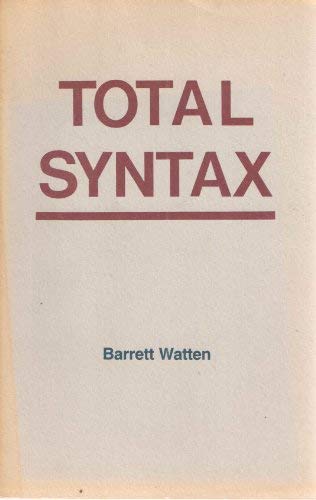
NOT THIS: SELECTED WRITINGS
BY BARRETT WATTEN

MOSCOW: POLYPHEM, 2024

[for Russian text, click here]

Polyphem, an independent press in Moscow, has announced publication of a comprehensive, bilingual edition of the writings of Barrett Watten.

The works, chosen by editor Vladimir Feshchenko, extend from his first collection (Opera—Works, 1975) to the unpublished “Notzeit,” written during COVID (2020).

The selection represents the author’s “turn to language” in the 1970s, his development of hybrid genres and longer forms, and his critique of distorted social communication. … More

Remarks on Jameson and Narrative

Under any house is a basement of psychological dimensions, a surplus affective space. And as I read The Political Unconscious into the night, a sump pump in the basement would go on and off, shunting gallons of water out of its perpetual flood. An editor asked me for a theory of such drainage in the form of a critical review, which I refused as not entirely serious. —”Foxes,” Bad History, 60

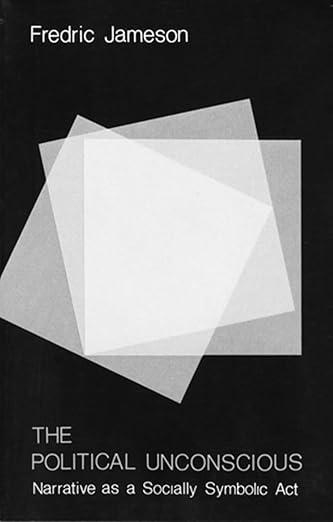
The year is 1981. Carla Harryman and I are living in a working-class bungalow on Hampshire Street in San Francisco’s Mission District, competing with raccoon families and occasional gunshots to establish a relationship in an indeterminate time. Ronald Reagan has been elected, while the alternative arts are forging ahead on multiple agendas. Poets Theater is in full swing, with a character called “Jameson” in Kit Robinson’s play, as I discussed previously. Jameson has entered the Language and New Narrative debates and given his talk at 80 Langton Street, siding with Narrative while symptomatizing Language, but also has now published The Political Unconscious, a watershed work that would have long-term impact on questions of narrative and form. Jameson’s “questions of interpretation,” bringing together form and history, would anchor a more expansive, contextual methodology not confined to surface language—bypassing precisely the critique of Language’s dissociation of sensibility in the postmodern. The “turn to history” via poetic form begins right here. … More

Entry 61: History Is What Hurts

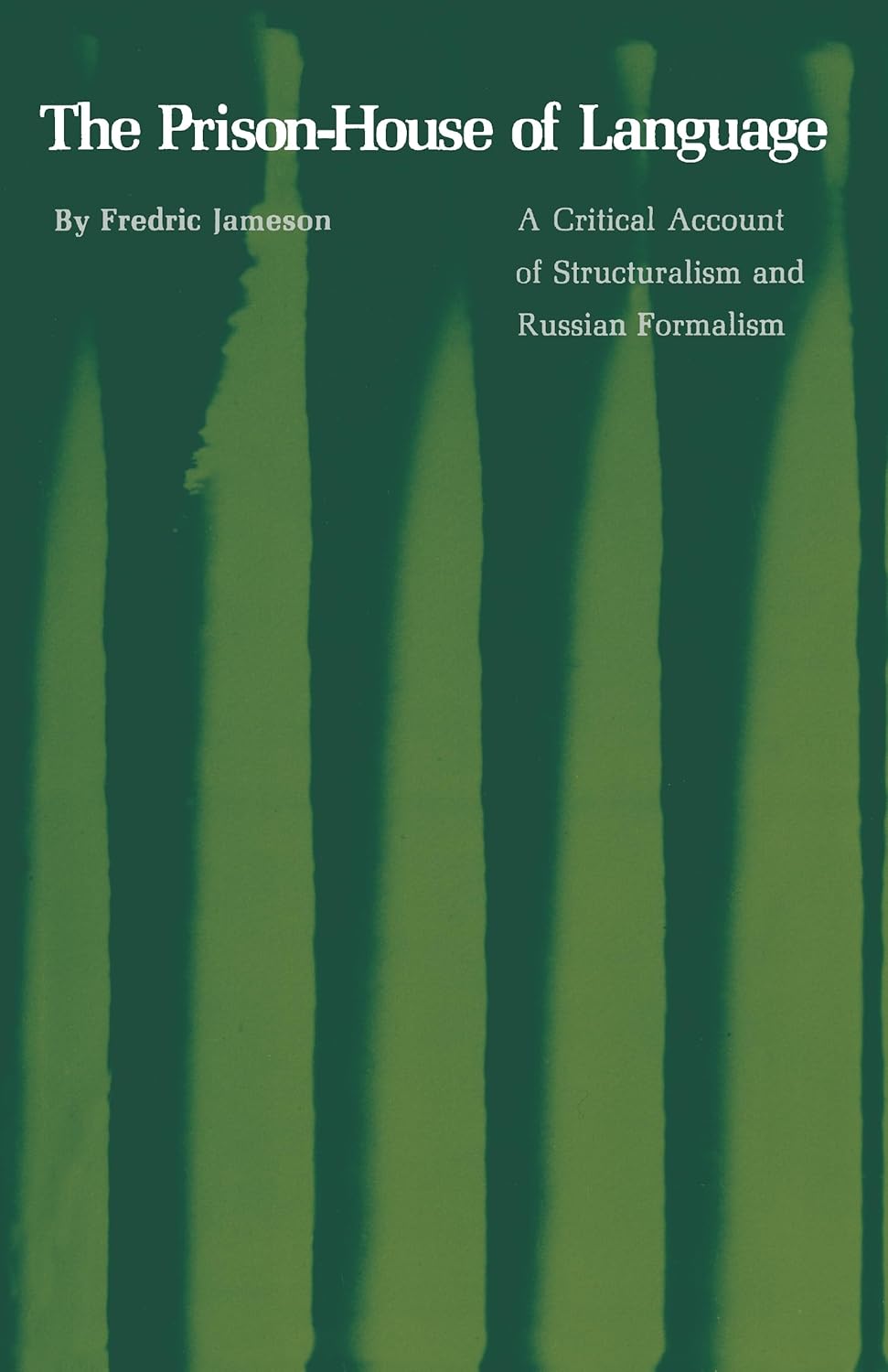
Remarks on Jameson and Language

The media, for once, are getting it right: with the announcement of Fredric Jameson’s passing on September 22, one often sees a likeable photo of an engaged, outer-directed, smiling and welcoming, if prodigious and awe-inspiring scholar and critic in early or late days of his notable life and career. There is something of the Peaceable Kingdom in the intellectual devotion and worldly accomplishments evoked: “For Fredric Jameson, Marxist Criticism Was a Labor of Love,” per The New York Times. While Critical Theory, in both nature and practice, accentuates the negative, Late Jameson presents a beneficent gaze that is rarely encountered—especially with Marxists. The Grand Narrative of Progress Toward a Better Life seems activated by his very presence, a moment of positivity restored at the moment of loss. … More

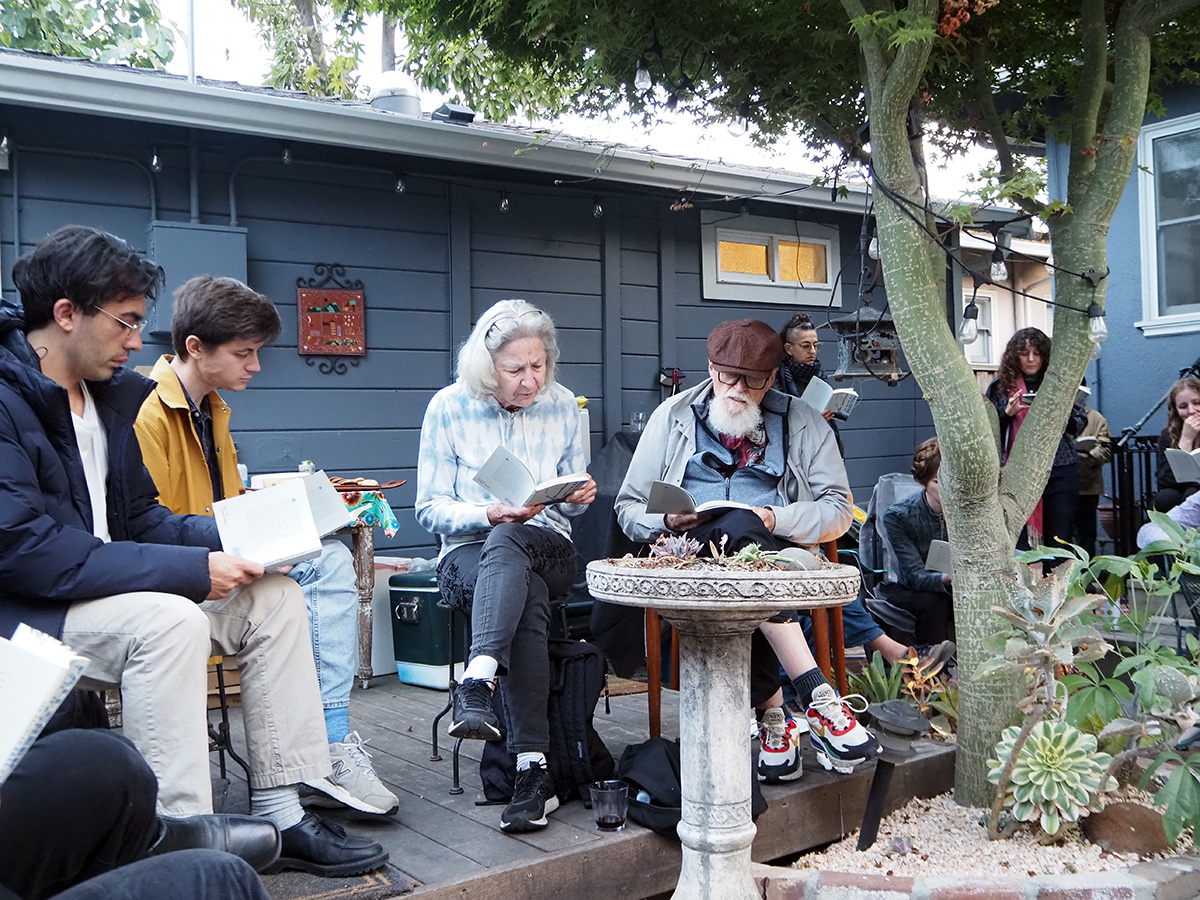
The photo registers the scene: it is Ron Silliman reading, Krishna Evans following the text. Or perhaps Krishna is reading and Ron is following the text, as will be the case in a minute or two, as soon as Ron finishes his passage. The vantage point is from where I am sitting, having read my part some time ago and now listening as it continues. To the side are  Eliot D’Silva next to Ivan Sokolov; then to the right are Jen Hofer, leaning against the garage; Claire Marie Stancek is just behind the forked trunk of a tree; Jennifer Scappettone between the branches of the tree, and Jane Gregory, the host of the event, is to the far right. Continuing out of the picture one would encounter Lytle Shaw, whose elbow is just visible, and then next Syd Staiti on the stairs. Everyone is not especially solemn but bent to the task, reading Lyn Hejinian’s just published Fall Creek (Litmus Press), copies and xeroxes of which are out on the table. All of them have taken their turn. There are thirty-three sections, with Ron and Krishna reading the next-to-final two, before the group takes up the last section in unison. This was my proposal to the group at the break, recalling the pleasure of cacophony in our Grand Piano reading of “A”–24, whose plurivocality Lyn internalized and, some decades later, realized in one of her last works.  … More

“Discrepant Analogy:
Immanent Transpositions of Surrealism”

CALL FOR PAPERS/SESSION PROPOSAL
SUBMIT BY MARCH 15, 12:00 P.M. CET

“Surréalismes Paris 2024
6th Conference of the International Society
for the Study of Surrealism (ISSS)
October 28–30, 2024 / pdf here
… More

Document 102: Note on Conduit

“Conduit” (“Kanal svyazi”)
trans. Arkadii Dragomoshchenko and Vladimir Feshchenko
Vsealizm (Moscow), 11 February 2024

From Moscow, for the second week in a row, comes a new translation of my work into Russian—here, “Conduit” into “Kanal svyazi”—in preparation for a bilingual edition to appear, one hopes, later this year. This work, brought forward over decades and across continents, truly stands as a conduit in the distressed conditions of communication, between the “territories of the East” and the rest of the world assuredly, but more generally as “what we live.” As I wrote on receiving word of this wonder:

There was a line from a Poets Theater play, Third Man by Carla Harryman, early 80s, spoken by Eileen Corder: “Go ahead, Moscow—I’m listening!” That was transgressive in the Reagan Era; in the current moment, one listens carefully to say the least. And now this translation of my poem “Conduit” has appeared—it is all about receiving messages, and not letting them stand as commonplaces or placeholders but as samples of “systematic distortion.” It’s about the “systematic distortion” of communication as communication itself, which we experience every day.

… More

And loveliness?
Death has an understanding of it
Loyal to many flags
And is a silent ally of any country
Beset in its mortal heart
With immortal poetry.
Laura Riding, “The Poet’s Corner

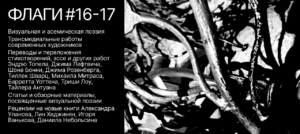
From Moscow, under conditions of global duress, comes the online publication of Flagii (Flags), double issue, numbers 16/17. Clicking on this link gets the issue, and for those without Russian, using Google translate or its equivalent yields a sense of the incredible poetic activity going on right now, with an intent to find “allies of any country.” Also breaching the gap are a number of texts with visual properties, in a selection introduced by Vladimir Feshchenko with work by Jackson Mac Low, Bernadette Mayer, Larry Eigner, Robert Grenier, Hannah Weiner, Rachel Blau du Plessis, Susan Howe, and myself (“Introduction to the Letter T”). I am also represented by an interview with Vladimir Koshelev and a translation of a section of Under Erasure by Lisa Kheresh, linked here, as well as the note on a little-known collage by Sylvia Plath that I wrote about on this site in 2010 (here), with commentary in Russian (here). It is not only a real honor to be included in this work but an example of what we should be doing now, connecting across the greatest distances possible, aspiring toward the horizon of “this time we are both.” … More

A Poetics of Encounter:
Dialectic of Outside with the Beats

Read at “Can We Teach the Beat Generation?”
Discussion organized by Erik Mortenson and Tony Triglio
Session 228, 5 January 2024, 10:15–11:30 AM, Loews 3rd Fl.
Modern Language Association, Philadelphia 

“The transmission of poetry is a passion unlike any other.”
“I too have started a riot in the academy.”

In this note, I want to call up certain moments of encounter that were, as with the visual image of a “diamond thunderbolt” or dorje, immediate, double-faced, and bivalent: outward in the transmission of poetry, from the Beats or New Americans and others; and inward, toward self-formation and a long process of professionalizing within the Academy. In charting such a poetics of encounter, I draw from my presentations at the “decades” poetry conferences at University of Maine, Orono, in the 90s and 00s that I, in the company of a shifting assemblage of poet/critics, took part in. I connect these moments to Steven Belletto’s genealogy of three early moments of encounter between Beats and the Academy: Jack Kerouac’s intervention at a symposium sponsored by Brandeis University in New York, 1958; Diana Trill­ing’s reaction to Allen Ginsberg’s being given an “unofficial” reading at Columbia, that same year; and Gregory Corso’s rebuttal to a symposium on the Beats in Wagner Literary Review, 1959. These are part of series of breakthrough moments: the Gallery 6 reading, San Francisco, 1955; Ginsberg’s appearance in Time magazine, 1959; the Vancouver Poetry Conference, 1963; the Berkeley Poetry Conference, 1965. What makes the first three definitively “Beat” aligns with two concepts from my essay on Michael McClure: antagonism and holism. In challenging the Academy’s scholastic pedagogy—I often thought of the English Department in the 60s or 70s as a kind of monastery, corridors filled with the brethren nodding to each other under hooded robes—the Beats took a position Outside that was, at the same time, subject to everything—“Is there a world?,” Kerouac asked; “Man does not exist,” opined Corso. The nature of this encounter between an unregulated Outside and a self-regulating Inside points to a dialectic of the Academy whose stakes are not only literary, pointing toward our volume’s significance not only for Literary but University Studies. … More

Scaffolding Repetition: Gertrude Stein,
Language Writing, Electronic Dance Music
(online here)
eLyra 22, special issue on “Poetics and Politics
of Repetition,” ed. Bruno Ministro, 25 December 2023
(online here)

Abstract: This essay takes up the critique of repetition in Gertrude Stein, her claim to have written a “continuous present” that “begins again and again” and “includes everything” versus her later qualification that repetition is always shifting in terms of “insistence” and “emphasis”. Even so, Stein focuses on the unfolding of the verbal material primarily in a linear fashion, though resonances and overtones abound. In Electronic Dance Music, from Detroit to Berlin techno, one finds more vertical layerings and “scaffolding”—a term taken from Soviet psychologist Lev Vygotsky—as a way of building up sonic elements in pleasurable and meaning-bearing ways. Using these two contrasting models of repetition, I read three language-centered poets—Ron Silliman, Leslie Scalapino, and Marjorie Welish—in terms of their complex forms of temporality in poetic form, seen in terms of Stein’s often repeated framework of “beginnings, middles, and ends”. I conclude with a discussion of ”vital movement” in the electronic dance music of Berlin DJ Ellen Allien.

Keywords: Modernism, avant-garde, repetition, language writing, poetry, electronic music, American, Berlin

… More