A week ago, I returned from Germany to find the online poetry community in an uproar over Ron Silliman’s “Je suis Vanessa Place.” There, Silliman triangulates the Charlie Hebdo award controversy with the petition to remove Place from a steering committee at AWP, and her conceptual project to tweet Gone with the Wind in 140-character chunks over several years. Since then, a second letter campaign in part led to the devolution and canceling of the Berkeley Poetry Conference 2015 (BPC), a situation still unresolved. Silliman sees the primary issue as freedom of expression in a climate of projective and even rhetorically violent debate. Unfortunately, whatever the merits of his position—which I agree with on many grounds—his own rhetorical strategy makes analogies and leaps that are at turns defensive and projective to the point of offense to most readers. … More
>> Entries <<
May 27, 2015
Document 36: Language Writing
“Language Writing”
an essay by Barrett Watten
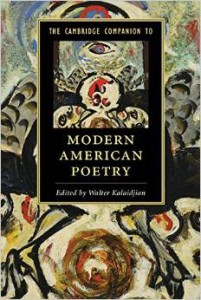
The Cambridge Companion to
Modern American Poetry
ed. Walter Kalaidjian
Table of contents:
1. The emergence of ‘the new poetry’
John Timberman Newcomb
2. Modern American archives and scrapbook
modernism / Bartholomew Brinkman
3. Experimental modernism
Alan Golding
… More
May 1, 2015
Document 35: May Day, 1975
It is forty years since the Fall of Saigon, and the first event I record, in my lead piece in volume 2 of The Grand Piano, recalls my activities on that day. I hope it still means something to put this out there:
Politics
On 1 May 1975, I attended a public meeting of a communist organization. The Fall of Saigon, of course, did not simply coincide with that date; it had been taking place for weeks. The meeting was in a rented hall on Telegraph Avenue in Oakland. Two million people, according to mass media, had been forced to evacuate Phnom Penh. The speaker interpreted this report in a positive light: Khmer Rouge authorities were only trying to prevent disease and panic. Half the people in the room read revolutionary newspapers as the speaker addressed them, while the other half listened attentively. He went on: now is the time the movement for revolutionary change must commence. There can be no going back. By next year the organization’s size must double. We have a simple choice before us.
… More
March 14, 2015
Document 34: Les Revues
The following is Martin Richet’s translation of “Magazines,” the first prose poem in Opera—Works (1975); it appears in the first issue of his handsomely produced translation journal Jongler (ordering information below). It does not address the question of whiteness, which has been preoccupying us, but does address feeling states around the possibility of being a poet.
Les Revues
Tu es dans un bâtiment puis à l’extérieur. À seize kilomètres de là, tu le visualises à peine — tu vois le sol depuis le ciel au ralenti. En même temps tu sens l’hélicoptère qui s’enfonce dans la rue. L’avion fend un nuage.
Le simultané comme attribut du non ressenti. Le littéral comme attribut du ressenti. Un simple intérêt littéral pour la diversité du monde et les implications des choses.
Un abonnement à une revue que l’on considère vaguement divertissante et complètement dispensable. Un carnet de correspondance — une bénédiction — un baiser mérité. L’horticulture variégée vue à la lumière ambiante. Les petites boîtes de plantes, les pots en céramique, les tiges vertes coupées, des tâches simples.
La gestion compliquée des tâches simples. Tu t’abonnes à une revue, la revue arrive, tu y jettes un oeil et tu t’inquiètes.
Les revues, c’est possible ?
* * *
… More
Reaching further back into my personal archive of whiteness, I find this poem—written in Iowa City about 1971 or ’72 and published in 1975, on the theme. It is the second poem in my first book, Opera—Works. The title quotes a line from Charles Olson’s “The Kingfishers.”
The Whiteness Which Covers All
Magnum opus
white
marginal waves
nested in whiteness
The triangle dilated
fragments—
the voracious snake
hidden
in the sheets of—
White sea
flat under a white sky
The narrow eye, such that
it encompassed the
compelling frigidity.
I was
witnessed throughout.
From Barrett Watten, Opera—Works (Bolinas, Calif.: Big Sky Books, 1975), 6; reprinted in Frame (1971–1990) (Los Angeles: Sun & Moon, 1997), 280. Copyright (c) Barrett Watten 1975, 1997, 2015.
The current discussion on the “whiteness of the avant-garde,” following Cathy Park Hong’s article in the journal Lana Turner, has brought up the question of whether avant-garde poets fail to deal with a supposed “color blindness” in their radical forms and experimental practices. The following is a section from Bad History, written in 1992 and published by Lyn Hejinian and Travis Ortiz’s Atelos Press in 1998, that addresses the cultural construction of whiteness—my own, in fact. It was written the summer following the Los Angeles riots after the beating of Rodney King, and is informed stylistically by the art writing I had been doing in Artweek during that period—many instances of which took up matters of cultural politics across the spectrum of race, class, and gender. It would only be a short while before I took up my teaching position at Wayne State University in Detroit, but that is another story. Those calling out the “avant-garde” as not confronting its racial cultural logics need to look a bit further.
To Elsie
On being the white male heterosexual I’m supposed to see myself “as”—but who’s looking? For William Carlos Williams, as a pure product Elsie was the exception that proved the rule of his own impure lack of identity—the non-solution of “no one driving the car” being the prescient mastery of a situation the poet’s white male heterosexual heirs would have to negotiate sixty years hence. And so indeed have we come to see ourselves predicted as the outcome of our incommensurate acts—Williams in ironizing himself as “not” the pure product he would libidinally like to be; we in retreating from the historical sentimentality of his look. Now we can only admit to having no such desire left as Williams would have liked to preserve—unless we are willing to be seen, in self-contradiction, “as” violent dissociations of Williams’s self-objectification. But does the resulting desire—”not mine”—convey any more politics than the one I could claim by negating my own lack of identity in the white male heterosexual’s violently self-destructive but cannily self-preservative acts? Think of Chris Burden shooting at a jetliner in 1973—it is of course granted that he missed. Such desire can have no object—either it casts itself out as its own unknowing or it is observed, from a distance, as something needing to be controlled. Are you someone who needs to be controlled? … More
January 17, 2015
Document 31: Zero Hour
Just published
in an interdisciplinary,
transnational essay collection
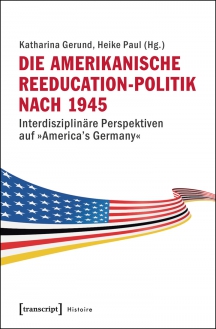
Barrett Watten, “Zero Hour/Stunde Null:
Destruction and Universals at Mid Century”
in Die Amerikanische Reeducation-Politik
Nach 1945: Interdisziplinäre Perspektiven
auf “America’s Germany,” Katharina Gerund
and Heike Paul, eds. (Bielefeld: transcript
Verlag, 2015); for more information click here
With Herbert Sirois, Michael Hochgeschwender,
Frank Mehring, Jeanpaul Goergen, Philipp Baur,
Reinhild Kreis, Dorottya Ruisz, Dieter Meindl,
Phillip Beard, Werner Sollors, Winfried Fluck
from the introduction:
“Barrett Watten problematisiert die Vorstellung einer Stunde Null als politisches und als ästhetisches Konzept aus der Perspektive eines “radical historicism,” der konsistente und wohlgeformte Erklärungen und Narrative zugunsten von Brüchen, Krisen und Kontingenzen in Frage stellt. Die Stunde Null wird als metahistorisches Ereignis verstanden, das vor allem hinsichtlich seiner verschiedenen Repräsentationen und deren kultureller Arbeit untersucht wird. Watten identifiziert retrospektive, antizipatorische und punktuelle Konstruktionen des historischen Moments in literarischen und visuellen Darstellungen und setzt diese in Beziehung zu dem historischen ‘Ereignis.’ Er untersucht exemplarisch die antizipierte Zerstörung als poetisches Prinzip in den Werken von William Carlos Williams sowie die retrospektive Konstruktion der Stunde Null in dem Film Judgement at Nuremberg (1961, Regie: Stanley Kramer) und in den Fotografien von Lee Miller. Er illustriert anhand dieser Beispiele seine zentrale These, dass Zerstörung die notwendige Vorbedingung des Universellen ist” (introduction, p. 15). [Translation t/k]
January 15, 2015
Document 30: Digital Archive

Wesleyan University Press
announces publication of
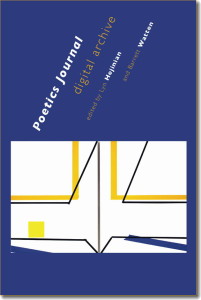
Poetics Journal Digital Archive
ed. Barrett Watten and Lyn Hejinian
A complete collection of key texts in the
development of contemporary poetics
Poetics Journal Digital Archive is a resource that re-publishes virtually all of the articles originally published in Poetics Journal, organized alphabetically by author and in searchable form. The archive features indexes by contributors, original publication volume, and keywords.
The archive was designed to be used with A Guide to Poetics Journal: Writing in the Expanded Field, 1982–98, an anthology that includes thirty-six articles selected from the run of the journal, organized in three chronological sections, along with comprehensive introductions by both editors, contextualizing headnotes, publication history, keywords, abstracts, and bibliographies for each article.
Together, the Guide and Archive comprise a print/digital publication that will make the best use of both media. Some of the essays published in the Guide are abridged versions of the originals, and readers will find the complete versions in the Archive. Nearly all the articles published over the life of Poetics Journal are included.
The writing that appeared in Poetics Journal reflects the development of a range of ongoing creative and critical approaches in avant-garde poetry and art. In making this content newly available, we hope to preserve the generative enthusiasm for innovative writing and art it represents, while encouraging new uses and contexts.
July 21, 2014
Document 29: Books (CN AU NZ)
China
Ancient Chinese Ceramics Gallery. Museum catalogue. Shanghai: Shanghai Museum, n.d.
Chen Haiwen, ed. Old Industries in Shanghai. Shanghai: Shanghai People’s Fine Arts Publishing House, 2010.
Childhood Friends Getting Fat: Moving Image of Liu Xiaodong, 1984-2014. Exhibition guide. Shanghai: Minsheng Art Museum, 2014.
Chinese Calligraphy Gallery. Museum catalogue. Shanghai: Shanghai Museum, n.d.
Huang Yan. Yan Ink: Ink Research Series. Exhibition guide. Shanghai: Leo Gallery, 2014.
Huang Yaping. Sun Yat-Sen in Shanghai. Trans. Pan Qin. Shanghai: Shanghai Century Publishing Co., 2010.
Köppel-Yang, Martina, ed. Advance through Retreat. Exhibition guide. Shanghai: Rockbund Art Museum, 2014.
Li Dong. Beginner’s Chinese Dictionary. Tokyo: Tuttle Publishing, 2004.
Ming Yang Pei, ed. Chinese Propaganda Poster Collection. Shanghai: Shanghai Propaganda Poster Art Center, 2013.
Shanghai Lady Postcards. Shanghai: Shanghai Propaganda Poster Art Center, n.d.
… More
July 4, 2014
Entry 20: Shanghai Notes
From 24 June to 2 July 2014, I was in Shanghai, attending an academic/arts conference and seeing as much of the city as possible when not otherwise engaged. The meetings took place at Shanghai Jiao Tong University; jiao tong means “transportation” but is the equivalent of “polytechnic.” Many of the early technical universities in China were concerned with various forms of transportation. In the case of Shanghai Jiao Tong University, the major focus was maritime engineering; there is a massive rusted iron anchor in a courtyard between classroom buildings where there might be the statue of a humanist or political figure in another context. Shanghai, of course, is built on maritime traffic on the Yangtze River, the scale of which was evident in the massive materiality of the anchor. There were many such confrontations with massive scale in Shanghai, from its population of 23 million to the waves of public housing and corporate building that extend outward in all directions to its burgeoning infrastructure, particularly elevated highways and metro system. Jiao tong seems to have been an important concept. Now, it is being reinterpreted to include more liberal forms of scholarship, as witness the arts and humanities program that was our host. A canny citation of Confucian scripture permits this broader, more inclusive reading.
*****