I Met (Berkeley/Oakland/SF)
9-13 May 2013
(After On Kawara)
Amy Smith
Suzanne Stein
Jan Watten
Emilie Watten
Jamie Brunson
Karen Yandow
Randy Hussong
Suzy Barnard
Betty Jo Costanza
Clint Imboden
Brian Ang
Sara Larsen
… More

>> Documents <<
May 14, 2013
I Met (Berkeley/Oakland/SF)
9-13 May 2013
(After On Kawara)
Amy Smith
Suzanne Stein
Jan Watten
Emilie Watten
Jamie Brunson
Karen Yandow
Randy Hussong
Suzy Barnard
Betty Jo Costanza
Clint Imboden
Brian Ang
Sara Larsen
… More
April 24, 2013
 An annotated bibliography from travels to Lodz and Warsaw, April 2013, with apologies for the lack of Polish characters and diacritics.
Modern History
Czerwinska-Rydel, Anna. W poszukiwaniu swiatla: Opowiesc a Marii Sklodowskiej-Curie. Warsaw: Akademia rozwuju wyubrazni BUKA. CD. Radio play on the life of Marie Curie, read by Anna Dymna.
Frankowski, Artur. Typespotting: Warszawa. Warsaw: Bec Zmiana, 2010. A guide to Warsaw through street signage and ad typography.
Kisny, Tomasz. Wielki Terror, 1937-1938 [The Great Terror, 1937-1938]. Warsaw: Narodowe centrum kultury, 2013. Photodocumentary of victims of Stalinist purges and terror trials, with contemporary images of remembrance. [See image.]
Kusinski, Jacek, Ryszard Bonislawski, and Maciej Janik. Ksiega fabryk Lodz. Lodz: Wydawnictwo Jacek Kusinski, 2009. Catalogue of industrial buildings in Lodz, then and now.
April 6, 2013
N. Katherine Hayles, “Speculative Realism and Speculative Finance: Exploring the Connections.” The 2013 Dennis Turner Memorial Lecture, Department of English, Wayne State University, 5 April 2013.
[KH abstract: Graham Harman’s object-oriented ontology (OOO) bears some startling similarities to contemporary finance capital, including the construction of objects whose content is obscure, increasing levels of abstraction, and the absorption of relations into objects. What can account for these convergences between two fields that are emphatically not engaged in conversation with each other? In exploring the question, this talk will discuss the economic conditions that currently shape academic employment as well as the financial markets.]
[BW disclaimer: the following are notes taken on my iPad during the lecture. No claims are made to adequately represent the structure and continuity of Hayles’s nuanced argument. Rather, these are “points sublimes” formulated in thinking along with her lecture. New arguments may be built out of them. Remarks in brackets are sidebars for responses or threads to pursue later.]
The Trading Pit and the Ivory Tower
[BW: boom and bust capitalism and devel of new media poetics]
global ecology and global finance as two great anxieties
mediation between/as spec realism [question of mediation; what is it?]
“secret alliances with speculative finance” with OOO [object-oriented ontology] as transducer
= “changing the construction of signals/values”
February 9, 2013
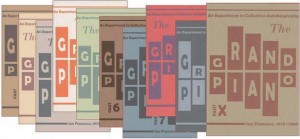
Luke Harley, “Poetry as Virtual Community: A Review of The Grand Piano: An Experiment in Collective Autobiography,” Jacket2, 7 February 2013. Click here.
In part due to its demanding format—ten volumes by ten authors, published over a five-year period (2006–10), totaling over 1600 pages—and in part due to the difficult questions of poetics and community it raises, The Grand Piano has only now, more than two years after the last volume saw the light, received the kind of engaged and comprehensive review that will help open its project to readers in all its multiple dimensions. Barry Schwabsky’s 2011 review in The Nation, uploaded to this site, was likewise welcome as an enthusiastic introduction to a broader readership, one that perhaps had not heard of Language writing and would like to know more. Harley’s review, on the other hand, assumes not only familiarity but positional engagement with the movement, these authors, this writing. Working through the debates of the 70s and 80s, as we did in The Grand Piano, Harley’s discussion extends literary history into the concerns of the present; it becomes, as Foucault would have said, a work of effective history. In so doing, his review joins Eleana Kim’s 2001 online history of Language writing to offer a broad overview of the movement, contributing to the work of documenting the past history and present possibility of language-centered poetics. Going beyond mere narrative history, critical readings like Harley’s reinterpret the effort to document the movement as a reenactment of its polemical force—from the archival matter of readings, talks, magazines, and books to its real-time engagement. Given the depth of discussion Harley and predecessors have initiated, one can only hope they will encourage more. La lutte continue!
... More
January 20, 2013
Modernism and the Abstraction of Value:
Poetry and Political Economy in transition (1927-38)
During this recent era, linguistic understandings of political economy found purchase for a wealth of reasons, many of which have a grounding in actual conditions. Nonetheless [. . .] the literarity of such conceptions ended up participating in, and sometimes generating, serious analytic errors . . . . The misrecognitions of value engendered by modes of literarity thus pose a radical limit to the history of the present. —Joshua Clover, “Value/Theory/Crisis” (107, 109)
[Introduction]
In my lecture at the Poetry of the 70s conference at University of Maine (under the rubric “Late Capitalism and Language Writing”; 2008), I made a strong claim that the “turn to language” in poetry must be seen as simultaneously a response to the emergent horizon of neoliberalism after 1973 along with an anticipatory illumination, undertaken at the level of form, of what the new order of intensified commodification and mobility of capital would look like—and how it might be comprehended and opposed. … More
January 7, 2013
[for Sarah Ruddy]
In lieu of a list of resolutions for the New Year, a bibliography of books acquired at the recent MLA in Boston and on a side trip to Gloucester may point toward some of its promises.
Modernism
Isherwood, Christopher. Goodbye to Berlin. New York: New Directions, 2012. New ed. in single volume.
Walser, Robert. The Assistant. Trans. Susan Bernofsky. New York: New Directions, 2007.
———. Microscripts. Trans. Susan Bernofsky. New York: New Directions/Christine Burgin, 2012.
Post-1945
Beckett, Samuel. Waiting for Godot/En attendant Godot: A Bilingual Edition. 1952/1953. New York: Grove Press, n.d.
Perec, Georges. La Boutique obscure: 124 Dreams. Trans. Daniel Levin Becker. Brooklyn: Melville House, 2012. Advance copy.
Modernity
Chang, Iris. The Rape of Nanking: The Forgotton Holocaust of World War II. 1997; New York: Basic Books, 2012.
June 30, 2012
[in memory of Ron Allen]
Returning to Detroit from Germany, I continued my frenzy for discovery in an afternoon session at John K. King Books, a monument to the material text located off a ramp of the Lodge Freeway, just beyond downtown Detroit. I think of John K. King as a kind of mine, much like one I visited in Germany, where one laboriously seeks an ore-bearing vein from the base substrate (of pulp fiction, back issues, technical manuals, legal handbooks, and so on). On the day I visited, the poetry vein was productive, as will be evident from the finds below.
Numerous personal associations surround these discoveries. Josephine Miles was the only woman faculty in the English Department at Berkeley in the 60s and wrote for my admission to the Iowa Writers Workshop. She pioneered the use of quantitative methods (word counting) in the study of poetry; the two volumes are the major results of her work. Christopher Caudwell is a now forgotten Marxist anti-modernist critic whose work I read, likely in this edition, in the 70s. Philip Whalen’s On Bear’s Head has always been a mystery as an object; how could such a mass of jottings find their way through a New York publisher? A similar mystery attends Clark Coolidge’s 1970 Space, from Harper & Row. Ronald Gross’s Pop Poems ought to be on any canonical list of conceptual writing, as it antedates that movement by forty years. Gross would take banal ad copy and other socially inflected messages and versify them, anticipating the work of Rob Fitterman and his “rubber duck” catalogue poem. … More
June 29, 2012
Geschichte des Zufalls no. 15
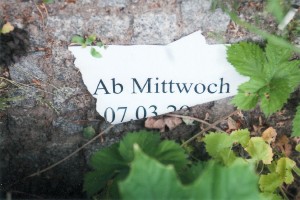
On 17 June 2012, I visited the Mauerpark flea market with friend and poet D— S—. The market was bursting at the seams with the detritus of pop culture; archives of tape and vinyl; retro furniture and avant-garde t-shirts; remnants of the former socialist state and occasional contraband from darker times; out-of-date art books and mass market magazines bleaching in the sun. A carnival of objects to anchor social ground within the shadow of the former Wall.
At the end of a long alley of stands, objects, and crowds—or at the end of a confusing story that was just about to arrive at its point—appeared a stall selling what look like small cardboard boxes, each with a stenciled number cut out on the top that let optical green paper show through, under the banner “Geschichten des Zufalls.” In the center of the table stood a gumball machine, containing wooden balls with the same optical green numbers. We were invited to purchase one of the boxes as a “chance object,” and to participate in a conceptual project in which we would inform the sellers/organizers of any coincidences that had occurred after its purchase. We could pay whatever price we felt appropriate for an opportunity to encounter chance in this way.
June 28, 2012
A resonant passage from Lyn Hejinian’s The Book of a Thousand Eyes, which should have wide circulation (and links) for pedagogical and moral purposes.
I am a failed fire chief
I am a failed thief
Didn’t I fail at the wrong thing, aren’t I a failure at failure
Failure is inevitable
I am a fan of failure
I am a failure flailed by failure
I leap into failure
I relish the self-pity that’s produced by the self-loathing that comes as a consequence of failure
The sauce has curdled, the meat is tough, the custard is runny—the meal is a failure
Failure is the offshoot of argument—but then failure occurs too from a lack of it
Moral failure
… More
June 24, 2012
[for Carla Harryman]
The following chronology documents two weeks of intensive travels in the zone of the aesthetic, under the aspect of the political, in Germany. I accompanied Carla Harryman, who had been invited to present a lecture in the closing week of documenta and was a credentialed participant for the preview, for the first week, and then continued on alone through Munich, Nuremberg, Jena, Leipzig, to Berlin. Annotations will be added to the entries, as time permits.
Monday, June 4
JFK > FRA.
Tuesday, June 5
“Auf dem Goetheweg zum Brocken.” Nationalpark Harz, Torfhaus, Lower Saxony.
Grenzmuseum, Sorge, Lower Saxony.
Wednesday, June 6
Weltkulturerbe Rammelsberg, Museum und Besucherbergwerk, Goslar.
“Der Andere Blick: Alltagswelten von Martin Parr, Tim Wood, Antanas Sutkus.” Mönchehaus Museum, Goslar.
documenta 13, Kassel. Preview.
Thursday, June 7
documenta 13, Kassel. Fridericianum.
“On the Kabul-Bamiyan Seminars and Exhibition.” Conversation with Christine Christov-Bakargiev, Chus Martinez, and artists. Ständehaus.