>> Events <<

“The House of Language: Laura (Riding) Jackson’s Rational Meaning
          and the Truth of Experience”

10 AM–12 PM, Wednesday, November 18, 2009
Laura Riding Jackson House/Environmental Learning Center, Vero Beach, Fla.
Sponsored by Florida Atlantic University and the Laura (Riding) Jackson Foundation

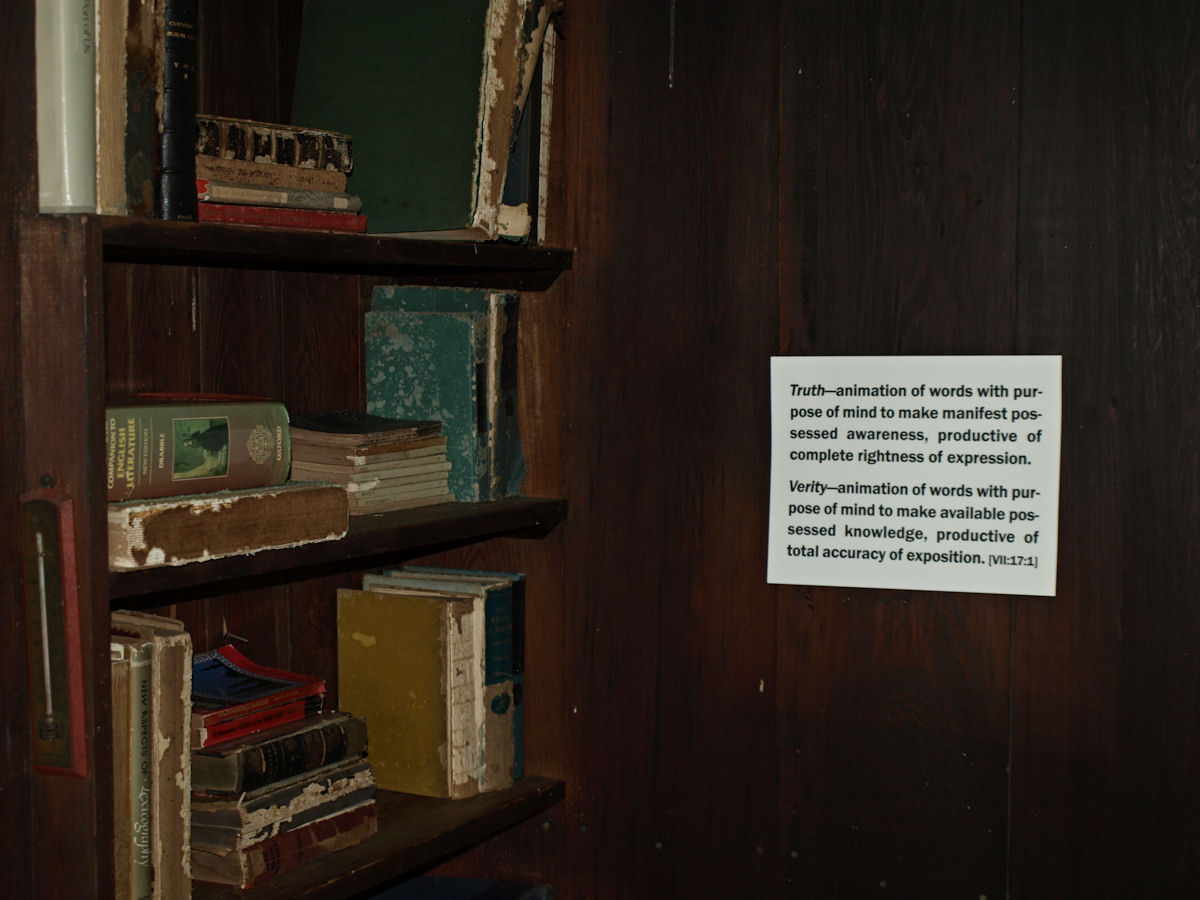
Installation of text from Rational Meaning at the Laura (Riding) Jackson House, Orchid Island, Fla., November 2009. Copyright (c) Barrett Watten 2009.

On 18 November 2009, I lectured on Laura (Riding) Jackson’s culminating work, Rational Meaning, which she wrote with Schuyler B. Jackson until his decease and then finished herself. … More

One should inscribe the letter A on the heart of one’s shadow.
[Next], without blinking, one should gaze fixedly at the latter A [drawn] at the heart [of the shadow],
And focus one’s awareness upon [the letter A].
Then, once the eyes have grown numb [through strain],
One should look up into the center of the cloudless sky,
At which time one’s own form should become visible in the sky.
One should then know that if the head and body of this [reflected image] are intact, and [the image] is pale in colour,
This is an auspicious sign that there will be no obstacles and that one will not die [imminently].

Tibetan Book of the Dead, trans. Gyurme Dorje (159)

GLOSS: in the midst of computer malfunction, visualization exercizes restore a sense of well being. Computers are machines for visualization exercizes, but these must not be accepted as automatic. The letter A stands out beyond the dysfunctional interface. One should stare at the computer until the eyes grow numb and the screen itself disappears. When the screen disappears, one’s own form is made visible. This is the letter A on the heart of one’s shadow.

From Stephen Cope at Essay Press: Carla Harryman discusses Adorno’s Noise and more in an interview recently published in [Inter]sections—the American Studies journal from the University of Bucharest, Romania:
http://www.americanstudies.ro/?article=55

Links to other reviews of Adorno’s Noise:

Rain Taxi review by Kit Robinson (posted on EMU Creative Writing Blog):
http://cw.emuenglish.org/?p=204

Jill Darling’s review in HOW/2 special feature “Reading Carla  Harryman”:
http://www.asu.edu/pipercwcenter/how2journal/vol_3_no_3/harryman/darling.html

… More

Link 01: This at Wikipedia

This, the literary magazine I co-edited with Robert Grenier from 1971–74 and continued to edit and publish until 1982, now has a Wikipedia entry: http://en.wikipedia.org/wiki/This_Press. This is how the entry currently reads:

This (magazine)

For the Canadian political magazine, see This Magazine.

This is a poetry journal associated with what would later be called Language poetry.

First three issues edited by Robert Grenier and Barrett Watten (1971-1973); subsequent nine issues edited by Watten (1973-1982) who also published monographs under the imprint This Press (1974?-1986?).

External links

… More

Location: Ozarks region; date: circa 1516; time: various.

In the 1530s and 40s, the Spaniard Cabeza de Vaca and his conquistadores followed the Mississippi River and came in contact with various Native American tribes of varying dispositions. Upon befriending the Avavares further westward they were told a most unusual tale. According to the Indians, approximately sixteen years earlier the region had been visited by another “bearded” character of unusual aspect. This fellow was called by the Indians “Malacosa” or Mr. “Bad thing” (according to the Spaniards) an accurate appellation given his proclivities. Even though bearded his facial features were “never seen clearly” or where otherwise indistinct or else clouded by a mist. This character “invaded” Indian homes by night, accompanied by a light and an electrical sensation that would make the hair of the inhabitants “stand on end.” Apparently paralyzed, the poor tribespeople would stand helpless as, armed with a “blazing brand” or wand the bearded creature would rush inside and perform intrusive surgeries upon its victims. … More

Entry 03: Mala cosa

This entry takes the place of a previous one, which turned out to be a gateway for malware. I wanted to undertake a small conceptual project, after posting Asa’s logo of Detroit “rising from the ashes,” of searching for the words “deterritorializing Detroit” and putting up the results, for use later perhaps. I did so, and listed the top ten entries, with descriptive copy: theory and techno, Arab Detroit and hiphop, globalization and Fordism were among the links.

The next morning I clicked on one, a theory blog that connected Deleuze and Guattari with Detroit techno. I checked a music site for Drexciya, a techno group from the 90s that has since disbanded—this was the entry point for the malware, which crashed the firewall and set up a fake virus protection program that simulated a virus scan, posted the results, and demanded payment as protection from further threats. Every action I took to bypass it resulted in an error message that said “program infected” or produced another popup.

… More

Image 03: Detroit logo

Detroit logo by Asa Watten. "It will rise from the ashes."

Cover of Henry Ford, Moya zhizn, moy dostizheniya (My Life and Work; Leningrad: Vremya, 1926); courtesy Jonathan Flatley.

A direct citation of my poem “Complete Thought,” without permission or credit (by “permission” I mean some form of notice or request) could be found (until I posted the link), at: http://withhiddennoise.net. It has since disappeared; I would be happy to have the poem online, but just with some credit and communication.

A direct citation with permission (accompanying translation into Dutch in the print journal Parmentier):

http://www.literairtijdschriftparmentier.nl/pop.php?id=65

The second meets the “alterity” test of my previous post. In the first instance, it was not clear whether this was an extract or the whole poem (twenty-five of fifty sections were printed), nor where the complete poem could be obtained. There are also at least two parodic rewrites of “Complete Thought”: one by Lisa Jarnot, “Complete Hog,” Night Scenes (Flood Editions, 2008); and a second in an ephemeral chapbook which I will post when I find it.

… More

Timed to coincide with the recent meeting of MLA in Philadelphia, a three-hour symposium to develop “best practices” of Fair Use in the citing of poetry was organized by the Poetry Foundation on 30 December, at the Franklin Institute. A notably expert group of poets and critics, led by a Washington, D.C.-based intellectual property lawyer, sought consensus (and divergence) around issues of the citation/appropriation of poetry in critical and creative works and the degree of protection that should be afforded to published, unpublished, and archival material. The process will continue, with the eventual goal of establishing recommendations for Fair Use in citing poetry that would encourage, rather than exploit in various forms of cultural profit-taking, public critical discussion of poetry.

… More