Document 38: Occupy Poetics

Barrett Watten, “Occupy Poetics:
A Work in Progress”
ASAP, 28 September 2015

This paper follows on a contribution to the EAM meeting in Helsinki that tracked two opposing accounts of language-centered writing’s influence on experimental poets engaged in Occupy movements, specifically Oakland. Moving from a materialist account of utopian possibility realized in poetic form to a combinatorial freedom associated with chance-generated strategies, the essay sought a convergence between contingent decision, radical freedom, and experimental practices among Occupy poets, focusing on poets David Lau and Brian Ang. In extending my argument, I survey a greater range of poets in the movement, beginning with Sara Larsen and Jasper Bernes, to develop a set of terms that interpret Occupy itself as informed by poetic principles. I return to the proliferation of poetics in the various Occupy sites, both to confirm the importance of a poetics of “combinatorial materialism,” and to extend the analysis of my first two examples by alternative concerns more prominent or visible in other poets. … More

Association for the Study
of the Arts of the Present
Greenville, South Carolina
24–27 September 2015
(after On Kawara)

Jonathan Eburne
Nico Israel
Lytle Shaw
Sarah Brouillette
Mark Goble
Gloria Fisk
Brian McHale
Esther Gottlieb
Jennifer Ashton
Walter Benn Michaels
… More

The following is a collectively authored and lightly edited chronology of significant events and publications in poetry and poetics from 2010 to 2015. Submit 3–5 entries, including year and month, to barrett.watten@gmail.com for inclusion. The project is intended to sample an expansive account of poetic activity during this period, as an aid to memory, reflection, and action.

 2010

April   Alice Notley, Reason and Other Women (Chax Press)
Rae Armantrout wins the Pulitzer Prize for Poetry

June   Rethinking Poetics conference, Columbia University; organized by Bob Perelman and Michael Golsten

July   95 Cent Skool: Summer Seminar in Social Poetics, Oakland; organized by Joshua Clover and Juliana Spahr

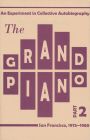
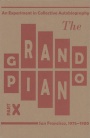
October   Final volume of The Grand Piano: An Experiment in Collective Autobiography (Mode A/This Press)
Gail Scott, The Obituary (Nightboat); a novel close to poetry and the impact of First Nations genocide on urban psycho-geography

November   Ed Roberson, To See the Earth Before the End of the World (Wesleyan UP)

December   Kit Robinson, Determination (Cuneiform Press)

2011

August   Durruti Free Skool, sequel to the 95 Cent Skool, Berkeley
ARMED CELL 1, ed. Brian Ang, distributed at Durruti Free Skool

September   Start of Occupy movement, which would include significant participation and related publishing by poets

November   Performances of The Grand Piano at University of California Berkeley and California College of Arts, San Francisco (dates t/k)

2012


January   Death of Stacy Doris (January 31)

February   Franziska Ruprecht’s Dichtwerkvariété events combine performed writing with American variety show style in Munich, Germany

April   Lyn Hejinian, The Book of a Thousand Eyes (Omnidawn)

May   Death of Leslie Scalapino (May 28)

September   Death of Arkadii Dragomoshchenko (September 12)

November   Amiri Baraka at the African-American Museum, Detroit (November 16)

2013

May   East Bay Poetry Summit

September   Carla Harryman, W/M (Split Level)

November   Ronald Johnson, Ark (Flood Editions)

2014

January   Death of Amiri Baraka (January 19)

March    Nathaniel Mackey, Outer Pradesh (Anomalous Press)

May   The Water Street Journal; an act of sublime and politically radical piracy published on May Day without a barcode and distributed free in Ypsilanti, MI

December   10th anniversary of Dos Madres Press, Heterotopia Book Store, Cincinnati (date t/k)

2015

January   Franziska Ruprecht, Meer-Maid (Wolfbach Verlag)

February   Tony Sanders (d. February 11) wins the Bernard F. Conners Prize

March   Kenneth Goldsmith performs Michael Brown’s autopsy report at Brown University (date t/k)

June   Cancellation of Berkeley Poetry Conference after complaints over inclusion of Vanessa Place; the conference is restructured and renamed Crosstalk, Color, Composition: A Berkeley Poetry Conference

August   Death of Stephen Rodefer (August 22)
Hungarian PEN awards Charles Bernstein the Janus Pannonius Grand Prize for Poetry

September   A poetry reading with three black men and one working-class man of unspecified ethnicity in an Ypsilanti house to celebrate one among them who has suffered from police harassment (September 11)

Entry 22: Speech Acts

Tim Kreiner has written a considered response to my previous post, an act of intellectual dignity given what else is out there. His piece circles around a conflict between abstract rights (Free Speech) and concrete acts (antiracist politics) he says Place herself caused when she pushed inadmissible racial content into the public arena. He also sees her timing as crucial: while I imagined that Place was grabbing a part of the limelight from Kenneth Goldsmith’s scandalous performance of Michael Brown’s autopsy, he believes that she “added the images in the midst of a live social movement against specific acts of state violence targeting black people.” [Correction: Place added the banner in 2012, and the profile photo in 2011; thus, both of our scenarios are incorrect. It is still an open question why a project that was not getting attention suddenly create intense outrage. The relation of image to text here is still crucial.] While we agree that adding the images converted a banal textual project into a racial provocation, he sees her opportunism as not simply in the aesthetic series but as an attack on the social movement, and thus criticizable from that perspective. Her cynical use of Free Speech, and by an extension the defense of her work in terms of it, cannot be dissociated from its effects on antiracist organizing and its larger concern, #blacklivesmatter.

… More

A week ago, I returned from Germany to find the online poetry community in an uproar over Ron Silliman’s “Je suis Vanessa Place.” There, Silliman triangulates the Charlie Hebdo award controversy with the petition to remove Place from a steering committee at AWP, and her conceptual project to tweet Gone with the Wind in 140-character chunks over several years. Since then, a second letter campaign in part led to the devolution and canceling of the Berkeley Poetry Conference 2015 (BPC), a situation still unresolved.  Silliman sees the primary issue as freedom of expression in a climate of projective and even rhetorically violent debate. Unfortunately, whatever the merits of his position—which I agree with on many grounds—his own rhetorical strategy makes analogies and leaps that are at turns defensive and projective to the point of offense to most readers. … More

OLYMPUS DIGITAL CAMERA

Bavarian-American Academy
Amerikahaus, Munich

University of Regensburg
10–23 May 2015
(after On Kawara)

Heike Paul
Volker Depkat
Marga Schweiger-Wilhelm
Markus Heide
Silvia Spitta
Florian Tatschner
John Landreville
Mary Catherine Lawler
Jessi Lee Jackson
Barry Shank
… More

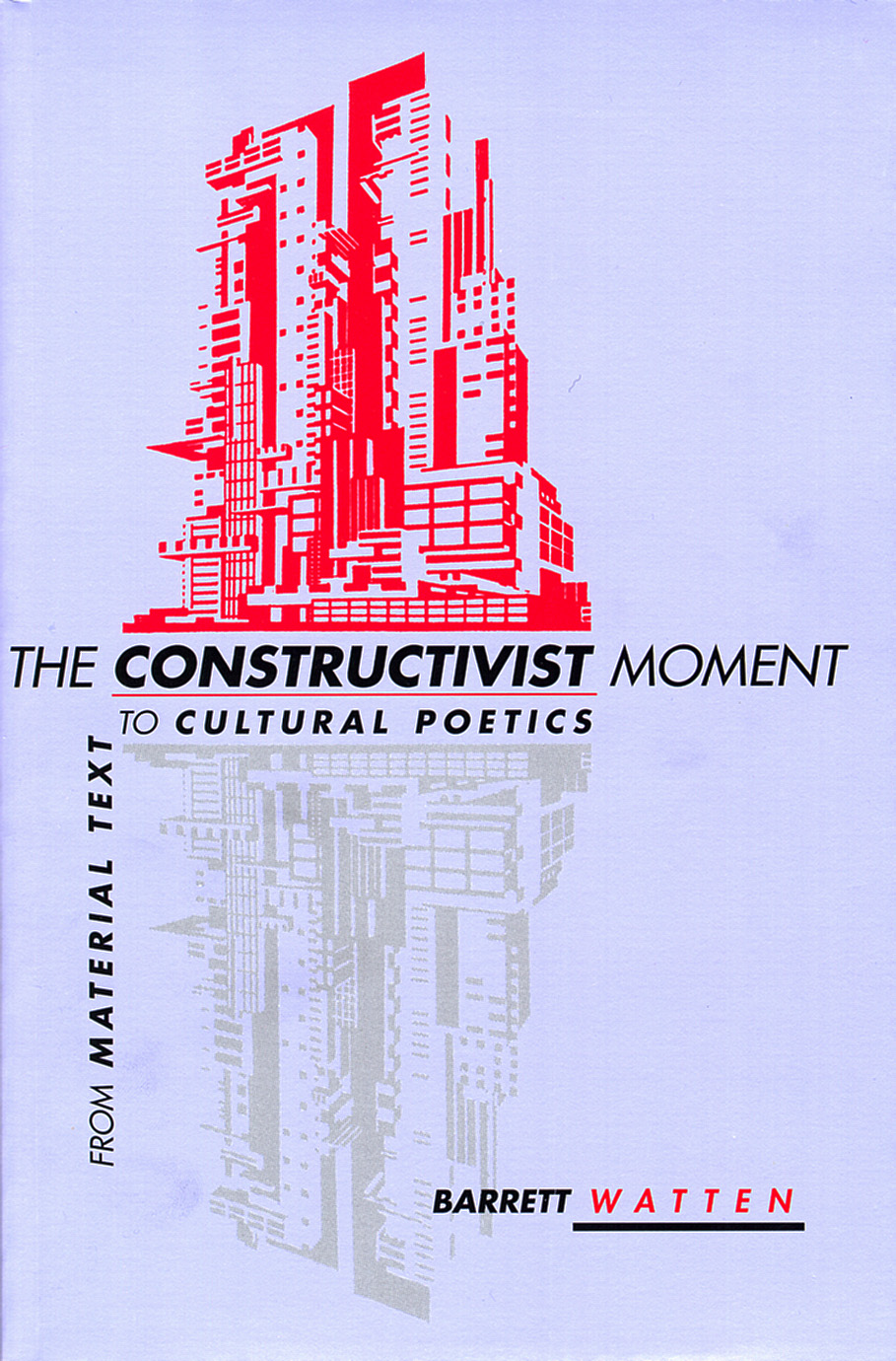
New in 2015:cover

“Language Writing”
an essay by Barrett Watten

The Cambridge Companion to
Modern American Poetry
ed. Walter Kalaidjian

Table of contents:

1. The emergence of ‘the new poetry’
John Timberman Newcomb
2. Modern American archives and scrapbook
modernism / Bartholomew Brinkman
3. Experimental modernism
Alan Golding
… More

It is forty years since the Fall of Saigon, and the first event I record, in my lead piece in volume 2 of The Grand Piano, recalls my activities on that day. I hope it still means something to put this out there:

Politics

On 1 May 1975, I attended a public meeting of a communist organization. The Fall of Saigon, of course, did not simply coincide with that date; it had been taking place for weeks. The meeting was in a rented hall on Telegraph Avenue in Oakland. Two million people, according to mass media, had been forced to evacuate Phnom Penh. The speaker interpreted this report in a positive light: Khmer Rouge authorities were only trying to prevent disease and panic. Half the people in the room read revolutionary newspapers as the speaker addressed them, while the other half listened attentively. He went on: now is the time the movement for revolutionary change must commence. There can be no going back. By next year the organization’s size must double. We have a simple choice before us.
… More

Event 51: I Met (ACLA)

American Comparative Literature Association
Seattle, 26–29 March 2015
(after On Kawara)

renee hoogland
Anjuli Raza Kolb
Marjorie Levinson
Jonathan Stalling
Nick Admussen
Jinyi Chu
Jacob Edmond
Paul Manfredi
Florian Wagner
Yang Zi
… More

Tracking the Chinese Avant-Gardes: Literary and Visual
Organizers: Barrett Watten, Wayne State University
Jonathan Stalling, University of Oklahoma
Jacob Edmond, University of Otago

American Comparative Literature Association
Seattle, 26–29 March 2015; stream B (10:30–12:10)
Dashpoint, Seattle Sheraton

The past thirty-five years has witnessed the phenomenal growth of numerous avant-garde art and poetry movements in China, from the 1979 Stars exhibition and Misty School of poetry to the present. This seminar will survey the formal innovations, historical development, and cultural logics of the Chinese avant-gardes, working across genres and disciplines in doing so. It will present examples of formally innovative and culturally provocative art, from its period of emergence after the Cultural Revolution in the 80s to the traumatic break that occurred with the events of the June 4/Tiananmen Square movement to periods of growth and dispersion in the 90s and global recognition in the 00s. How have Chinese avant-gardes developed, dispersed, changed, been absorbed—what are their influences, accomplishments, contradictions, historical mission? How are the Chinese avant-gardes global; how do they respond to or resist globalization; how do they reflect, affirm, or critique China’s role in the global order? How are the Chinese avant-gardes a moment of cultural translation or hybridity between Chinese and Western/avant-garde aesthetics, philosophy, and/or politics (including gender)? How were emergent forms of transnational art, such as Conceptual Art or Concrete Poetry, interpreted in China? How do the Chinese avant-gardes negotiate the visual/verbal interface between pinyin and roman characters as a part of its task? And finally, what does the emergence of the Chinese avant-gardes, in their specific historical and cultural conditions, mean for the theory of the avant-garde, given its Eurocentric historical basis?

… More