>> Documents <<

CFP FOR PROPOSED SESSION(S)
“Global Parataxis and the Avant-Garde:
Rethinking Histories on a Planetary Scale”

“Globalizing the Avant-Garde”
European Network for Avant-Garde and Modernist Studies (EAM)
Instituto de História da Arte, IHA/FCSH–Universidade NOVA de Lisboa
Lisbon, Portugal, 1–3 September 2022

The conference proposal for EAM’s eighth biannual conference, reconvening in Lisbon after a two-year hiatus in 2020, clearly calls for a critical reassessment of the Eurocentric history of the avant-garde, given the multiple writers, artists, styles, and movements that bear similarities and links to the historical avant-gardes as they develop culturally but also regionally specific projects that challenge the given accounts of what is “avant-garde.” Otherwise put, if global avant-gardes overall conduct a “systemic detotalization” of the global system through radical formal means, what does that mean if the “global” is open, not yet determined, always in process, even violently contested across multiple regions. An open horizon of the avant-garde may indeed be the project of global exhibitions such as Documenta, the Venice and São Paolo Biennales, and others, often involving conceptual, site-specific, performative strategies but also new forms of positive representation. The recent handbook Global Art by Jessica Lack (2020) summarizes a compelling range of multiple movements and styles, from anti-Imperialist and revolutionary movements to movements founded at moments of independence, as acts of resistance, as interrogations of identity and collectivity, and as overtly political artistic practices. In literature, the shift of comparative literature away from Eurocentric literariness and toward a more complex account of multiple languages, diasporic histories, and possibilities of translation create opportunities for rethinking the avant-garde as always addressing cultural displacement as much as metropolitan location; here the convulsive growth of global cities comes into view in work from East Asia, South Asia, the Middle East, and Africa in particular. This Call for Papers seeks to establish a multiple, decentered, global or planetary frame for the avant-garde(s), in the present, recent past, or longer history. Presentations on specific writers, artists, styles, or movements as sites of inquiry; or rethinking of what terms such as “global,” “planetary,” or “world” mean for the avant-garde in an era of pandemics and climate change, as well as political antagonism and the aporias of global capitalism will be most welcome. At the intersection of radical particularity and detotalized globality may arise new approaches that augment and depart from the historical avant-gardes.

The conference proposal deadline is Saturday, January 15. Please submit an abstract and bio for consideration by Friday, January 14 to Barrett Watten, barrett.watten@gmail.com.

Links and Notes

For PDF flyer, click here; for EAM conference site, click here.

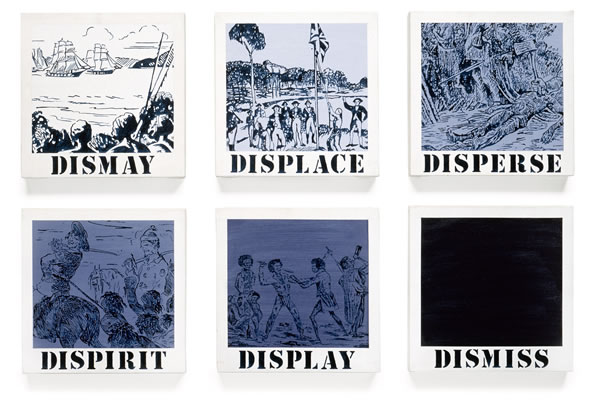
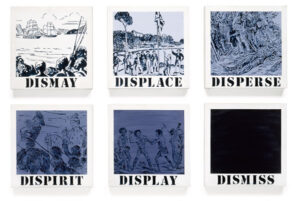
Image: Gordon Bennett, untitled, 1989; from Global Conceptualism: Points of Origin, 1950s–1980s, Queens Museum, 1999.
Event 90: I Met (en España)

I first got to know Claudia Franken through academic channels; she is a Europe-based scholar of Gertrude Stein and Arno Schmidt, a less-well-known prose writer who anticipates American postmoderns such as Thomas Pynchon. As his Wikipedia entry states, “Arno Schmidt (1914–79) was a German author and translator. He is little known outside of German-speaking areas, in part because his works present a formidable challenge to translators.” Claudia’s proposal for a session on “Avant-Gardes @ Zero Hour” took up Schmidt’s early “trilogy” of novellas focusing on cultural displacement after 1945, pursued by analogies to Egyptian and Phoenician antiquity—as if the two time frames were disturbingly (felicitously) co-present (see John E. Woods’s unequaled translation). The conference itself was canceled due to COVID but was revived as a webinar in March 2021, where Claudia presented her work on Schmidt—in a form, on first hearing, that was as allegorically complex as Schmidt’s work itself. I then engaged Claudia’s essay editorially, working toward publication in the Hunan, China-based Journal of Foreign Languages and Cultures, where it appears (here). All this is complicated, but is what it takes to get the work done in this era of travel restrictions and ideological blockage. What resulted is a fine literary essay that the editors selected to inaugurate their issue. … More

Event 89: I Met (Metropole)

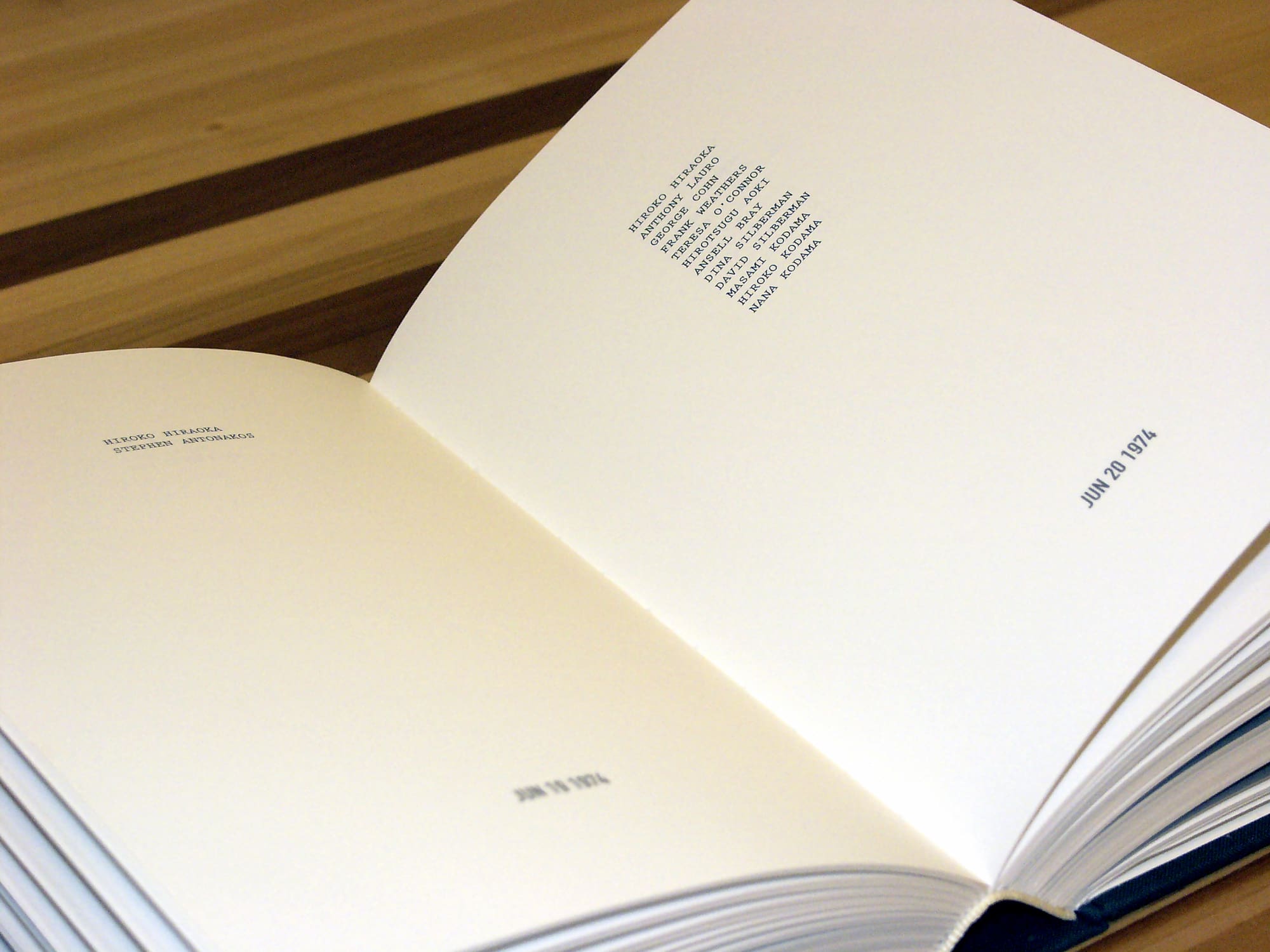
I return here to the series of “I Met” posts, begun in January 2010 after the work of On Kawara. In a series of journal entries, On Kawara documented his life in art as identical to the names, location, and dates of his dealers, contacts, and friends, giving no further interpretation. Thus he interpreted his life as identical to his art, and his art as identical to its names, locations, and dates. This project is unique, and must be so, in its radicality; it is an essay on meaning as a “restricted code” that is at the same time a subtext of the public exhibition of his iconic works and the private circulation of artistic property (as I found when permission to reproduce one of his date paintings for Questions of Poetics was denied). In my entries, the purely conceptual project undergoes mutation to the forms of life and art I inhabit while still focusing on the intersection of names, locations, dates. At one point, the series achieved a kind of “feedback” state, as when people I met at conferences or readings would ask if there going to be an “I Met” for the event; alternately, for more than two years this form of work has been nearly impossible.

Wednesday, October 6
Delta DTW > LGA

Carla Harryman

Lisa Yuskavage @ David Zwirner
Jesse Murry @ David Zwirner
Alice Neel @ David Zwirner
Frank Moore @ David Zwirner
Tyler Mitchell @ Jack Shainman
John Currin @ Gagosian
Philip Guston @ Hauser & Wirth
Robert Rauschenberg @ Pace
Robert Longo @ Pace
Jeanne Liotta @ Microscope Gallery

Michael Gottlieb & Josef Kaplan
@ St. Mark’s Church

James Sherry
Lee Ann Brown
Tony Torn
Brenda Coultas
Drew Gardner
Kyle Dacuyan … More

Entry 44: Global Archives

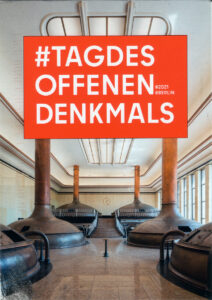
About this time, on an every-other-year basis, I would be traveling to Berlin to further investigate the “Tag des offenen Denkmals”—the Day of Open Monuments (2021 program here). I see this event as a “global archive“—one of many I am engaged with, as also the documenta exhibitions in Germany since 1955, which I have written and just published on:

In defining “the global archive,” this essay refers, first of all, to the historical development of exhibitions in Germany that address a global horizon, a distinct cultural project since at least the Enlightenment. After 1945, modern art, which had been removed from public view by the Nazi state, was reintroduced as a project of reeducation as much as aesthetics. Documenta, beginning in 1955, exhibited modern and later artists in the destroyed buildings of the city of Kassel, and expanded its formal and cultural address to a global scale over its fifty-year history. Documenta itself became a kind of continuous archive of its own exhibition history, a mode of formal presentation that increasingly relied on the works it presented. Here I read in detail the archival strategies and form of dOCUMENTA 13, arguably a highpoint of this effort to archive globality as it emerges. “The Global Archive and the Future of Poetics,” Journal of Foreign Languages and Cultures 5, no. 1 (June 2021): 94–108 [pdf here].

… More

Document 93: Global Ideation

The global circulation of ideas advances with the publication of the Journal of Foreign Languages and Cultures, vol. 5, no. 1, edited by Laurie Scheyer from Hunan Normal University. As with last year’s special forum on “Modernity @ Zero Hour,” this issue contains a set of papers—distributed through a capacious issue with numerous related themes—that developed in an online webinar, “Avant-Gardes @ Zero Hour,” which took place during conditions of COVID in March 2021. The webinar itself, thanks to Zoom, was itself global and involved participants from seven time zones, from New Zealand to Moscow. It also could include a performance event, the in-time screening of Carla Harryman’s “Occupying Theodor W. Adorno’s Music and New Music: A Re-Performance,” originally proposed for the canceled EAM conference in Fall 2020. In this best of all possible worlds, our proposed event went forward; papers were presented, comments generated, drafts revised, and the results are now distributed to the world at large. Below I list the contents and link to the six papers that were the result of that effort, seen as part of a larger conversation in a global framework. Indeed my own contribution, “The Global Archive and the Future of Poetics,” looks at the form of the global exhibition after the German documenta, but it easily applies to what we are doing here. … More

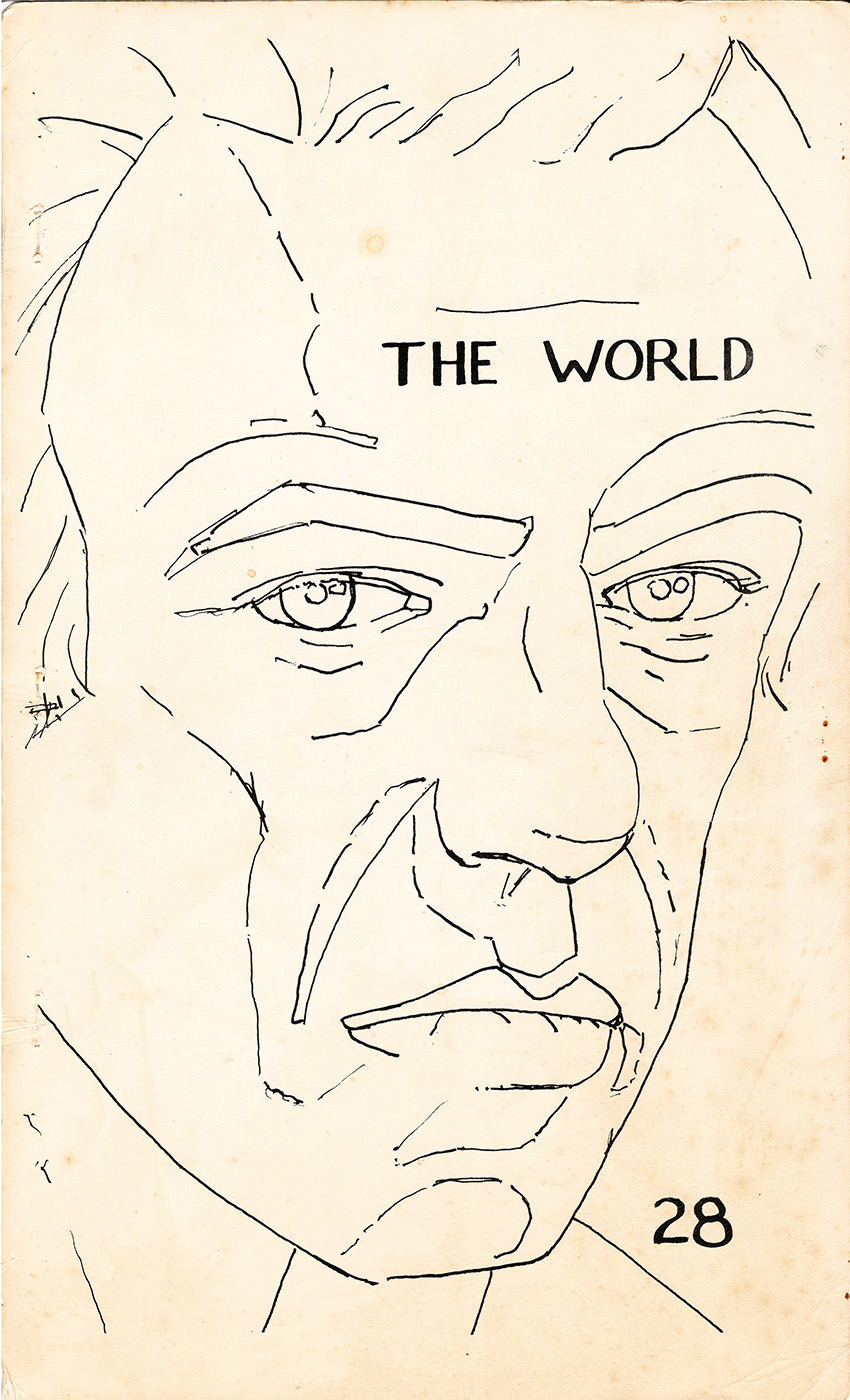
I return to the vexed question of autobiography, which in earlier times I believed one should “start writing” only when all other options—of world transformation, for instance—had failed. The two key terms are brought together in the 1973 cover of The World 28, the “Autobiography Issue” edited by Lewis Warsh. As I recalled when Lewis died late last year, I first met him in Mendocino, on his way down the coast to Bolinas, where I visited him before he moved back east. In his editing of The World, he wanted to radicalize autobiography not as a genre but as a mode of writing. Writing from an immediate perspective of “personhood” in any genre was of interest, from poetry to fiction to memoir, journal entries, letters, portraits, and snapshots.

Autobiography would be the royal road to writing per se; there was a tradition and consensus that “self/life/writing” was what there was to do, in fact was all that could be done. For a brief while there was in fact a kind of period style of autobiographical self-discovery, nothing like the persona poems of the workshop but evoking a tradition from Rousseau and the romantics, Zukofsky’s “the words are my life,” Beat spontaneity, and New York School everyday life. The consensus—and it was not long lived—was that “into the company of self it all returns,” one might say. Warsh’s 1973 project, bringing together writers of several diverse schools, was the highpoint of that moment.

I was the early Language writer in that group, in company with Clark Coolidge, Bernadette Mayer, Tom Raworth, Bobbie Louise Hawkins, Bill Berkson, Anne Waldman, all poets who would appear in the first issues of This, but also Diane Di Prima, Kenward Elmslie, Lee Harwood, Harris Schiff, and John Wieners. The issue should be reprinted in its entirety, to reflect on the question of writing that Lewis proposed: where the fact of writing and the events of life are seen as nearly identical. What historical circumstances obtained for that to be possible, desirable, likely? But there is also a moment of transition here: from person to language—at one pole the iconic representation of personhood, in condensed and presentable form, and on the other the endlessness of scribbling in letters and journals, a fascination of writing per se. … More

This shouldn’t be so difficult. My archive contains my vaccination records. Since being vaccinated for a disease like polio in a pandemic is a matter of public concern, I post them here as a matter of interest. The series of three from 1962 to 1963 I would have received in the 10th grade; as the card indicates, I was 14 at the time. They were probably given at the U.S. Naval Hospital in Oakland, given my father’s signature on the card.

… More

Archive 12: Micropoetics

Thanks to the online research of C.V. Henriette, I now have a visual record of my second appearance in a literary magazine, Gum 2, ed. Dave Morice (Iowa City, September 1971). Morice’s goal as editor was to be small and sustainable—in both aesthetic and material terms—a reflection on the political economy of poetry at the time and a counter-cultural alternative. A protominimalism, at the intersection of concrete poetry, midwestern imagism, the New York school, and the not-yet-named Language school (as well as a first instance of “actualism,” the movement that was not one) was the result. The poem was written, likely, at Berkeley under the influence of Robert Grenier, and I gave a copy to Dave after I met him in Iowa City. No title, no capitalization, no regular stanzas, no persona, no narrative, but with the use of asterisks in the mode of Ted Berrigan, Anne Waldman, and later Anselm Hollo.

“obliged to Dumbarton / Dumbarton Bridge / and his oaks” is a triangular pun on the Dumbarton Bridge, a relic of the times and one of the most ungainly bridges ever, crossing the southern San Francisco Bay, and Dumbarton Oaks, the site of the Dumbarton Oaks Conference, the progenitor of the United Nations. Also, there are many oaks in the South Bay, as the poem notes.

In the late summer and early fall of 1944, at the height of the Second World War, a series of important diplomatic meetings took place at Dumbarton Oaks, officially known as the Washington Conversations on International Peace and Security Organization. Delegations from China, the Soviet Union, the United Kingdom, and the United States deliberated over proposals for the establishment of an organization to maintain peace and security in the world. Their meetings resulted in the United Nations Charter that was adopted in San Francisco in 1945. [Wikipedia]

… More

Poetics & the University in Crisis
Friday, March 5–Sunday, March 7 / 3:00–7:00 P.M.
featuring 22 poets, critics, teachers, artists
free registration required; click here

A virtual colloquy on the role of poetics in the American university in crisis, for a nation also in crisis. The humanities and arts continue to be major targets of increasingly austere budgets—and so, too, has critical thinking. How can poetics—as inventive, intellectually engaged creative series of practices and modalities of thought—offer an intervention into this moment? How can the university re-embrace the necessity of art based in critical thinking and open inquiry that includes the aesthetic and the political? The three days of this colloquy will aim to unite creative poetic practices with analytical critique and pedagogy from a wide range of voices, methods, points of view.

… More

Working through has never had a clearer usage than to “work through an archive,” which is now my task virtually on a daily basis. Things emerge from files and folders with breathtaking immediacy, though in actuality they have been there all along—a form of latency that is also a structure of the present. An archive, in my experience, is not a thing of the past; we are constituted in the present by our archives. This notion of archive is distinct from memory—a memory can pop up at any time, prompted by as little as a similarity in sound or image or even a proximity in neural networking. I remember walking to our black Chevrolet in a San Leandro parking lot coming out of a Five and Dime store with my mother in 1956. An archive is more logically or interpretively or thematically structured; it has a filing system that is a product of labor, vertically organizing materials in their lateral connections to form a network that begins in the archived past but extends to the present. Just so, I was organizing a set of files to be accessed under subhead 5.3.3.1 “Discussions and controversies: literary/artistic,” of which I have seen many. I open the file marked “Georgia Review” to organize/distribute its contents in three records:

5.3.3.1. controversy (1981). NEA/Georgia Review
letters following publication of “Go Down Dignified: The NEA Writing Fellowships” [see also 5.2.2.1981.1–1982.1]
MASTERS and WILK articles, w introduction, xer, 14 pp.
D’SOUZA article, sent by FRANK CONROY to MARY MACARTHUR and LYN HEJINIAN, xer w notes, 9 pp.
BW > GEORGIA REVIEW, tcb, 5 ppl.; drafts, tcb, 3 pp.; > BILL HENDERSON (PUSHCART PRESS), tcb, 1 p., 1 cp.; > JEANETTA JONES MILLER (SMALL PRESS DISTRIBUTION), tcb, 1 p.; > BILL BERKSON, 2 tcb, 3 pp.; > THOMAS M. MEYER (attorney), tcb, 1 p.; DAVID WILK, tcb, 1 p.; FRANK CONROY (NEA), tcb, 2 pp.; STANLEY W. LINDBERG (GEORGIA REVIEW), tcb, 3 pp., 2 cp.
BERKSON > GEORGIA REVIEW, tcb w BW edits, 10 pp.; > LINDBERG (GEORGIA REVIEW), 2 tlx, 5 pp.; > BW, als and tls, 2 pp.
LINDBERG (GEORGIA REVIEW) > BW, tls, 1 p.; > BERKSON, 2 tlx, 3 pp.
WILK > BW, tlx, 2 pp.
HEJINIAN > HENDERSON (PUSHCART PRESS), tcb w hm note, 1 p.
HENDERSON > BW, tls, 1 p.
JENNIFER MOYER (CCLM) > BERKSON, tlx, 1 p.
MARY MACARTHUR (NEA) > BW, tls, 1 p.
BW notes, hm, 1 p.; mailing rects, 5 pcs.

… More