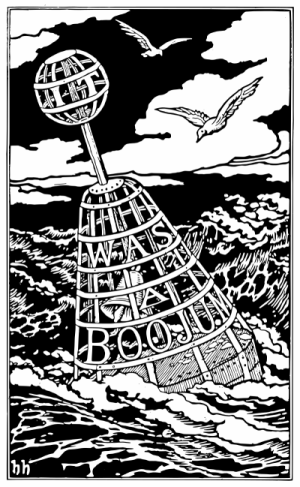
boojum

Grant Jenkins opens his review of Questions of Poetics: Language Writing and Consequences (ALH Online Review, ser. 14:1 [2017]) with an anecdote that has now become canonical lore in American poetry, the encounter between me and Robert Duncan at the San Francisco State Poetry Center’s 1978 Zukofsky memorial. As the story is now forty (4-0) years old, it is more than surprising that it is used to frame a discussion of my 2016 volume of critical poetics, as if no one had ever heard it before:

One of the most infamous events in the history of “postmodern” or “experimental” US poetry is the 1978 argument between Robert Duncan, a veteran of the New American Poetry anthology generation who was 59 at the time, and upstart Barrett Watten, then the 30-year-old self-fashioned cofounder of the more recent school of modernist-inflected verse called “Language poetry.” The incident took place during a film screening at the San Francisco Poetry Center memorializing the “objectivist” poet, Louis Zukofsky, who had recently died at 74. According to most accounts, Duncan interrupted Watten because he did not like the younger poet’s reading of Zukofsky’s poetry.

… More

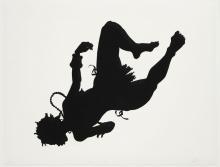
Entry 32: For Kara Walker

kara walker 01

Context is everything. To begin with, there is the question of intent in the circulation of racialized images, and the way racism may be ascribed to them. To display racialized imagery in America is to open a Pandora’s Box of every conceivable projection and denial. This is not to separate intention from context, but to find ways of reading it that are contextual and historical. Pandora’s Box is an apt metaphor for the racial content of Kara Walker’s work. There was an incident, about a dozen years ago, when her work was to be first shown at the then-quite-stodgy Detroit Institute of Arts. Think of the recent film Get Out as another of Pandora’s Box—the basement and its horror of substitute body parts. Kara Walker was new to Detroit, and the DIA was still a bastion of cultural separatism in the city. In the film, black bodies are used as vehicles for whiteness that has run out its biological course and needs new life. Off hours, a black janitor encountered the work during installation and complained; the show was cancelled. A state of mind called “the sunken place” is introduced in the film as the horror of racial subjectivity. This is the kind of textbook case that organizations such as the National Coalition Against Censorship deal with all the time, from Huckleberry Finn to the controversy of Vanessa Place tweeting 140-line texts from Gone with the Wind. On the other hand, the contrast between that moment to the ramp up of Kara Walker’s career in museums could not be more marked. The art world itself is represented in the form of a blind gallery owner lusting for authentic talent. … More

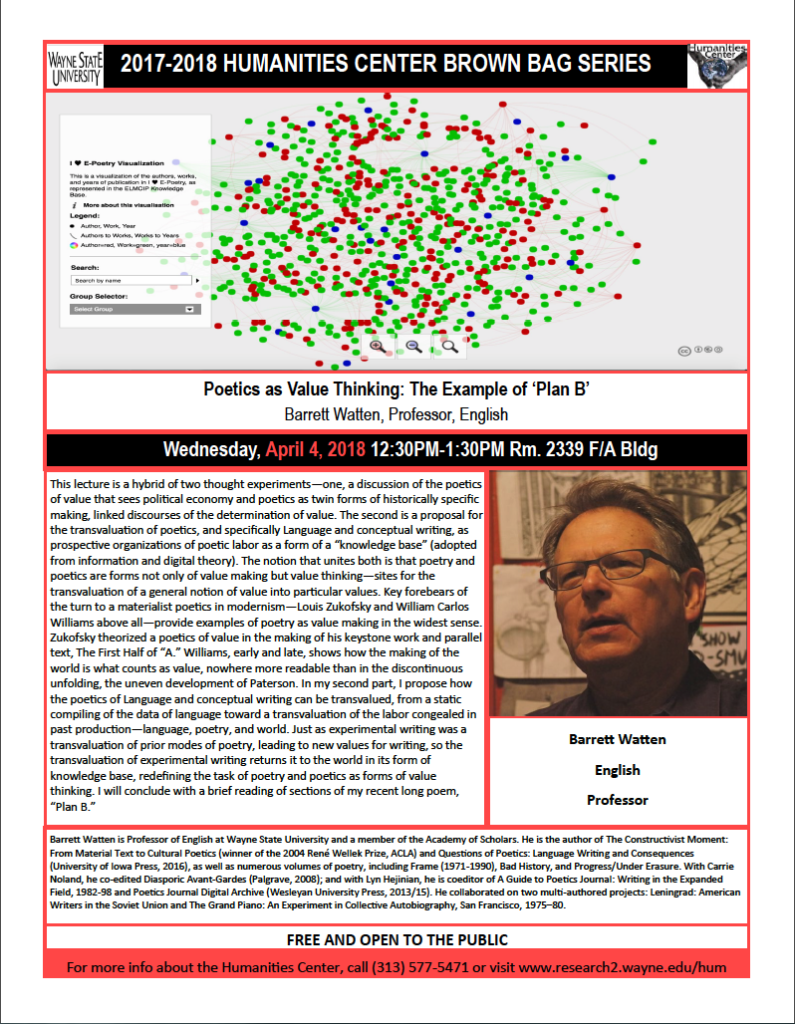
Poetics as Value Thinking:
The Example of “Plan B”

BB Barrett Watten flyer
Wednesday, 4 April 2018, 12:30–1:30 PM
2339 F/AB, Wayne State University

This lecture is a hybrid of two thought experiments—one, a discussion of the poetics of value that sees political economy and poetics as twin forms of historically specific making, linked discourses of the determination of value. The second is a proposal for the transvaluation of poetics, and specifically Language and conceptual writing, as prospective organizations of poetic labor as a form of a “knowledge base” (adopted from information and digital theory). … More

Six Moments of Occupy:
Transvaluations of the Symbolic

Humanities Center Faculty Fellows Symposium
Wayne State University, 23 March 2018

[excerpt from the introduction] Occupy was, and continues to be, an event; we speak of “the event of Occupy” much as we refer to the “event of 9/11.” To begin with, the concept of “revolution” in Occupy—as distinct from other specific moments such as Tahrir Square or anti-austerity Greece—oscillates between “radical particularity” of material conditions (such that every local instance of Occupy, from Zucotti Park to to Oakland to Paris to Moscow, could be seen to have substantially different strategies and goals) and a utopian horizon that must be preserved as an abstract totality: “We are the 99%.” … More

“Third Factory: Avant-Garde,
Social Construction, and Ideology in the Soviet 20s”

European Network for Avant-Garde and Modernist Studies (EAM)
Universität Münster, 5–7 September 2018

For this year’s EAM, centered the theme of “Realisms of the Avant-Garde and Modernism,” I propose to organize a panel or multi-session series of panels that would revisit the relation of the avant-garde to social construction. Such a project would necessarily be revisionist, in deepening but questioning the role of the avant-garde in the project of social construction, particularly after new archival materials and critical perspectives have become available. But it would also try to refocus interest on the Soviet 20s as scene of a coordinated Gesamtkunstwerk beyond individual artists, works, groupings, or genres that has continued relevance for a global, mediated, ideologically distorted world. … More

Entry 31: Generation

Generation n. 1 All of the people born and living at about the same time, regarded collectively; ‘one of his generation’s finest songwriters.’ 1.1 The average period, generally considered to be about thirty years, in which children grow up, become adults, and have children of their own; ‘the same families have lived here for generations.’ 1.2 A set of members of a family regarded as a single step or stage in descent; as modifier, in combination ‘a third-generation Canadian.’ 1.3 A group of people of similar age involved in a particular activity; ‘a new generation of actors and directors.’ 1.4 A single stage in the development of a type of product or technology; ‘a new generation of rear-engined sports cars.’ 2 mass noun The production or creation of something; ‘methods of electricity generation’; ‘the generation of wealth.’ 2.1 The propagation of living organisms; procreation. Origin Middle English: via Old French from Latin generatio(n-), from the verb generare (see generate).

—Oxford Living Dictionaries

Introduction to “The Face Gone:
Generation in Presentist Poetics”

presented at ASAP 9, 27 October 2017
“Generation and the Arts of the Present”
with Lawrence Rinder and James Smethurst;
chaired by C.D. Blanton; Rita Raley, respondent

In critical and creative terms, “generation” is a blindspot in the discourse of the arts of the present. My essay starts by questioning the reliance on art historical, literary, and critical paradigms of periodization as assumed across the disciplines: from Foucault’s “epistemic shift” to Jameson’s “cultural logic of late capitalism” to periodizing notions of the literary, artistic, or cultural succession of one movement, school, style, or group to the next. Rather, I see “generation” as a cultural logic is negotiated at every moment in poetic practice: for instance, Language writing does not simply succeed and overturn the “presentness” of the New American poets, nor is it simply overturned by conceptualism or new activist poetries—rather, a complex negotiation of generation takes place at each moment, which may be seen both within the details of the work or movement’s construction or self-understanding, and externally in terms of its aesthetic positioning. … More

ASAP 9
The Arts of the Present

Oakland Marriott Hotel
University of California, Berkeley
26–29 October 2017

Ken D. Allan
Vincent Adiutori
Peter Hitchcock
Annie McClanahan
Regina Weinreich
Erik Mortenson
Tyler Coburn
Sara Blair
Richard Purcell
Daniel Reynolds
… More

Reception Study Society
Seventh Biannual Conference
St. Catherine University, St. Paul
21–23 September 2017

Celebrating Forty Years
of Feminist Reception

Sarah Hagelin
Daniel Morris
Jennifer Freeman Marshall
Burt Kimmelman
Paula Rabinowitz
J. Peter Moore
Susan Wegener
Stephen Paul Miller
Molli Spalter
Isaac Pickell
… More

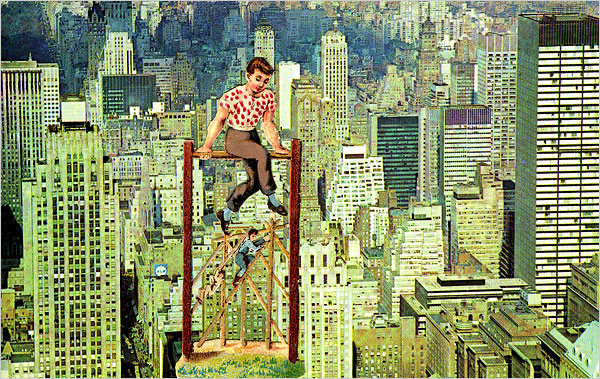
Document 66: The Bungalows

[In memory of John Ashbery]

ashbery collage 01

THE BUNGALOWS

Impatient as we were for all of them to join us,
The land had not yet risen into view: gulls had swept the gray steel towers away
So that it profited less to go searching, away over the humming earth
Than to stay in immediate relation to these other things—boxes, store parts, whatever you wanted to call them—
Whose installedness was the price of further revolutions, so you knew this combat was the last.
And still the relationship waxed, billowed like scenery on the breeze.

They are the same aren’t they,
The presumed landscape and the dream of home
Because the people are all homesick today or desperately sleeping,
Trying to remember how those rectangular shapes
Became so extraneous and so near
To create a foreground of quiet knowledge
In which youth had grown old, chanting and singing wise hymns that
Will sign for old age
And so lift up the past to be persuaded, and be put down again.

… More