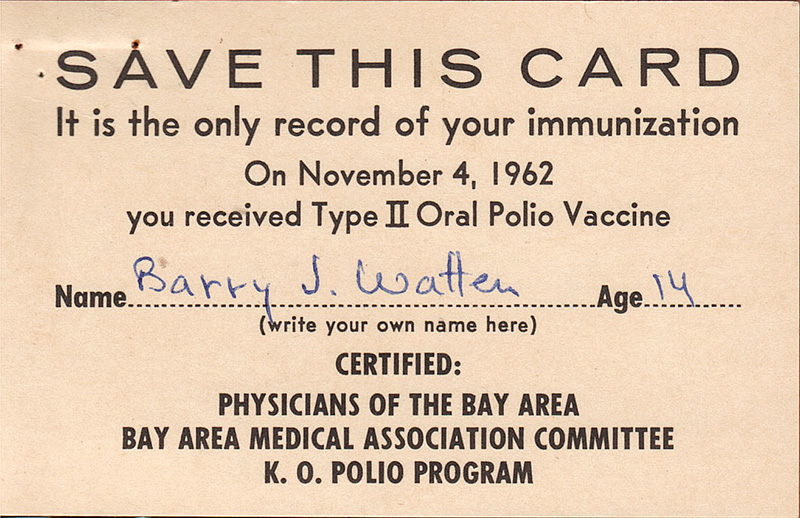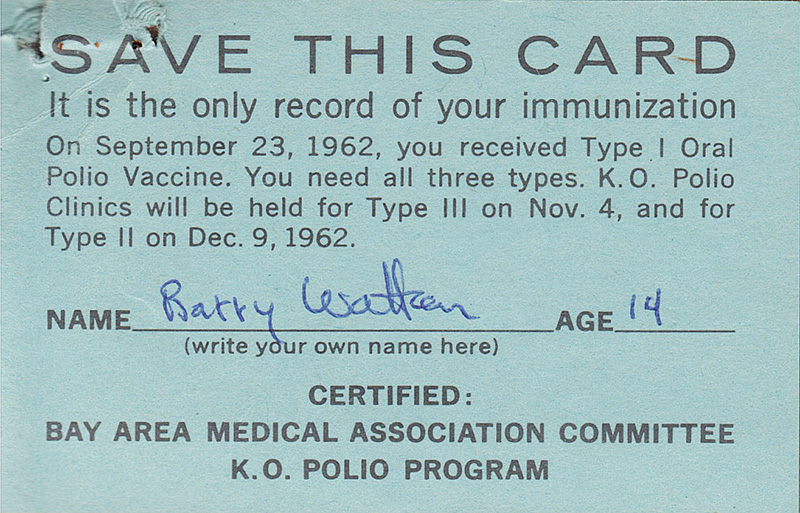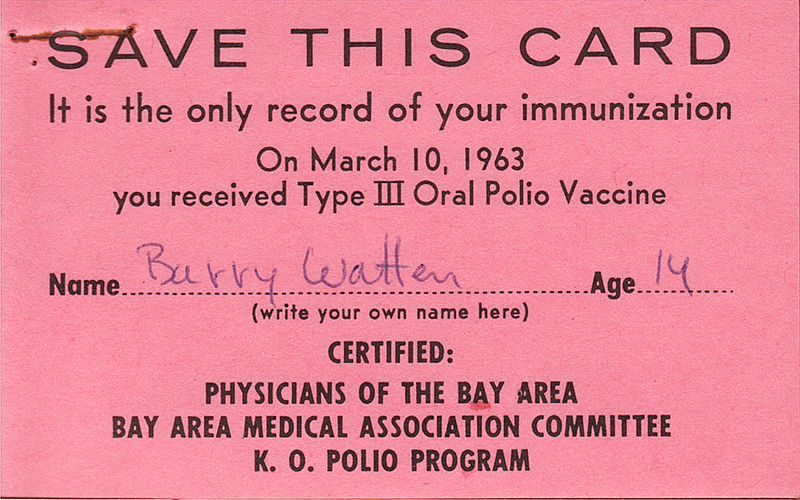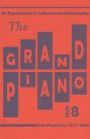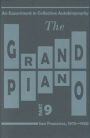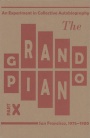
This shouldn’t be so difficult. My archive contains my vaccination records. Since being vaccinated for a disease like polio in a pandemic is a matter of public concern, I post them here as a matter of interest. The series of three from 1962 to 1963 I would have received in the 10th grade; as the card indicates, I was 14 at the time. They were probably given at the U.S. Naval Hospital in Oakland, given my father’s signature on the card.

… More

Archive 12: Micropoetics

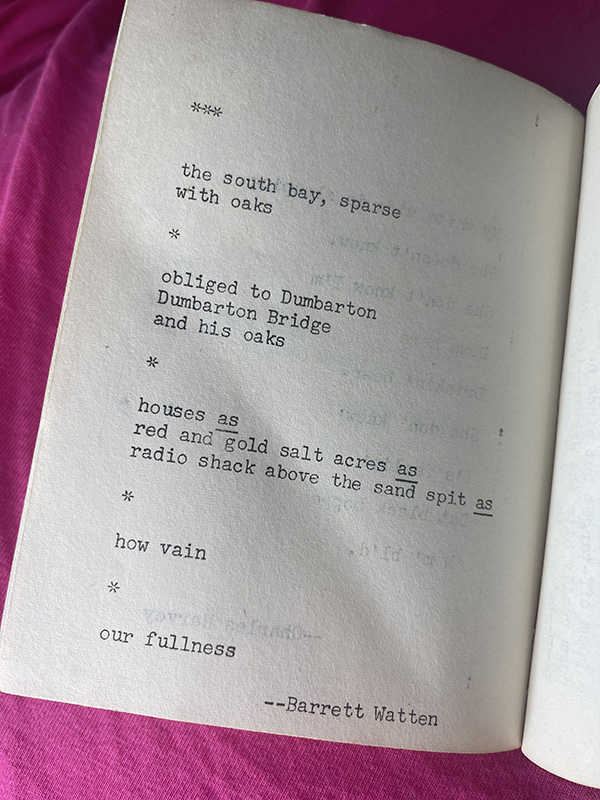
Thanks to the online research of C.V. Henriette, I now have a visual record of my second appearance in a literary magazine, Gum 2, ed. Dave Morice (Iowa City, September 1971). Morice’s goal as editor was to be small and sustainable—in both aesthetic and material terms—a reflection on the political economy of poetry at the time and a counter-cultural alternative. A protominimalism, at the intersection of concrete poetry, midwestern imagism, the New York school, and the not-yet-named Language school (as well as a first instance of “actualism,” the movement that was not one) was the result. The poem was written, likely, at Berkeley under the influence of Robert Grenier, and I gave a copy to Dave after I met him in Iowa City. No title, no capitalization, no regular stanzas, no persona, no narrative, but with the use of asterisks in the mode of Ted Berrigan, Anne Waldman, and later Anselm Hollo.

“obliged to Dumbarton / Dumbarton Bridge / and his oaks” is a triangular pun on the Dumbarton Bridge, a relic of the times and one of the most ungainly bridges ever, crossing the southern San Francisco Bay, and Dumbarton Oaks, the site of the Dumbarton Oaks Conference, the progenitor of the United Nations. Also, there are many oaks in the South Bay, as the poem notes.

In the late summer and early fall of 1944, at the height of the Second World War, a series of important diplomatic meetings took place at Dumbarton Oaks, officially known as the Washington Conversations on International Peace and Security Organization. Delegations from China, the Soviet Union, the United Kingdom, and the United States deliberated over proposals for the establishment of an organization to maintain peace and security in the world. Their meetings resulted in the United Nations Charter that was adopted in San Francisco in 1945. [Wikipedia]

… More


Kim D. Hunter
The Official Report
on Human Activity

Zoom discussion
Thursday, April 22
7:00–8:30 P.M. EDT

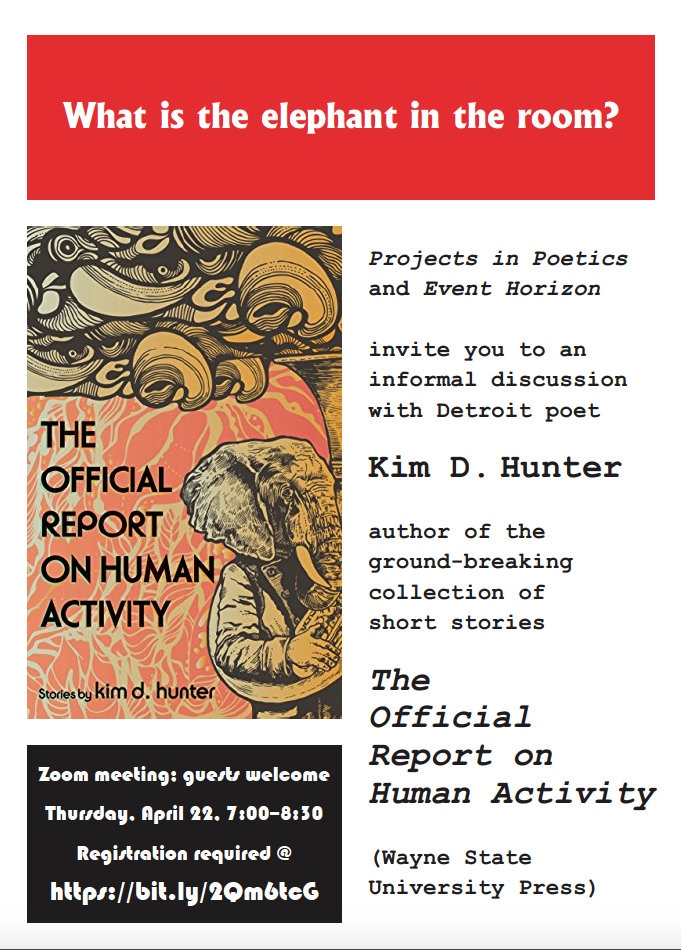
Projects in Poetics and Event Horizon announce an informal discussion with Detroit poet kim d. hunter, author of the ground-breaking collection of short stories from Wayne State University Press. Guests  are welcome; register here: https://bit.ly/2Qm6tcG.


The Official Report on Human Activity
, which is neither official nor a report, is a collection of long stories that are linked by reoccurring characters and their personal struggles in societies rife with bigotry, in which media technology and capitalism have run amok. These stories approach the holy trinity of gender, race, and class at a slant. They are concerned with the process and role of writing intertwined with the roles of music and sound. … More

Avant-Gardes @ Zero Hour: European, American, Transnational
Monday, April 5–Wednesday, April 7

A virtual colloquy featuring 16 scholars, writers, artists
& the global premiere of Carla Harryman’s “Occupying
Theodor W. Adorno’s Music and New Music: A Re-Performance”
attendees welcome; registration required; click here

Originally organized for the 2020 conference of the European Network of Avant-Garde and Modernist Studies (EAM) conference in Ghent, Belgium, canceled due to COVID-19 (here), and following last year’s virtual colloquy on “Modernism @ Zero Hour” (here). The seminars have  been reorganized and expanded, with participating scholars and artists from seven nationalities and time zones, and with the addition of the streaming of Carla Harryman’s revised production of “Occupying Theodor W. Adorno’s Music and New Music,” originally staged at dOCUMENTA 13 (2012). The colloquy takes up transnational approaches to the emergence of avant-garde art and practices after the metahistorical date of “Zero Hour,” 1945—the end of the war which is not one—to comprehend the profound reflection on destruction, displacement, and a new global order in post–1945 movements and works.

Organized by Barrett Watten, English, Wayne State University
and Lauri Scheyer, British and American Poetry Research Center,
Hunan Normal University
Sponsored by Projects in Poetics and Statement Magazine,
California State University, Los Angeles
… More

Poetics & the University in Crisis
Friday, March 5–Sunday, March 7 / 3:00–7:00 P.M.
featuring 22 poets, critics, teachers, artists
free registration required; click here

A virtual colloquy on the role of poetics in the American university in crisis, for a nation also in crisis. The humanities and arts continue to be major targets of increasingly austere budgets—and so, too, has critical thinking. How can poetics—as inventive, intellectually engaged creative series of practices and modalities of thought—offer an intervention into this moment? How can the university re-embrace the necessity of art based in critical thinking and open inquiry that includes the aesthetic and the political? The three days of this colloquy will aim to unite creative poetic practices with analytical critique and pedagogy from a wide range of voices, methods, points of view.

… More

Working through has never had a clearer usage than to “work through an archive,” which is now my task virtually on a daily basis. Things emerge from files and folders with breathtaking immediacy, though in actuality they have been there all along—a form of latency that is also a structure of the present. An archive, in my experience, is not a thing of the past; we are constituted in the present by our archives. This notion of archive is distinct from memory—a memory can pop up at any time, prompted by as little as a similarity in sound or image or even a proximity in neural networking. I remember walking to our black Chevrolet in a San Leandro parking lot coming out of a Five and Dime store with my mother in 1956. An archive is more logically or interpretively or thematically structured; it has a filing system that is a product of labor, vertically organizing materials in their lateral connections to form a network that begins in the archived past but extends to the present. Just so, I was organizing a set of files to be accessed under subhead 5.3.3.1 “Discussions and controversies: literary/artistic,” of which I have seen many. I open the file marked “Georgia Review” to organize/distribute its contents in three records:

5.3.3.1. controversy (1981). NEA/Georgia Review
letters following publication of “Go Down Dignified: The NEA Writing Fellowships” [see also 5.2.2.1981.1–1982.1]
MASTERS and WILK articles, w introduction, xer, 14 pp.
D’SOUZA article, sent by FRANK CONROY to MARY MACARTHUR and LYN HEJINIAN, xer w notes, 9 pp.
BW > GEORGIA REVIEW, tcb, 5 ppl.; drafts, tcb, 3 pp.; > BILL HENDERSON (PUSHCART PRESS), tcb, 1 p., 1 cp.; > JEANETTA JONES MILLER (SMALL PRESS DISTRIBUTION), tcb, 1 p.; > BILL BERKSON, 2 tcb, 3 pp.; > THOMAS M. MEYER (attorney), tcb, 1 p.; DAVID WILK, tcb, 1 p.; FRANK CONROY (NEA), tcb, 2 pp.; STANLEY W. LINDBERG (GEORGIA REVIEW), tcb, 3 pp., 2 cp.
BERKSON > GEORGIA REVIEW, tcb w BW edits, 10 pp.; > LINDBERG (GEORGIA REVIEW), 2 tlx, 5 pp.; > BW, als and tls, 2 pp.
LINDBERG (GEORGIA REVIEW) > BW, tls, 1 p.; > BERKSON, 2 tlx, 3 pp.
WILK > BW, tlx, 2 pp.
HEJINIAN > HENDERSON (PUSHCART PRESS), tcb w hm note, 1 p.
HENDERSON > BW, tls, 1 p.
JENNIFER MOYER (CCLM) > BERKSON, tlx, 1 p.
MARY MACARTHUR (NEA) > BW, tls, 1 p.
BW notes, hm, 1 p.; mailing rects, 5 pcs.

… More

Entry 43: Rolling Out Plan B


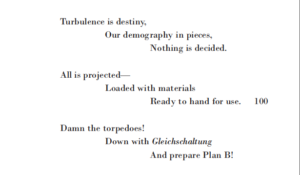
These are the words that conclude “Plan B,” my poem written after the Trump election in 2016. What has transpired since could not have been more like—turbulence has been destiny, our demography is in pieces, and nothing is decided. It is that moment of stoppage—”the stopping / of the battle,” as Charles Olson wrote—that I wanted to get down, as my contribution to radical democracy perhaps. But even the concept of “radical democracy” is not now decided—that is in the nature of a decision—with the spectacle of the “mob” thinking it represents the demos violating “the People’s House,” as we have been told and can see for ourselves. My point is the instability of the moment, but also that of the discourse that represents it or attempts to intervene in it. Is that a good thing for poetry, to record such a moment, or a bad thing for politics, that its confusions may be reproduced? … More

Entry 42: Hello, Indiana!

On 4 December, this year, I was emailed by John Pratt, English teacher at Greensburg High School in Indiana, asking if I would read for his program (virtually), and send a shout out to the students. Greensburg has experienced two waves of COVID and was forced to return to all-online classes; the readings would be an end-of-year bonus for students. I also see it as an effort to communicate between “regions” of the pandemic: Indiana, a red state with huge uptick in cases in December, and Michigan, a blue state where a similar surge was somewhat damped but still compares with other Midwestern states, as I know from the Michigan Coronavirus page [here].

With a population of 11,000, our small town of Greensburg Indiana was hit hard by the pandemic in March and last week it returned with full force. Once again Greensburg High School has been moved to virtual learning. As one of our teachers, I have launched a campaign to provide an inspiring lesson for our over 700 students. It is called The Bucket List—Our Greatest Poets. I have sought out those who I feel would inspire us with a few words. Would you be willing to read a poem for my students? Simply tape yourself saying who you are, give a shout out to Greensburg High School students, then read a poem. Thank you for your consideration and have a great week.

No problem, you bet. On 14 December, I recorded a section from my poem of the COVID duration, “Notzeit (After Hannah Höch),” with a short exhortation to the students to write about what they have learned from strange times:

John Pratt, in turn, posted the video to his Virtual Chautauqua page [here], which provides links to the fifteen poets who responded; I was pleased to see myself in company with Eileen Myles, Martín Espada, and other poets new to me. The readings are marvelous, unified by the prospect of speaking to youth across time zones, and worth the time clicking through. … More

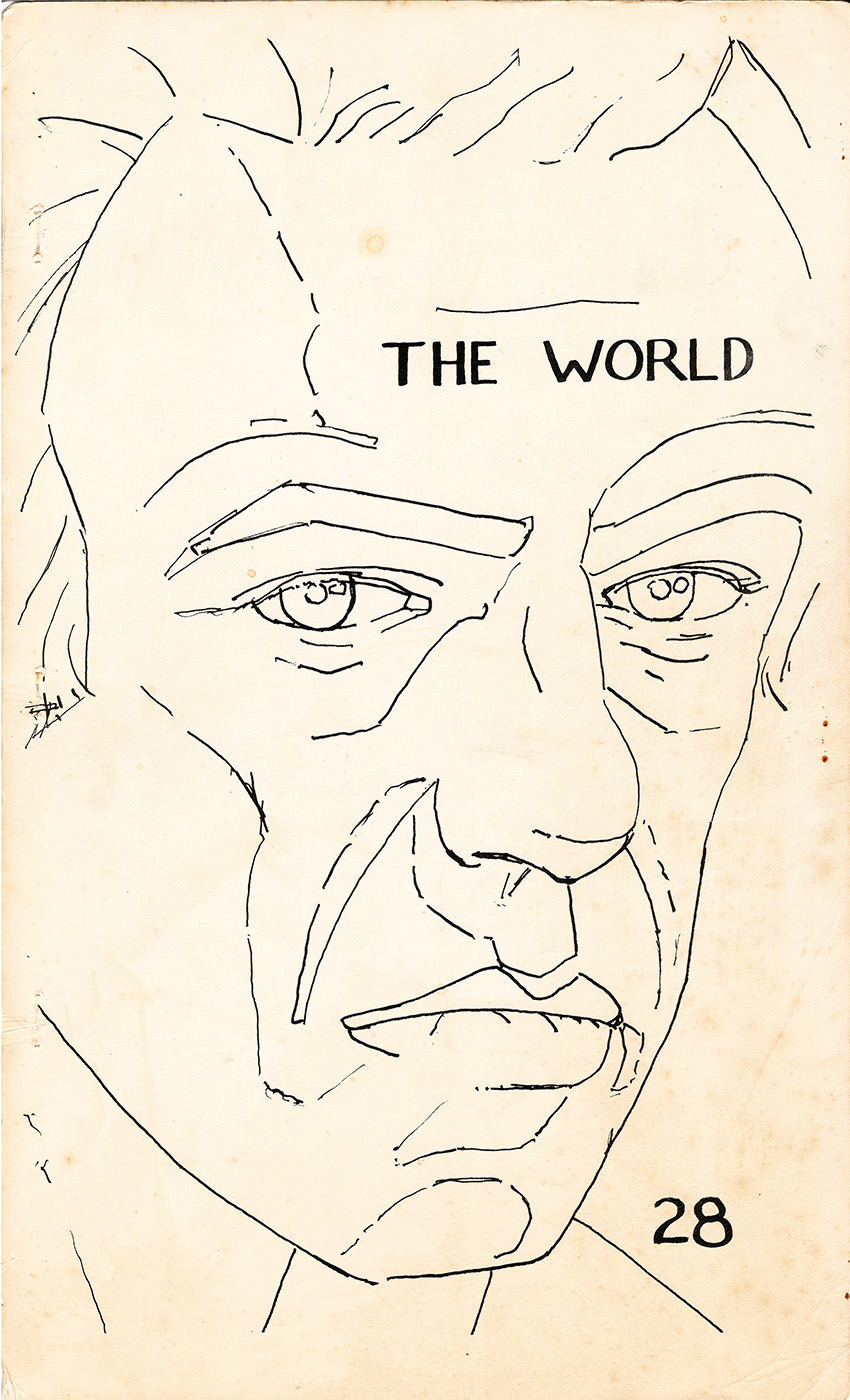
Yesterday I received news that New York poet Lewis Warsh has died. He had been ill, I heard from a distance, and I had sent birthday greetings earlier in the month—unanswered. We had a kind of  . . . rivalrous, or contestatory, poetic conversation over the decades, concerning basic issues of what counts as poetry, what the poetic calling is. The issue was person versus language, if a bit characterized and reduced. We go way back. I met Lewis in Albion, California, up the coast in California, the summer of 1972. I had moved there with Sandy Berrigan, David, and Kate, and Lewis visited on his way down to Bolinas, where I would also see him, and later in Stinson Beach, sharing a beach house with the cartoonist Greg Irons. When I assumed full editorship of This in 1973, taking a turn toward more complex aesthetics, he sent me several works, which I have scanned below. He would have sent them from Cambridge, where he lodged briefly after the West Coast. We wrote a collaboration (now in the archive), and he published my autobiographical writings—some exceptionally raw—in the “Autobiography” issue of The World (28), with its larger than life format and cover drawing by Alex Katz, New York School period style for sure. For the issue of This (4), he sent three works (he had a particular way of calling poems “works,” each being unique):

… More

Working through my archive, a copy of the above letter from William Carlos Williams, dated “April 29” and addressed to a “Rubenstein,” turned up. Given the degraded quality of the Xerox, it must have been passed around from hand to hand, and is now far removed from its origins. I have no idea how it came into my possession; my impulse was to distribute it forthwith as widely as possible, given our situation four days before a decisive political event. It does not appear in Williams’s Selected Letters, but an article from the William Carlos Williams Review (here) gives a thumbnail history. The addressee is Richard Rubenstein, editor of a little magazine The Gryphon, a poet associated with the emerging Beat movement in San Francisco who died of the effects of psychiatric treatment in 1958. The date is 29 April 1950, at which time Williams was recently investigated by the House Un-American Activities Committee (HUAC) for his association, I now believe is likely, with Popular Front groups in the Spanish Civil War but reputedly for his friendship with Ezra Pound, which resulted in his being denied appointment as the Poetry Consultant to the Library of Congress in 1949. In its resistance to the “stupidity” of “political dogma,” Williams writes: “A mind accustomed to the poem as it is gradually being understood can never be quite as deceived by the testimony of the scurrilous liars who beset us as they could have been had we not had the poem to test them against.” Four days before our opportunity to run the scurrilous liars out of power, his words have a new force.  … More