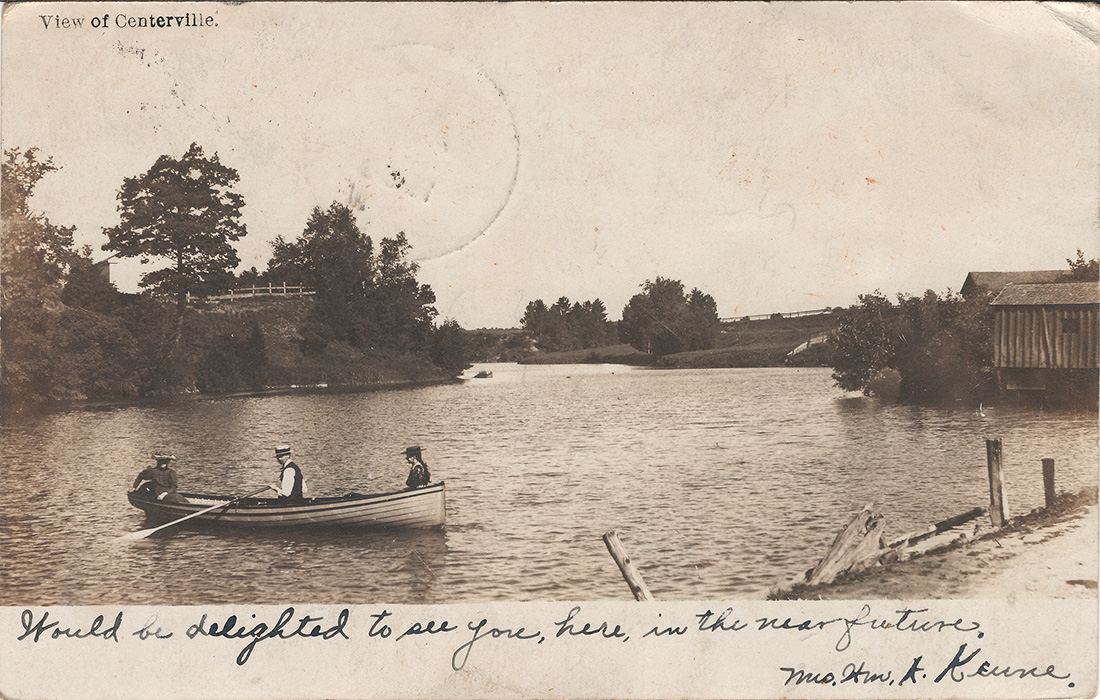
View of Centerville.

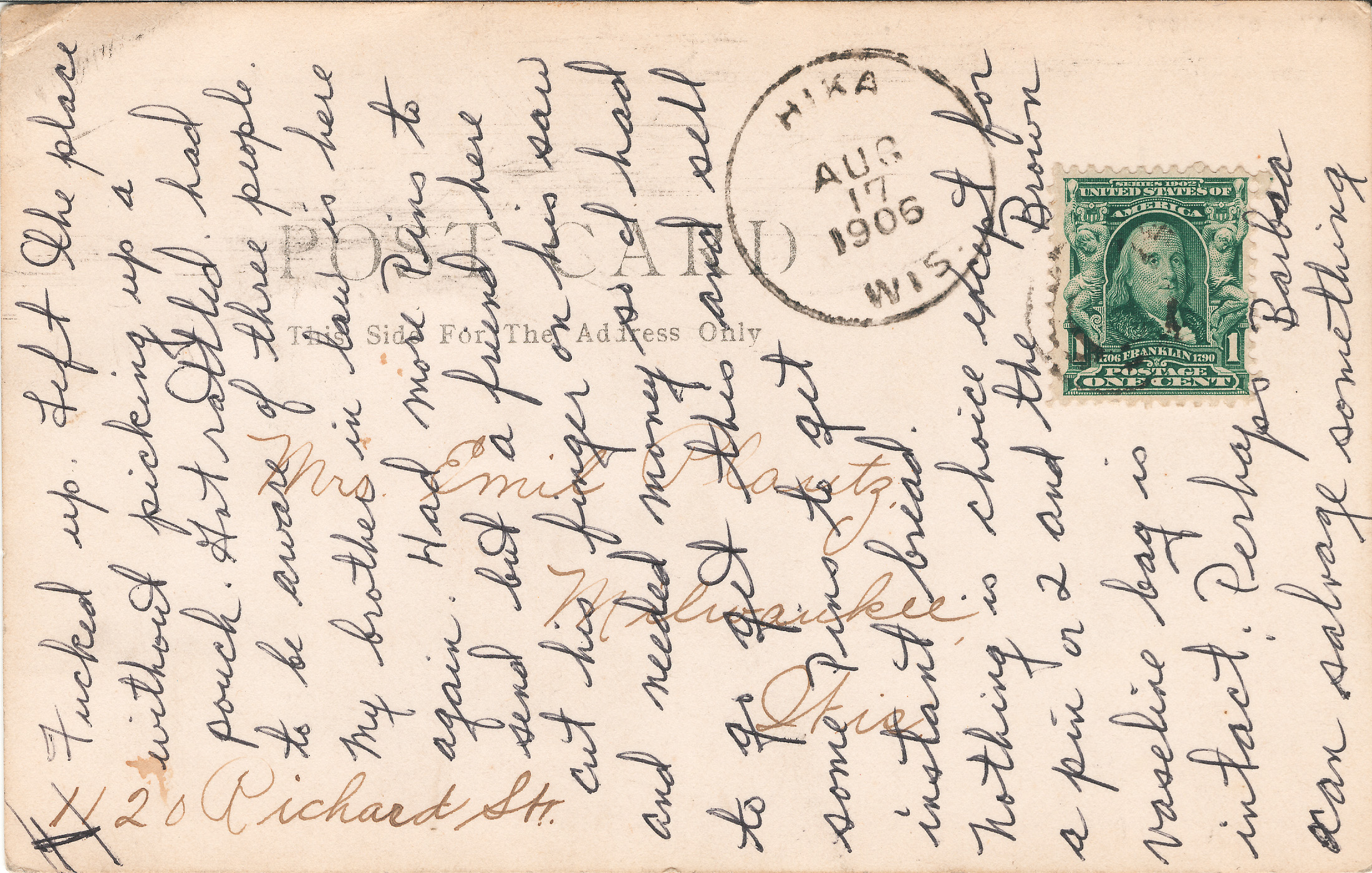
Would be delighted to see you, here, in the near future.
Mrs. Wm. A. Keune

[Hika Wis. Aug 17 1906]

Mrs. Emil Plantz, Milwaukee, Wis.
1120 Richard Str.

Fucked up. Left the place
without picking up a
pouch. Got rattled had
to be aware of three people.
My brother in law is here
again. Had more Pins to
send but a friend here
cut his finger on his saw
and needed money so I had
to go get this and sell
some Pins to get
instant bread.
Nothing is choice except for
a pin or 2 and the Brown
vaseline bag is
intact. Perhaps Barbra
can salvage something.

… More

CALL FOR PAPERS

Avant-Gardes @ Zero Hour:
European, American, Transnational

American Comparative Literature Association
Virtual conference, 8–11 April 2021

This seminar continues the work of “Modernism @ Zero Hour,” focusing on European, American, and transnational avant-gardes after the epochal moment of “Zero Hour,” 1945. At a moment of crisis and renewal, modernity is disclosed in a process of “systemic detotalization” that new avant-garde tendencies interrogated in forms of mimetic activity, at once preservative and self-undoing. The destruction of European cities, the displacement of peoples, the end of colonial empires, political and economic antagonisms, the specter of mass extermination, but also new cultural freedoms are enacted in a broad range of aesthetic, philosophical, and political forms, differing substantially from the historical avant-garde. What was “new” in 1945 was to see the world as it had never been, as a locus of destruction and creation on a global scale. Seminar topics could include transnational routes for the avant-garde: the global influences of surrealism and existentialism; the ethical imperatives of “bare life” and abstraction; the eruption of absurdism; cross-racial aesthetic motives and possibilities; the circulation of new cultural forms such as American jazz in Europe or New Wave film in the U.S.; the tension between avant-gardes, state formations, and ex/repatriation; and aesthetic movements of the global South that oppose the spatial hierarchy of prior avant-gardes. In each instance, radical form addresses modernity in crisis and the inauguration of a new global order in unique ways.

Submit proposals to ACLA by Saturday, October 31
For ACLA portal, click here; for seminars, click here
Contact barrett.watten@gmail.com for more information

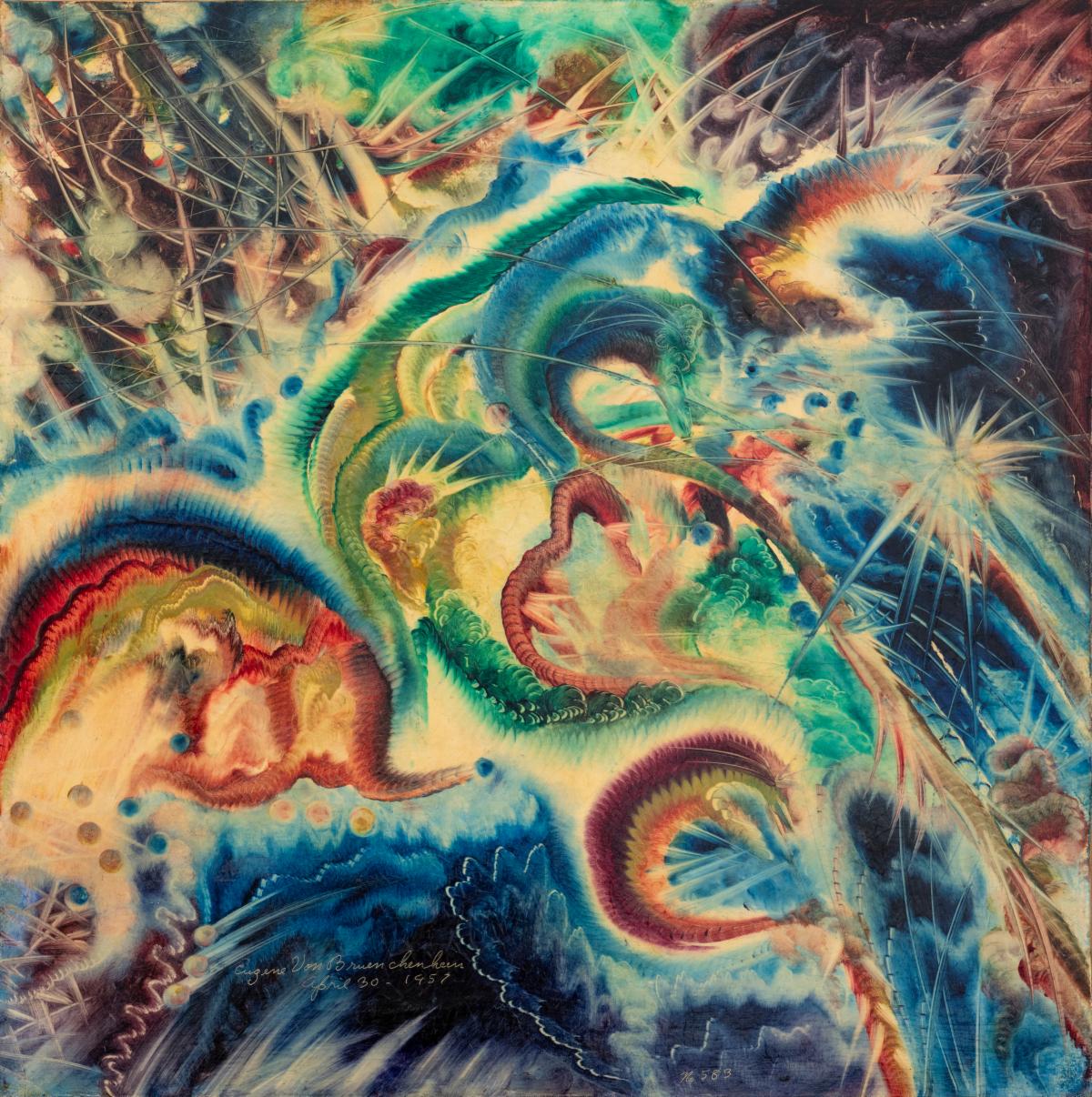
Image: Eugene Von Bruenchenhein, No. 583, 30 April 1957

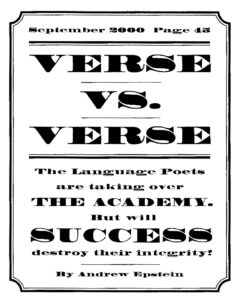
Twenty years on, it is timely to reread the kind of discourse—or brazen publicity—that was circulated about Language writing and the academy, and indeed the entire project of poetics that was imagined as their synthesis, about 2000. In the two decades that followed, everything has changed in terms of the “horizon of expectation” that led to this premature discussion of the dominance of Language writing in the academy; in 2020, I will say confidently from my experience, and what I know of others’, that such a thing never happened. Perhaps it was meant not to happen, and the provocative title page to the September 2000 article in Lingua Franca by Andrew Epstein may be the reason why. As I work through my archive, I am finding numerous such signposts to futurity that did not arrive, while at the time I was caught up in the process, let us charitably say, of negotiating the “stakes at the table” of the future of Language writing. Why this discourse was misdirected, and for whose interests, will be the substance of my reading below; those interested may find, in the interest of time travel, the full text of the article here… More

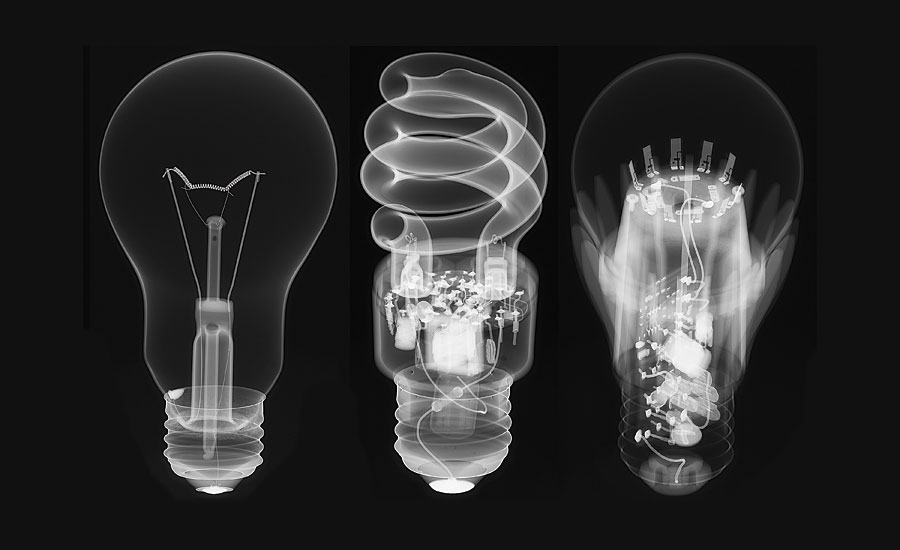
Reflective  sandboxing of software code within a machine built to parse it is seen in the case of a computer language like Java which must be compiled and  then run as bytecode inside a special runtime environment, or, as with the language C, compiled and then run as “native” machine instructions, or with a simple mark-up language like HTML the specifications for which must be entirely designed into any browser destined to interpret and display it, or also with other interpreted code such as a three-dimensional model whose mathematical values for vertices and textures must be transcoded according to the rules of a given data format and given style of visual projection.

—Alexander Galloway, The Interface Effect (65)

The distinction between code as executable and language as interpretable has a basic horizon in the question of new meaning. Machinic encoding is not capable of making new meaning—only humans are. But caught in the web of mediated processes (as above), humans often fail to recognize the new—or attempt to transcode it in terms of earlier structures of interpretation. The example of the “failed mail art piece” will illustrate this. … More

Document 88: Crisis @ EAM

The weekend of 17–20 September was to have been seventh in a series of biennial conferences of the European Network for Avant-Garde and Modernist Studies (EAM). I have been presenting at EAM since their first meeting in Ghent, Belgium, in 2008. Each of the meetings that followed was remarkable, and opened a window onto new vistas on the aesthetics and politics, in fact the historical importance, of avant-garde and modernist studies—an expanding field that departs significantly from its Eurocentric origins and turns toward postcolonial and post-socialist contexts. The latter was encouraged by meetings in Poznan, Poland, and Helsinki, Finland, where I met a number of Eastern European scholars, and that connection is an important aspect of my organization of a seminar on “Avant-Garde @ Zero Hour.” The seminar was to focus on radical formal innovation in the crisis of the immediate postwar period, seeking different frameworks for the avant-garde than those that define the “historical avant-garde”—seeking a different register of the historical, in fact, one that eschews any form of progressive historicism for the crisis, destruction, discontinuity, and universality that attends the Zero Hour.

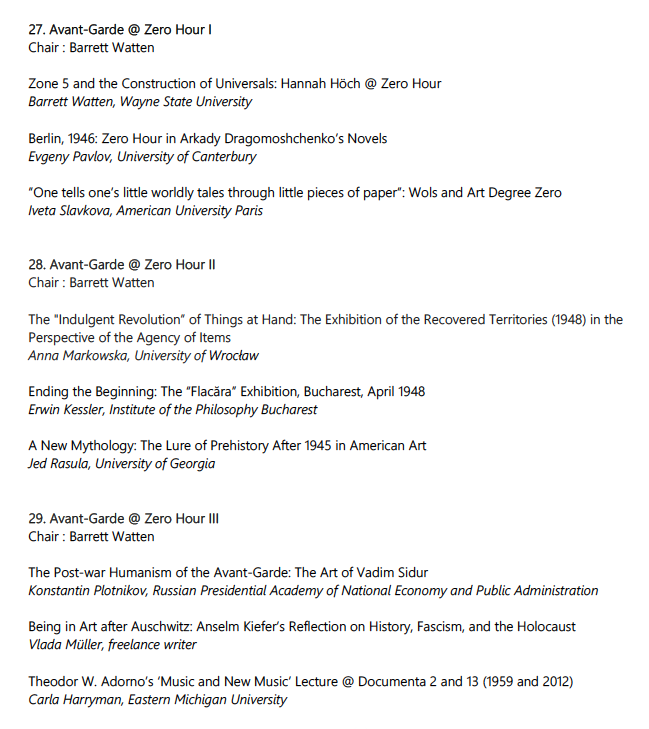
As it happened, the conference was canceled due to the current crisis. Much reflection may follow on the nature, and specificity, of “crisis” in its many instances. My proposal for the seminar may be found here; the conference CFP is linked here and above; and below is the line-up for our seminar. I will update this page with a link to full conference program soon; while the organizers have proposed a conference volume on our evolving understanding of crisis, with the avant-garde as both instance and guide.


Archive 06: Leningrad/ATD


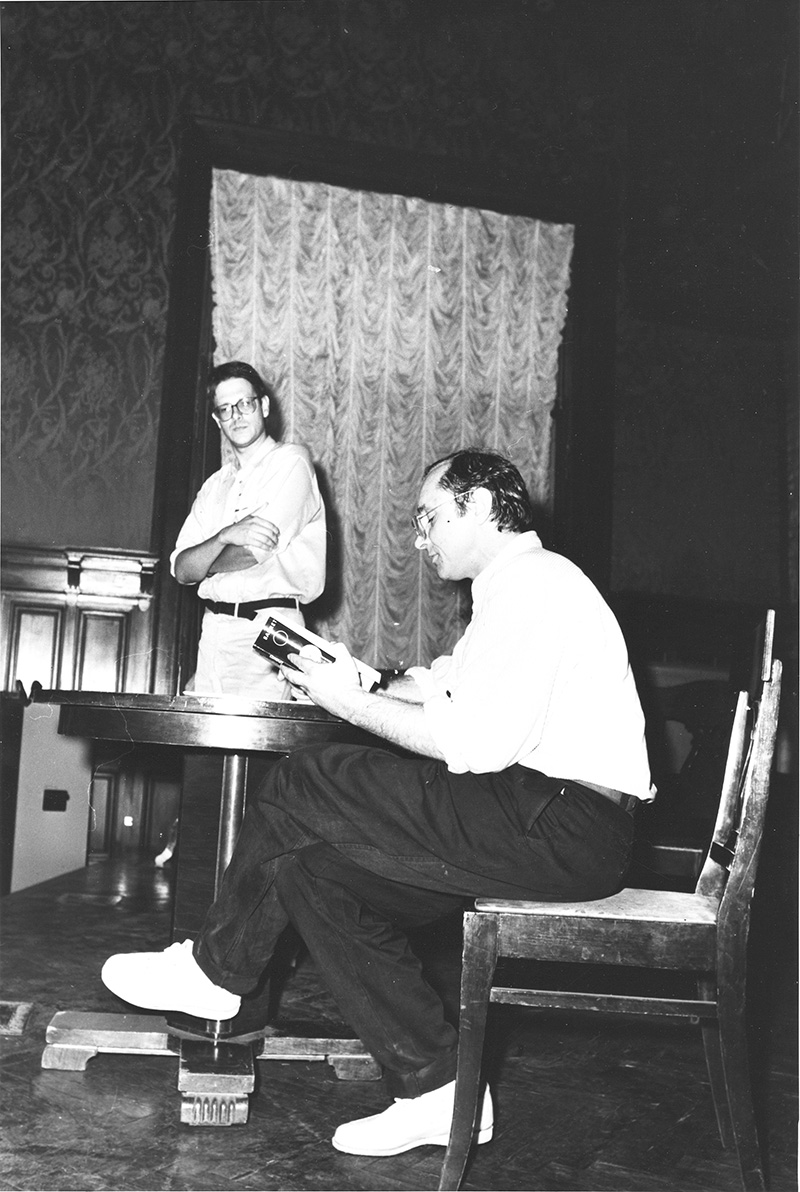
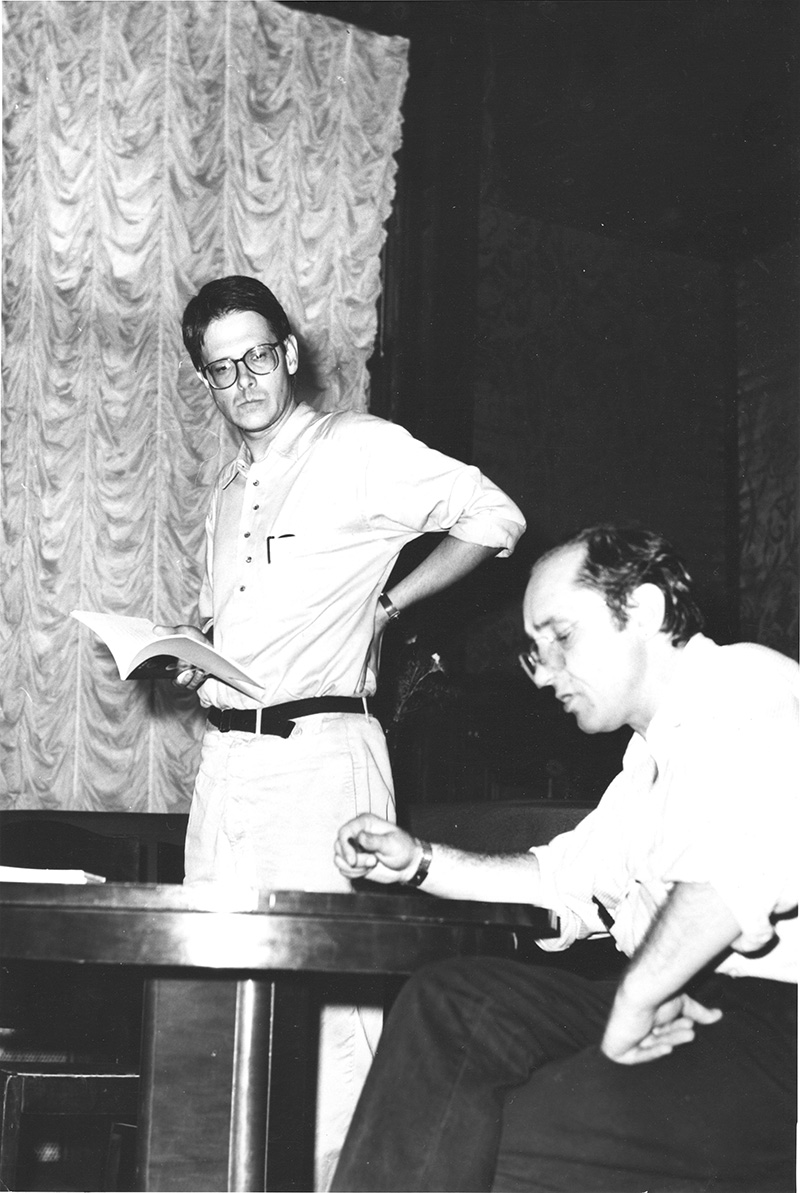
There is a proliferation of anniversary dates this time of year. This one remembers our Summer School in Leningrad, August 1989, during the last days of Perestroika and the Soviet Union itself—thirty-one years ago. An international conference of avant-garde poets would not have been possible previously, and its meaning took part in that nearly evacuated moment—which we record in our nonnarrative history, Leningrad: American Writers in the Soviet Union. The grandiosity of our monumental title betrays the actual import of the event, which was all in the details—an occurrence that could happen once only, as its effective history. Which is always potential, always about to have an effect. Arkadii and I are pictured above, at the reading where I read in English followed by his translation. I would now say that it is the distance between the two figures that is most active and alive with possibility.

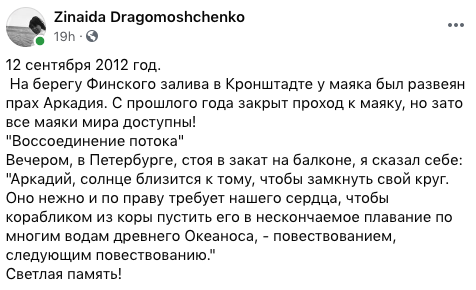
Today I saw Zinaida Dragomoshchenko’s post on, I assume, the scattering of Arkadii’s ashes in 2012, which adds to the historical prompt for my post. At another moment of distance, I want to read Zina’s tribute in Russian, which I screen capture without translating (and as the Cyrillic alphabet does not work on my site). Zina recalls the scattering of Arkadii’s ashes near the lighthouse at Kronstadt, in the Baltic off Petersburg, which has since closed, “but all the beacons of the world are available.” I wonder if the line in quotes, “Vossoyedineniye potoka,” translated as “stream reunion,” is from Arkadii’s works. Streams are coming together, converging. She returns to Petersburg and, speaking to herself, imagines the sun’s closing of a circle and a return “endless swimming” in the stream of Okeanos. She ends, in convergence across the space of eight years, “Svetlaya pamyat’!,” “Bright memory!”

Notes

Photographs: BW and Arkadii Dragomoshchenko, International Summer School, Leningrad, August 1989. Photographer: t/k.
Permission to reproduce screen shot.

Archive 05: Olson in This

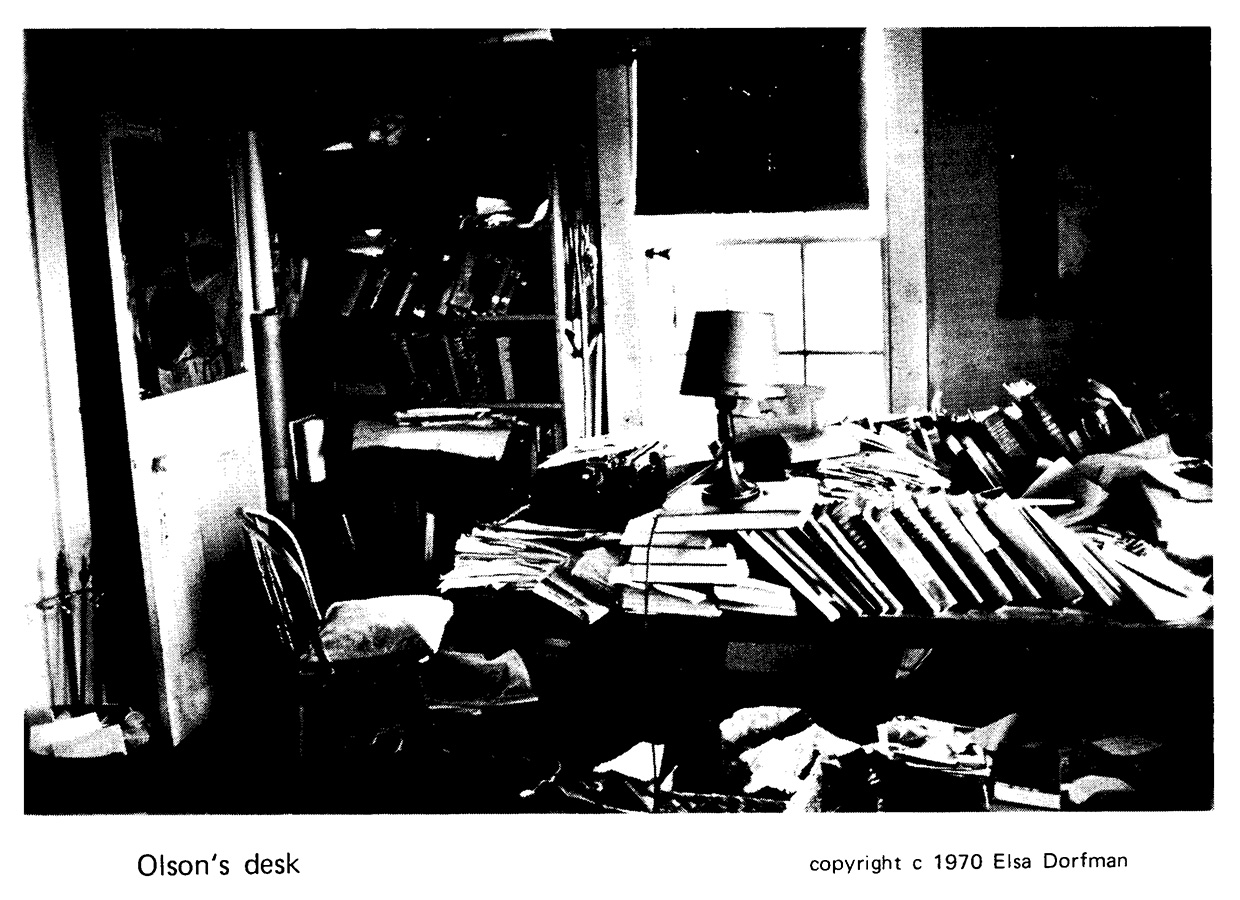
The first issue of This (1971) included a short photo essay and memorial to Charles Olson by photographer Elsa Dorfman, who died in May 2020. Bob Grenier, co-editor and mentor, had moved to a small house by the cove in Lanesville, Mass., on Cape Ann, and would have been in contact with Robert Creeley, Larry Eigner, and, through poetry connections, Elsa Dorfman. Olson had recently died (10 January 1970) and I was in the thick of his influence, visiting Gloucester that summer and organizing a reading group on the “modern epic” at Iowa in the academic year 1971–72 that included renowned scholar Sherman Paul, who credited the group discussion in his book Olson’s Push (1978). A signal moment in that seminar was unfolding the Coast and Geodetic Survey map of Gloucester harbor, which I bought when I visited, to provide a “spatial reading” of the otherwise cryptic poem: “In the harbor // Can 9 Nun 8 / Nun 10 Can 11 //// Charles Olson / Friday, November 23rd //  #1” (Maximus IV V VI, n.p.; Maximus Poems, 302). From the map, one can track a sequence of buoys in the harbor (termed “cans” and “nuns” from their shapes, presumably) that transposes the subject-centered experience of sighting the buoys to a sequence of signs in space. It is tempting to imagine that Language writing was born right there, though there were many converging influences, never reducible to a moment of origin. In fact, it was the gap between what Olson was seeing and what his poem and the map record that signified, a way of reading that makes clear why the poem had to be written as it was. Many of the short poems from the second volume of Maximus, along with Creeley’s Pieces, were objects of fascination then. … More

Announcing publication of

Modernity @ Zero Hour:
The Question of the Universal
and the Origins of the Global Order

Barrett Watten (Guest editor)

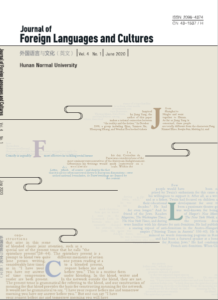
Journal of Foreign Languages and Cultures
Hunan Normal University, Changsha, China
vol. 4, no. 1 (June 2020)

Table of contents [here]

Barrett Watten, introduction [here]
“Modernity @ Zero Hour: Three Women
(Lee Miller, Hannah Höch, Anonyma)” [here]

Maggie Rosenau
“Universality and the Zero Hour:
Interrelationship Between the Avant-Garde, Denazification,
and German-Language Literatures” [here]

Herman Rapaport
“The Ethical Break: Marguerite Duras, Jorie Graham,
and M. NourbeSe Philip” [here]

Lauri Scheyer
“Zero Hour and the Changing Same: Aesthetic Modernism
and Black Nationalist Identity” [here]

David Kellogg
“Modernist Non-Events: Disappearing Modernisms
in New York and Singapore” [here]

Parvinder Mehta
“Fractured Feminine Selves, Autospecular Affect, and Global Modernity:
Meena Alexander and the Postcolonial Artist as a Woman” [here]

Gary Huafan He
“Entropy and Utopia @ Zero Hour:
Modernity and the Manhattan Project” [here] … More

The fatalism by which incom-prehensible death was sanctioned in primeval times has now passed over into utterly comprehensible life. The noonday panic fear in which nature suddenly appeared to humans as an all-encompassing power has found its counterpart in the panic which is ready to break out at any moment today: human beings expect the world, which is without issue, to be set ablaze by a universal power which they themselves are and over which they are powerless.

—Adorno and Horkheimer,
Dialectic of Enlightenment

In modernity, “Zero Hour” is an event waiting to happen, as critical theorists from Adorno to Žižek have presciently seen; our experience of the COVID-19 pandemic reconfirms the event as a “noonday panic fear” that structurally recurs. In Germany at 1945, this moment of destruction is conventionally known as Stunde Null, which we may translate as “Zero Hour.” I use the concept of Zero Hour—seen as the punctual moment of political and material destruction that ended Germany’s Totaler Krieg (total war) through unconditional surrender on 8 May 1945—as a metahistorical concept, after the work of narrative and conceptual historiographers. As such, Zero Hour is not simply reducible to its historical date; it has a structural relation to real-time historical unfolding in both narrative and nonnarrative terms. Zero Hour thus did not simply happen; rather, it is a phenomenological moment that took place “as if” it were an actual event, no matter how the particular details of history coincided with it. Psychoanalytic processes of destruction, repetition, and Nachträglichkeit are crucial for the historicity of Zero Hour, as an opening to the Real “that can only be known in its effects.” At the same time, what we term Zero Hour as a historical fact is irreducible to a concept—formed from a complex multiplicity of individual and collective, human and material experiences that only retrospectively condense into the univocal date, 8 May 1945. There is, as well, a unique political content to this historical endgame, a combination of the persistent German commitment to Totaler Krieg after massive defeats that began with Stalingrad, matched by equally persistent Allied demands for total capitulation. Zero Hour is thus a composite historical fact, viewed through an imprecise historical frame, that extends from a series of moments of destruction and liberation that constitute it. As a historical event, Zero Hour is a punctual moment that is not one, depicted and imagined through a series of iconic images of human bodies and urban destruction that took place with military defeat, the liberation of the camps, the destruction of cities, the mass displacement of peoples, occupation by allied armies, and civilian privation throughout Europe. A reduction of human experience to material bare life as a political, cultural, and even existential reference point—and its overcoming—gives Zero Hour a meaning well beyond its narrative origin as null point. My account of Zero Hour is thus not primarily concerned with the narrative it begins for the immediate postwar political or cultural order, but focuses on the moment of the event itself. Zero Hour is a material, not merely a phenomenological, event of destruction that announces a new world order; to locate it, we must work carefully through the combined figural logics and material evidence by which it was experienced and represented.

Notes and links

Text: from “Modernity @ Zero Hour: Anticipatory, Punctual, Retrospective Universals” (work in progress)

Image: Karl Hofer, Schwarzmondnacht—Potsdam, 1944

Introduction

To be a writer and write things
You must have experiences you can write about.
Just living won’t do. I have a theory
About masterpieces, how to make them
At very little expense, and they’re every
Bit as good as the others. You can
Use the same materials of the dream, at last.

It’s a kind of game with no losers and only one
Winner—you. First, pain gets
Flashed back through the story and the story
Comes out backwards and woof-side up. This is
No one’s story! At least they think that
For a time and the story is architecture
Now, and then history of a diversified kind.
A vacant episode during which the bricks got
Repointed and browner. And it ends up
Nobody’s, there is nothing for any of us
Except that fretful vacillating around the central
Question that brings us closer,
For better or worse, for all this time.

—John Ashbery

Notes and links

Text: John Ashbery, “Introduction,” in A Wave (New York: Penguin, 1985): 34.

Image: Vija Celmins, Untitled (Ocean), 1977.

Links: Entry 11: “For a Left Ashbery Critique”
Entry 14: “The Perfect Ashbery (Review)”
Entry 36: “Ashbery Alpha and Omega”