Entry 67: Language Notes

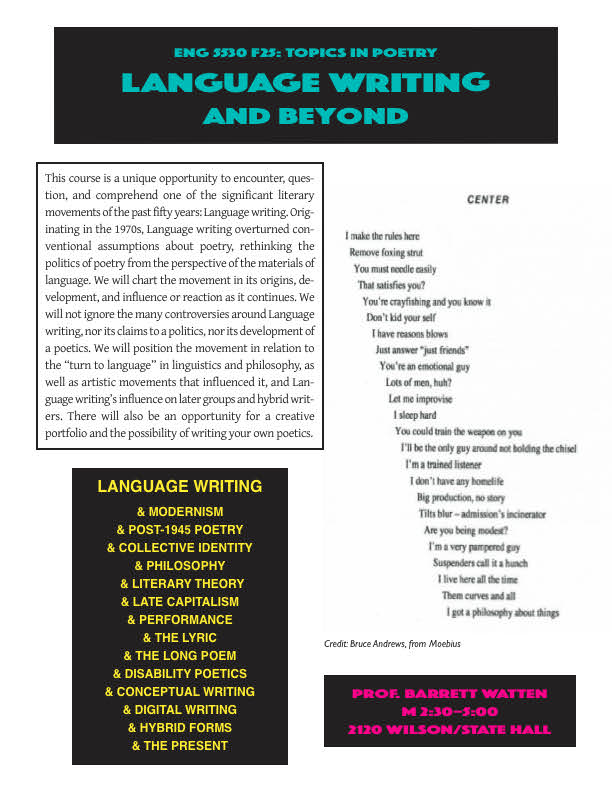
This fall, I continue an adventure of some 50 years with the literary movement with which I am associated, Language writing, once so-called and now so inscribed. ENG 5530 is a dedicated “Topics in Poetry” course, addressing students at all levels at Wayne State University. For some, this will be a first encounter with poetry; others are already writing in ways identified by their teachers as “aha! Language writing!”; and others are taking a literature or creative writing elective with, hopefully, open minds and interest. I want to approach the topic with new eyes and ears, and thus have not given much thought as the opening of school approaches to how, precisely, I will proceed. In moving forward, I will be retrospectively assembling a curriculum but not in any linear fashion—that end has already taken place. How then to redefine, redeploy, rethink Language writing while constructing the course of study that opens new issues and opportunities?

My first thought was to provide a useful historical background, summarizing the “tale of the tribe” without dwelling on it. One divergence from the canonical narrative already appears—as Language writing gathered momentum and a degree of institutional recognition, there was a kind of mimicry of the Pound tradition and its “tale of the tribe,” a concept that is in need of historical and cultural correction. “Tribe” is not an auspicious term, for example, and the fact that there might be one “tale” that would hold it together even less so. The Orono conferences, importantly, were the site for a shift from the Pound model to an increasing pluralism, that over the decades (30s, 50s, 60s, 40s, and 70s) had increasingly to do with departing from a single narrative. Still, some kind of historical or periodizing ground is needed.

The best source I know for that was a series of online essays by Eleana Kim, written in 1994 and published on Gary Sullivan’s web site Readme, which is no longer online. Nada Gordon, however, has archived the series on the Wayback machine and I was able to download and pdf the series, with the addition of the bibliography from Nada directly. I have assumed that Kim is the same person as the UC Irvine Professor of Anthropology (here), but that needs to be confirmed. If so, she likely wrote the history as a graduate student, as she began publishing in Korean Studies about 2000. I suspect there is a connection, however, as the account of Language writing has a political awareness, sense of inclusion and exclusion, and critical astuteness about dominant narratives that could well connect to a cultural anthropologist. When that is determined I will repost, but this stands for one of the questions that now could be asked as the course unfolds: Why did Eleana Kim write on Language writing, and what does she think now? How did this very well written, politically savvy narrative become forgotten and erased, and why?

Eleana Kim, “Language Poetry: Dissident Practices
and the Makings of a Movement”

Note to the archived publication: “This essay was written in 1994 and, with the exception of minor editing for clarity, has not been rewritten. It does not, in other words, take into account material published in the years since.”

Part 1: “What is Language Poetry?” here

Part 2: “Tradition and Communal Praxis” here

Part 3: “San Francisco, circa 1975” here

Part 4: “Theory, What Theory?” here

Part 5: “Rumor in the House of Fame” here

Part 6: “The New Americans vs. the Treed Americans” here

Part 7: “Inclusions” here

Part 8: Bibliography here

Bear in mind that this was written in 1994; thus the bibliography is out of date. It would be important, first, to establish a 90s bibliography, but even more to track the works that have appeared since the millennium. That body of work could lead to an entirely different narrative. As well, the emergence of two immediate offshoots of Language writing, Flarf and conceptual writing; the influence of Language writing on poets of color; its relation to New Narrative, hybrid writing, disability aesthetics, digital writing and AI—all would need to be taken into account, which is precisely what I plan to do over the next fourteen weeks. Stay tuned for more posts as decisions get made on what to read and feedback happens on how that reading takes shape.

On May 29, Iris Cushing wrote the Pete’s Candy Store mailing list with news of dear friend and former student Cole Heinowitz’s drowning in the Yuba River, Northern California, on Saturday, May 25—Memorial Day Weekend. This page records a series of dates; I first learned of the terrible fact on Tuesday, May 27, just arrived in San Diego for several days work in the UCSD Archive. It is now Saturday, July 5, as I write this, six weeks to be precise from the initiating date. Thus I am making a memorial within the confines and limits of memory, as a memorial in itself. On June 6, Iris wrote again, inviting me and a number of writers close to Cole to read at a memorial event on June 13. I have found that memory works in a series (a nested stack) of distinct but mutually supporting frameworks. There could be no doubt about my wanting to participate and attend. First there is the durational spread that gives us the illusion of living in the present; then short-term memory, lasting through the day and likely as long as a weekend. My decision to attend and book a flight and lodging was made in that frame, and was implemented over the next few hours. As I move forward, through ever longer spans of duration, I reach the proximate limit of a time span of about three weeks. It was within this initial three-week time span that the memorial was scheduled and took place; it is now three weeks from that date. I am writing, then, before its temporal proximity shifts and the event, and all that it articulated, is further displaced. … More

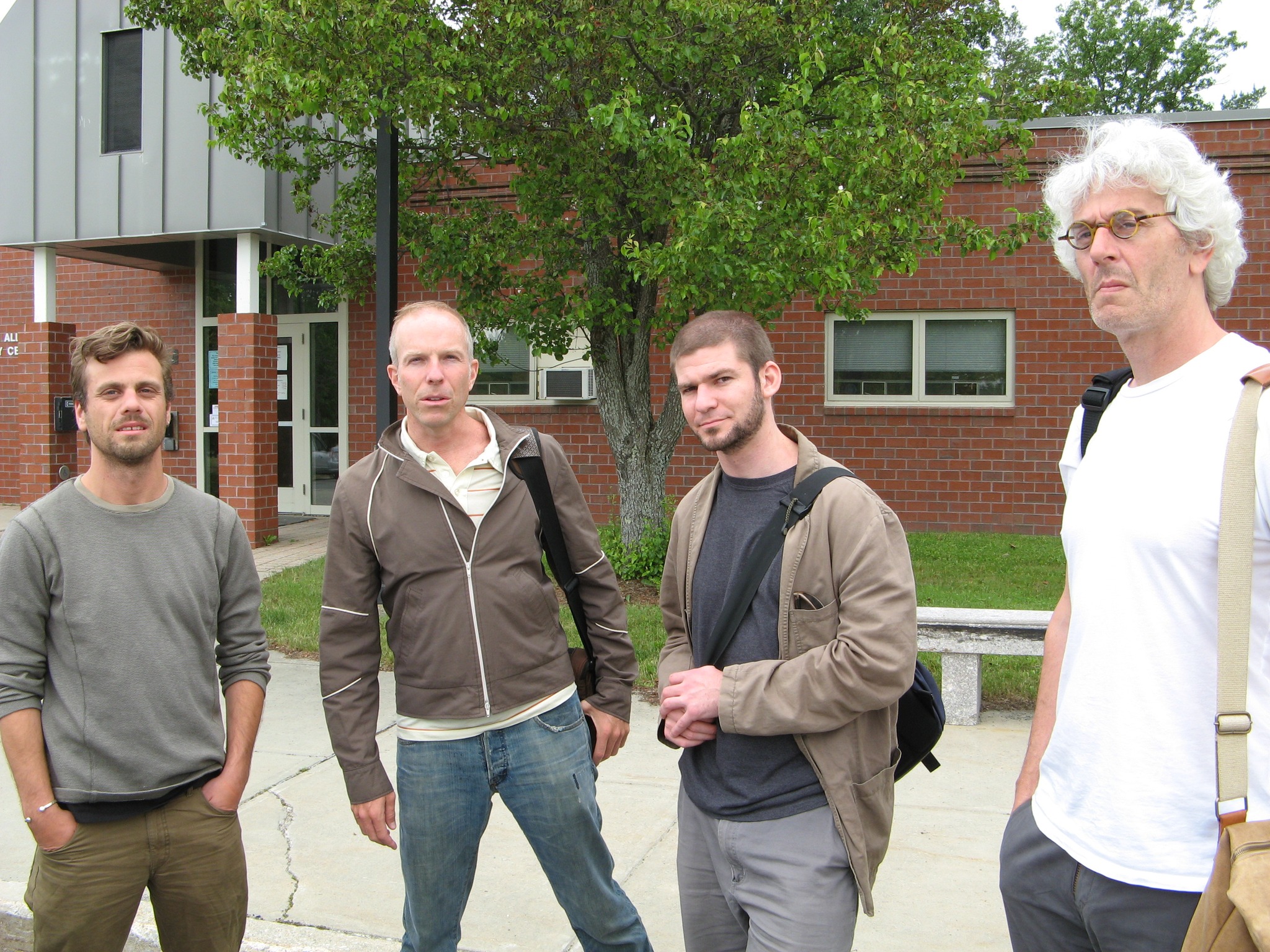
In 2013, I took the stage at a session of the Modern Language Association in Boston, on a panel hosted by the Marxist scholar Jason Baskin on “Marxism and Modernist Studies.” My hope was to extend an argument I raised about Language writing and neoliberalism at the 2008 Orono Conference to an account of modernist poetics—expatriate poet Eugene Jolas’s editing of transition magazine in the 20s and 30s. But I also wanted to start a dialogue, even a polemic, with the new school of Marxist poet-critics I had encountered there: Joshua Clover, Christopher Nealon, and Ruth Jennison. With Clover’s recent, untimely death, various tributes and memories have circulated, for example this Orono photo by Patrick Pritchett. I had some memories of Clover too, some of them benign and some less so, which when I mentioned them led to a considerable reaction and disclosure of an antagonistic post mentioning me, linked here. The link to Clover’s writing online led to the “blog” published in 2019 (see here for full discussion). It turns out Clover had published an anonymous hit piece on the “blog,” which up until then I could not place or interpret. The scene he describes, it turns out, was the session at MLA Boston in 2013. The main argument of my paper has since been published (see here), but without the opening polemic with Clover, Nealon, and Jennison. To understand, and refute, Clover’s anonymous “blog” post as participating in the larger group take-down of my work and person, it is necessary to return to the traumatic scene itself, which Clover describes in these terms: … More

For its pedagogical interest, I want to document the 23 seminars and 1 proto-seminar that I taught at Wayne State University since 1995. The seminars build on a series of dialectical faultlines, from the first offerings on the avant-garde and social modernity; literary subjectivity and language; cultural studies and poetics; social form and literary agency; to the crisis of modernity and the subject. The arrival of the New Modernist Studies offered a disciplinary framework for this sequence, followed by twin historical critiques of the avant-garde and postmodernism. As the series developed, I tried to construct spaces that would unite critical thinking and poetry. The series provisionally concluded in 2018 after three seminars that pushed toward new approaches at a moment of increasing crisis in the university: “The Poetics of Value”; “After the End of History”; and “Questions of Unreason.” While it was not a foregone conclusion that this level of ambition could not continue, it is now now time to look back and imagine what the prospects of this pedagogical endeavor may have been, what they were as they unfolded, and what they still might be.

1. ENG 7004 / Fall 2018 / Theoretical Issues in Cultural Studies: “Questions of Unreason in Modern Cultures” (https://bit.ly/2vgHFYL)

This seminar will bring together several interrelated areas of inquiry: 1) critical and psychoanalytic theories that address the genesis and form of “unreason” in modern culture and public art, including Critical Theory after Dialectic of Enlightenment and The Authoritarian Personality and psychoanalytic theory from Freud to Žižek; 2) theories of language and the public sphere from Habermas to ideology criticism; 3) theories of populism, racism, xenophobia, fascism, and gender and class antagonism; 4) popular movements that are relevant to these theoretical approaches, from hyper-nationalism to fascism, populism, and authoritarianism; and 5) works of modernism and the avant-garde that reflect on, diagnose, or exemplify questions of public unreason, from surrealism to the present. [See https://bit.ly/2vgHFYL]

2. ENG 8004 / Winter 2018 / Seminar in Literature and Culture after 1870: “2049: Historicizing the Present After the End of History”

The release of Blade Runner 2049 offers a chilling register of the global present and its dark futurity. This seminar will take the questions explored by the film, in relation to its postmodern progenitor Blade Runner (1982/1992), and explore the historical present through a series of dystopian registers. These will include global capitalism, democracy, and authoritarianism; climate change and ecocide in the anthropocene; the man/machine interface in ever advancing forms of digital technology; new class formations and urbanization; gender, sexuality, and the decline of patriarchy; war and the fragmented body; and new forms literary and artistic representation and response, both mimetic and antimimetic.

3. ENG 7033 / Winter 2017 / Postmodernism and Postmodernity: “The Poetics of Value: Modernity, Crisis, and the Work of Art”

We are constantly reminded in public discourse that our “values” have deteriorated and that we are living in a state of “valuelessness” that requires drastic measures. This seminar will take up the relation of values as represented in works of art to underlying forms of value and valuation they depend on—from aesthetic to moral to political to economic. Putting the question of value to works of art and cultural production, we will read a wide range of genres and text—literary, visual, and cinematic—with major theorists of value from Kant to contemporary Marxism. The seminar will begin with questions of aesthetic and moral values and valuation but will look forward to the turn to political economy and critique of modernity that emerged after the financial crisis of 2008, broadening it to include the “making” of value in an economic sense as a question of poetics and the valuation of the work of art.

… More

For the thousand manifestations that dotted the American landscape yesterday, I want to post this broadside poem by Robert Creeley. It has always seemed a kind lurching effusion of a politics, a consequence of the state of mind he wrote it in without doubt. Creeley was often convulsive, and that is to the point of his aesthetic, even concerning details. But here the subject of his “attack” in William Carlos Williams’s sense is broad, vast, gestural, involuntary. It is worth remembering that much poetry that followed shelters in the shadow of that attack. Thus it bears some comment at a later moment, as late as the one we are in, where the poem resonates anew. … More

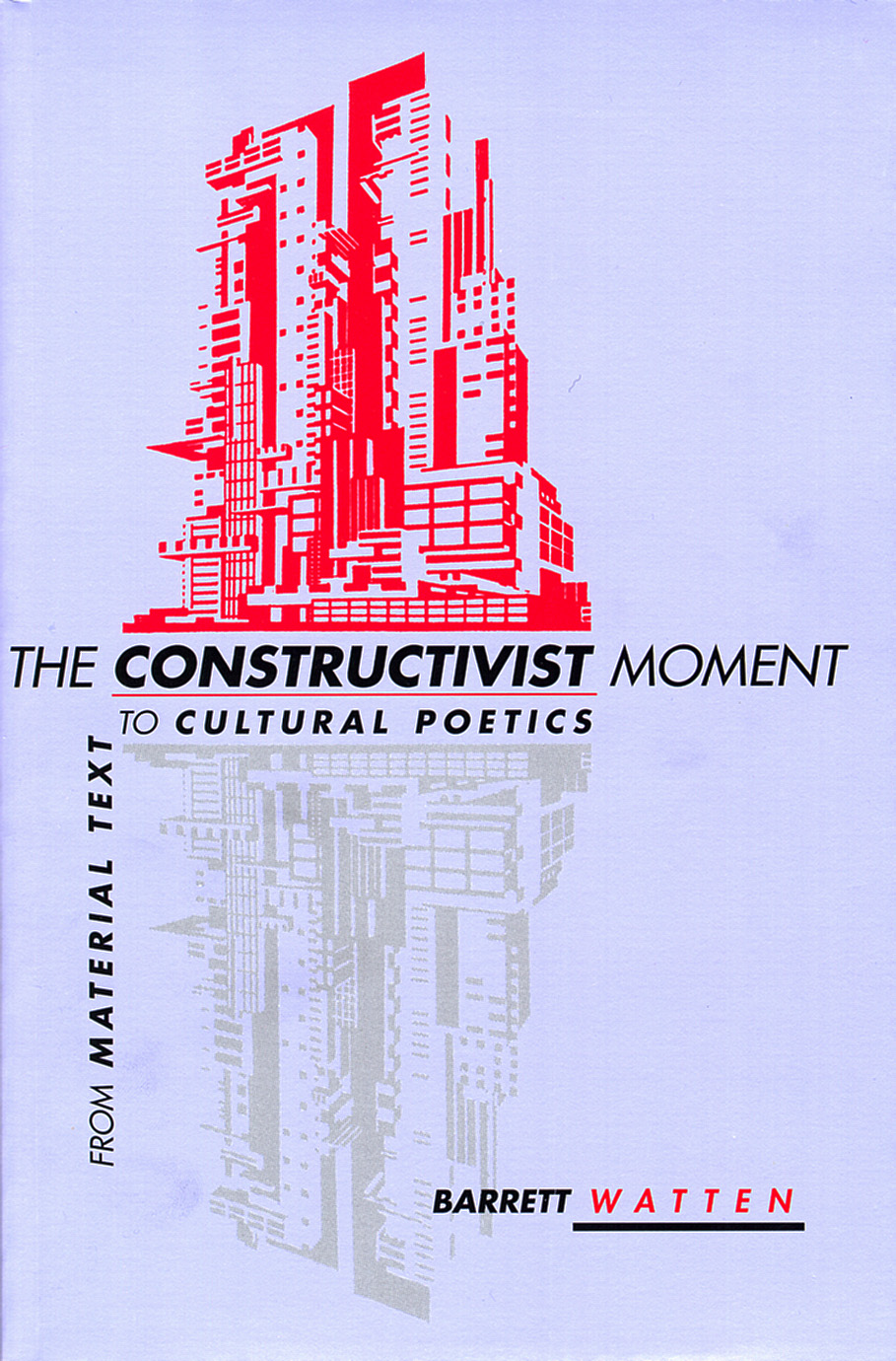
Launch of  Barrett Watten,
Not This: Selected Writings

Voznesensky Center, Moscow
46 Bolshaya Ordynka Street
January 24, 2025

The meeting focuses on how American literature experienced a “turn to language” in the 1970s, what the hybrid genres of contemporary poetry are, and the challenges faced by translators working with the “language trend” in literature. (Voznesensky Center announcement)

On the given date, at about 11:30 A.M. from a Detroit suburb, I was transported behind the lines of antagonistic states for a literary evening that, I hoped, would have long-term cultural and political meaning. It was not the first time had I stepped over this line, as I did for our “Summer School” in then-Leningrad, 1989, about which much has been written (including the multi-authored text published in 1991; here). Twenty-seven years later, with Carla Harryman, I traveled to now-St. Petersburg to participate in the Dragomoshchenko Prize awards in 2016. The consequences of these transpositions, as they may be called, between literary and cultural/political realities, continue to expand and be productive as sites of meaning. The turn to language turns out to be more than one thought. … More

“Dispersed Poetics: Signifying Non-Solutions
in Time of War”

Ekaterina Derisheva, University of Pennsylvania
Barrett Watten, Wayne State University
Jamie Olson, St. Martin’s University

The Louisville Conference on Literature and Culture
University of Louisville, February 22, 2025

“Dispersed Poetics: Signifying Non-Solutions in Time of War” introduces the work of experimental poets writing in Russian and Ukrainian, from positions of opposition, emigration, and displacement, from the late Soviet period to the present conditions of war and exile. The notion that “the non-solution must signify” is a formulation by critic Terry Eagleton that seems apt to the present moment, where poetry can best address a situation of profound indeterminacy.

… More

Marxism, at the end of the 19th century and the beginning of the 20th century, admitted that in capitalist societies mankind had not reached its full possibilities for development and self-realization. . . . [What] model did Marxism use to conceive, project, and eventually realize that human nature? It was, in fact, the bourgeois model: sexuality of a bourgeois type, family of bourgeois type, aesthetic of bourgeois type. —Michel Foucault, “Human Nature: The Chomsky-Foucault Debate” (1971)

The Waiting Room

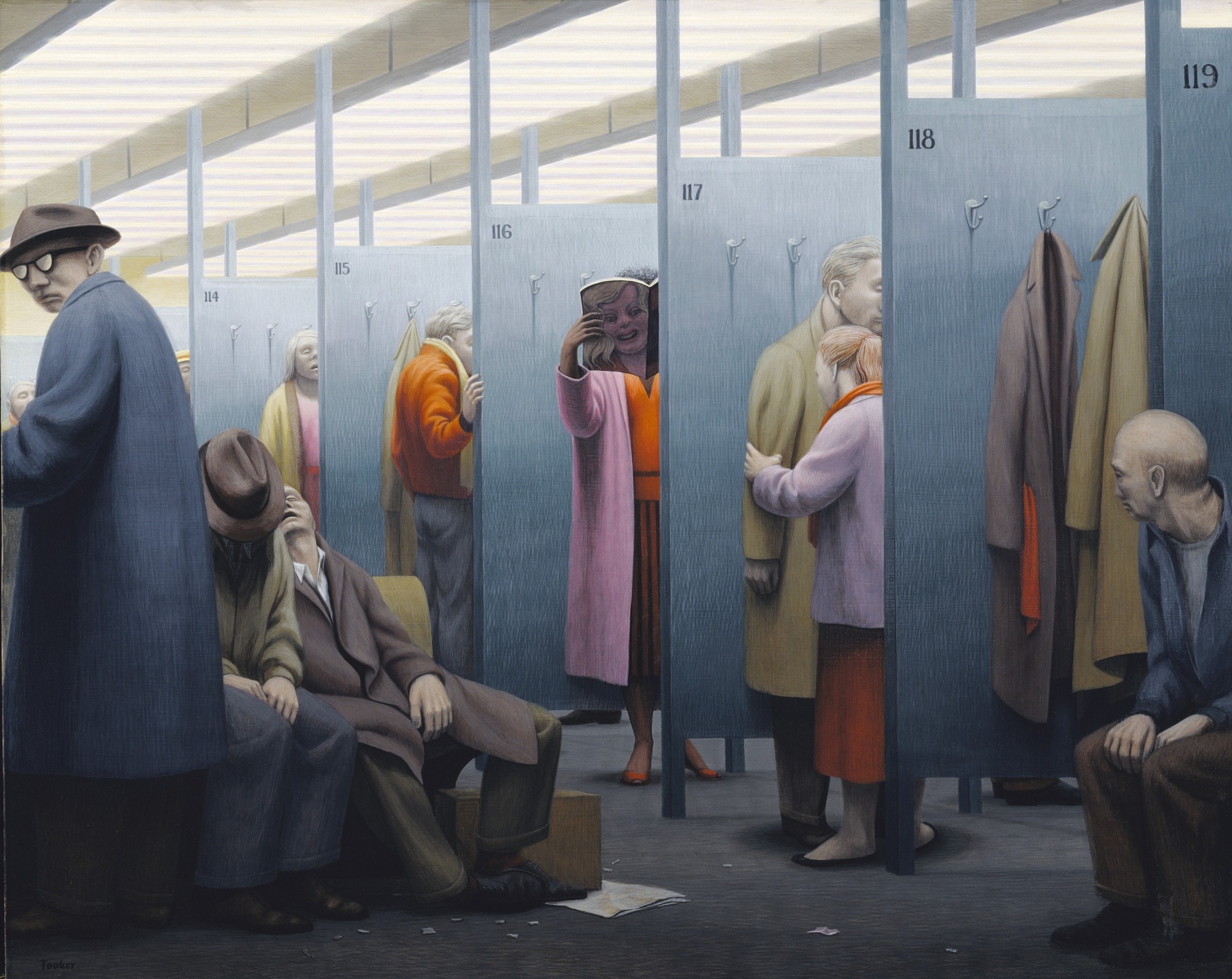
I am in a medical waiting room in Novi, Michigan, reading the politics of dream in Les Vases communicants. On a large screen unfold tedious details of home improvement projects, finding new spatial arrangements, knocking out windows, sanding floors. Three older women are facing the screen, representative of Novi and its majority suburban demographics. They are possibly X voters, I imagine. Interrupting the quotidian program are three election ads, two paid for by Y and one by X. The space of the waiting room becomes a scene of unfolding dreams. In the first, X brags that he only hires the best in the business. We next meet a series of former subordinates, from A to B. All are white male counter authorities, having once believed in but turned from X. The message is impactful and distressing, a diremption in the structure of legitimacy. It provokes displeasure and crisis that cannot be revealed among the three women, who rigidly stare straight ahead. The next features a sympathetic woman they might identify with: an older white woman in an ordinary scene. Social security will be at risk under X, she explains. She finishes her argument with a risqué turn of speech: he will give the middle finger to the middle class. The three women’s basic livelihood appears at risk, after the legitimacy crisis. The third ad feature a younger women who claims the federal government, under Y, will pay for gender reassignment care. She is a mother and there is an imagined threat to her obligation to care for her child in the way she believes. The first two messages attack certainty in order to draw out and question a core belief. The last preserves a core belief by promoting an untenable fantasy. At the bottom of the dream is a nonexistent object that the three messages attempt to disclose. How much of the disclosure itself—seeing the ad content as analogous to a dream on waking—can be retained on waking; what does the erosion of memory mean for the core belief? In two cases the core belief is unsettled; in the latter, it is preserved as inaccessible fantasy, what people may think but will not admit to, the basis for a turn to fascism in a democracy. My reading of Les Vases communicants extends, of necessity, from 1932 to this scene.

“The Best People,” Harris campaign ad: view here
“Kamala Is for They/Them. I am for you” ad: view here

… More

Document 106: Various Devices!

FOR IMMEDIATE RELEASE! 

VARIOUS DEVICES:
SELECTED WRITINGS

BY CARLA HARRYMAN

MOSCOW: POLYPHEM, 2024

[for Russian text, click here]

Polyphem, an independent press in Moscow, announces publication of a comprehensive, bilingual edition of the writings of Carla Harryman.

The works, chosen by editor Vladimir Feshchenko, represent the full range of her pioneering genre-disrupting, performative texts—from Percentage (1979) and Under the Bridge (1980) to Cloud Cantata (2020) and Scales for the Living (2023).

Also featured are the complete scripts of her germinal works for San Francisco Poets Theater: “Third Man” (1978); “There Is Nothing Better Than a Theory” (1984); and “Memory Play” (1994).

Excerpts from her dystopian novel Gardener of Stars (2001) and the ludic hybrid text Baby (2005) are included, along with selections from her erotic picaresque, co-authored with Lyn Hejinian, The Wide Road (2011).  … More

Document 105: Not This!

FOR IMMEDIATE RELEASE! 

NOT THIS: SELECTED WRITINGS
BY BARRETT WATTEN

MOSCOW: POLYPHEM, 2024

[for Russian text, click here]

Polyphem, an independent press in Moscow, has announced publication of a comprehensive, bilingual edition of the writings of Barrett Watten.

The works, chosen by editor Vladimir Feshchenko, extend from his first collection (Opera—Works, 1975) to the unpublished “Notzeit,” written during COVID (2020).

The selection represents the author’s “turn to language” in the 1970s, his development of hybrid genres and longer forms, and his critique of distorted social communication. … More